Corporate team building is a structured set of shared activities designed to improve how employees communicate, cooperate, and trust one another at work, not just a day of fun. Gallup's 2024 Q12 meta-analysis found that teams in the top quartile of engagement had 23% higher profitability than teams in the bottom quartile (Gallup's employee engagement and productivity findings).
You may be staring at a calendar, a leadership budget, and a list of possible outings, wondering how to choose something employees will enjoy. The useful question is not which activity sounds exciting. It is whether the experience gives coworkers a chance to practice working together, and whether they will carry that connection back to the job.
Why Corporate Team Building Matters More Than You Think
A company outing can be pleasant and still have little effect on teamwork. The difference lies in its purpose: corporate team building is an intentional organizational practice, where people share an experience designed to support the way they communicate, make decisions, and solve problems at work.
A practice run gives colleagues a low-stakes chance to listen, share responsibility, and adjust when a plan changes. If the activity is designed well, those behaviors become easier to recognize and discuss back at the office.
From activity to workplace behavior
Start with the work problem, not the activity menu. If project handoffs regularly miss important details, choose an experience that asks people to coordinate roles and exchange information. If a department has grown quickly and coworkers barely know one another, an informal shared outing may help open conversations that rarely happen during routine meetings.
That connection matters because enjoyment alone doesn't prove that an event improved teamwork. Attendance and enthusiasm tell you whether people showed up and had a good time. They don't tell you whether colleagues became more comfortable asking for help, voicing concerns, or collaborating across teams.
Practical rule: Pick an activity only after you can name the work behavior you want it to encourage.
A useful plan connects the activity to a goal, gives everyone a fair way to participate, and creates a moment to reflect on what the group learned. That doesn't mean every outing needs to feel like a training session. It means the experience should have a reason to bring this particular group together.
As you compare options, keep four questions in view: What should improve at work? Which format fits the group? How will you make participation welcoming? And what will you look for afterward? Those answers can help you choose an event that feels like a reward to employees and makes sense to leadership.
The Roots of Team Building as an Organizational Practice
The idea behind team building grew from a change in how employers and researchers viewed workers. Instead of treating each employee only as an individual completing tasks, organizational research began to examine how groups, supervisors, and informal relationships influence workplace behavior.
The Hawthorne studies at Western Electric's Hawthorne Works near Chicago, conducted during the 1920s and early 1930s, helped draw attention to social dynamics at work. Researchers examined how attention, group relationships, and informal norms could shape behavior. The broader lesson wasn't that a single outing could fix a workplace. It was that working conditions include the human relationships surrounding the work.
From group dynamics to engagement
Later, organizations developed ways to measure how employees experience their work and teams. Gallup's U.S. engagement tracking began in 2000, when 26% of employees were classified as engaged and 18% as actively disengaged (Gallup's employee engagement indicator). A more recent global indicator reported that 20% of employees worldwide were engaged, and that managers accounted for at least 70% of the variance in team engagement.
These figures help explain why team building became part of organizational development rather than a novelty on the office calendar. Employees don't work in isolation. Their ability to coordinate depends partly on shared expectations, trust, and how managers shape the environment.
An event can't substitute for clear goals, capable leadership, or fair processes. It can, however, give people a structured opportunity to interact differently, especially across roles or departments that don't often meet outside normal routines.
That distinction is useful when you're making a case for a corporate event. You aren't claiming that one outing will solve every management challenge. You're choosing a shared experience as one practical way to strengthen the relationships and behaviors that make coordinated work possible.
Goals and Benefits That Move the Needle
A team leaves a meeting with decisions still unclear, or work stalls because one department didn't know what another needed. These are concrete problems a team-building event can address. Instead of promising “stronger team spirit,” define a behavior to practice, such as clearer handoffs, asking questions sooner, or coordinating input across roles.
Gallup's Q12 meta-analysis examined 183,806 business and work units across 347 organizations. Compared with teams in the bottom quartile of engagement, teams in the top quartile recorded 18% higher sales productivity, 14% higher productivity based on production records and evaluations, and 23% higher profitability. They also experienced 78% lower absenteeism, 32% fewer quality defects, and 51% lower turnover in low-turnover organizations (Gallup's analysis of engagement and productivity).
These figures describe differences between teams with higher and lower engagement. They do not show that one event causes those outcomes. For an event proposal, the findings offer context: workplace conditions and business results can be connected, so choose an experience that gives people a chance to practice a specific behavior.
Translate the goal into a design choice
- Clearer decisions: At a sales kickoff, a timed group challenge can ask participants to compare information and agree on a plan. The activity gives them a low-stakes way to practice reaching a decision together.
- Better handoffs: A cross-functional retreat can bring colleagues from different departments together to solve a shared problem. A short reflection afterward can reveal where ownership or communication needs clarification.
- Stronger connection: An informal outing gives coworkers room to talk beyond their usual roles. It may suit a team whose meetings run efficiently but whose working relationships feel distant.
- Fewer preventable errors: A group exercise with shared responsibilities can prompt discussion about how people pass along details and check assumptions.
The format should match the behavior you want to support, much like choosing the right tool for a particular job. For more workplace context, read this guide to why team building matters in the workplace. Then make the proposal specific: name the coordination challenge, explain how the event gives people a chance to address it, and state what signs you'll look for afterward.
The Hidden Ingredient That Makes Events Work or Fail
A group challenge can end with laughter and still leave people less willing to speak up. If participants feel judged, ignored, or pressured to perform, the event may expose existing discomfort rather than help coworkers connect.
The design principle that changes this outcome is psychological safety: the sense that people can ask questions, admit mistakes, offer ideas, or disagree without embarrassment or punishment. It does not require agreement or shield a team from difficult conversations. It gives people room to participate openly.
Research involving 104 field sales and service teams found that psychological safety supported effectiveness indirectly, through learning behavior and team efficacy. Google's analysis of more than 180 teams and over 250 team attributes also associated psychological safety with successful teams (research on psychological safety and team effectiveness). For an event planner, the lesson is practical: a shared experience can support learning when people can try, reflect, and contribute without fear of ridicule.
Build safety into the format
Set a clear objective and a reasonable time limit. Mix roles and departments, and rotate who leads so the same voices do not control the activity. Before a challenge starts, explain that the group is there to work together, not to single out someone who makes a mistake.
Reflection helps turn an activity into learning. Afterward, ask what the team planned, what happened, what participants noticed about communication, and what they might change at work. A broad evidence review found that after-action reviews improved team attitudes, cognition, processes, and performance, with a sample-weighted mean effect size of d = 0.79. The review is discussed in the same research on psychological safety and team effectiveness.
A high-energy activity can still miss the mark if success depends on athletic ability, comfort speaking to a crowd, or a manager's preferred style. Give people different ways to contribute, and do not make private disclosure part of the entertainment. Like a well-run meeting, a well-designed event makes participation possible without requiring everyone to take the same role.
An inclusive event makes room for people to join in their own way, without making them explain why.
Common Formats and How to Choose the Right One
The right format depends on what the group needs, how people prefer to participate, and how much structure the event requires. A workshop can focus attention on a specific work challenge. A recreational outing can make conversation feel less formal. Neither is automatically better; the match between goal and experience matters.
| Format | Best For | Group Size | Risk Level |
|---|---|---|---|
| Facilitated workshop | Practicing communication, decision-making, or conflict resolution | Small to large, depending on facilitation | Low physical risk, moderate participation pressure |
| Off-site retreat | Building relationships and working through shared priorities | Department or leadership group | Low to moderate, depending on activities and travel |
| Volunteer day | Shared contribution and informal cooperation | Small to large, depending on the project | Low to moderate, depending on the task |
| Recreational outing | Relaxed conversation and shared enjoyment | Groups that fit the venue | Varies by activity and setting |
| Adventure challenge | Practicing coordination under a shared challenge | Groups that can be divided into teams | Higher, depending on physical demands |
| Lake outing | Informal connection, celebration, and a memorable shared experience | Groups matched to vessel capacity | Varies with water comfort, access, and activity choices |
Use the table as a starting point, not a substitute for knowing your team. A workshop may suit a group that needs to practice a specific skill. A retreat can create room for both work discussions and downtime. Volunteer activities center a shared contribution, while recreational events let people relate outside their usual work roles.
Match the experience to the people
Ask whether employees want a structured challenge or a relaxed setting. Consider physical access, comfort with the activity, travel demands, and whether colleagues can participate without feeling singled out. For more ideas across different workplace settings, browse these team bonding activities for work.
A lake outing can be a strong fit when the aim is enjoyment, informal conversation, and a shared memory. A captained boat provides a setting for coworkers to relax together, while optional activities let people choose how actively they want to participate. The key is to make the experience welcoming for the full group, not just the people who are already comfortable with boats or swimming.
How to Measure Whether the Event Actually Worked
You don't need a complicated evaluation system to learn from an event. You do need a point of comparison, attention to what happens in the moment, and a follow-up that checks whether people feel more connected afterward.
Before the event
Choose a few practical baseline questions about trust, communication, and cross-team familiarity. For example, ask whether employees know whom to contact for help on a shared project, or whether they feel comfortable raising a concern with another department. Keep the questions brief and relevant to the workplace goal.
During the event
Watch how people work together rather than counting attendance as the only sign of success. Do they invite others into the conversation? Share responsibilities? Ask for clarification? Notice whether one role or personality type dominates, and whether participants can choose different ways to contribute.
After the event
Send a short survey about belonging, psychological safety, and connections across teams. Then compare those responses with your baseline. A brief, facilitated review can help participants name what went well and what they'd change next time.
Over the following quarter, look at relevant operational indicators such as project cycle time, error rates, employee engagement, or cross-functional responsiveness. These measures can be affected by many factors, so use them as context rather than crediting every change to the outing.
This gives leadership a clear account of what you assessed: how the event was designed, how people participated, what employees reported, and which workplace signals you'll keep monitoring. It also gives you useful information for improving the next event.
Planning a Lake Travis Outing Your Team Will Brag About
A Lake Travis outing can start with coworkers stepping aboard a captained, double-decker party boat and end with a group photo on the rooftop deck. Bluetooth sound sets the mood, while lily pads and water toys give guests optional ways to enjoy the lake. Those details can make a corporate event feel like time away together, not another meeting in a different room.
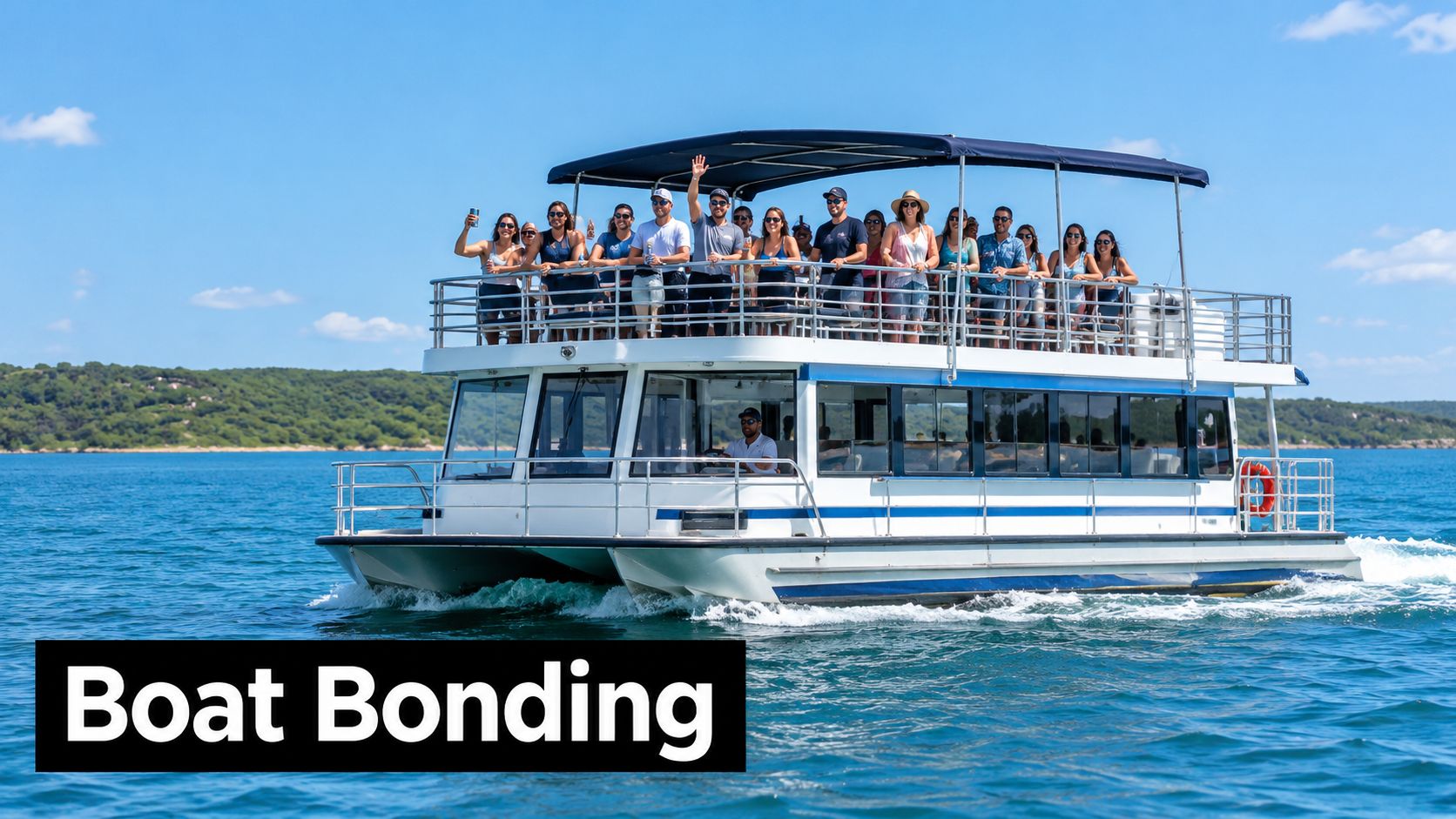
The best outing makes space for different comfort levels. Let guests know they can enjoy the cruise without swimming, offer non-alcoholic options, and ask about accessibility and dietary needs before booking. Clear information about water safety can help guests who feel uncertain about being on the lake.
For a more structured experience, executive team-building retreats can help planners think through how a shared outing fits a company gathering. On the water, you can keep the event relaxed or add organized activities and friendly challenges. Either way, give people more than one way to take part.
Check the details before you reserve
Start by checking which vessels can accommodate your group and what each option includes. Review the booking details and transparent pricing, then look at recent customer reviews and event photos to get a clearer sense of the setting. If your team has specific accessibility or food needs, ask about them before confirming.
Dates and vessels are tied to actual availability, so don't assume your preferred option will remain open while the group decides. When you find a date that suits your team, check the available boat and reservation details promptly. That turns an appealing idea into a plan employees can look forward to.
Your Next Step From Plan to Booked Date
A successful team-building event starts with intention, makes room for different people to participate, and connects the experience to a real workplace goal. You don't need to turn a celebration into a training exercise. You do need to know why you're bringing people together and what would make the day worthwhile for them.
Use this checklist to move from idea to reservation:
- Define the goal: Choose the work relationship or behavior you want to support, such as clearer communication across departments.
- Pick the format: Decide whether your team needs a facilitated activity, relaxed conversation, or a combination of both.
- Confirm a date: Check when the group can attend and identify the dates that work for the people you want included.
- Review the boat options: Check fleet size, guest capacity, vessel features, and recent customer reviews on the Lake Travis Yacht Rentals website.
- Lock in the reservation: Once the date and vessel fit, complete the booking rather than waiting and risking losing the preferred option.
A well-planned outing gives colleagues a shared experience they can enjoy and a chance to strengthen how they work together afterward. Choose the date, invite the group, and start turning the idea into a day on the lake.
Lake Travis Yacht Rentals offers fully captained boat and yacht charters on Lake Travis, including double-deck party boats equipped for group outings and corporate events. Visit Lake Travis Yacht Rentals to check available vessels and reviews, then reserve a date your team can look forward to.