Gallup reported that global employee engagement stood at a record 23% in 2022 and remained there in its 2024 summary, meaning roughly three-quarters of employees weren't fully engaged and representing an estimated $8.9 trillion in lost productivity worldwide (Gallup's global engagement report). That figure changes the question from “Should we organize a fun day?” to “How do we create the conditions for people to work well together?”
Team building matters because strong results depend on more than individual talent. People need to communicate clearly, trust one another, understand their roles, and feel safe raising concerns. A boat outing can support those conditions, but only when leaders design it with purpose, choice, and follow-through.
Why Teams Fall Apart (and How Team Building Helps)
A team rarely breaks down because people lack talent. It breaks down the way a relay race breaks down. The runners may all be fast, but the baton still gets dropped if the handoff is unclear.
That is what happens at work every day. Sales assumes operations has the update. Operations assumes account management already told the client. A newer employee spots a risk, stays quiet, and the issue grows until everyone is reacting instead of coordinating. Strong individuals can still produce weak team results when communication is uneven, ownership is fuzzy, and people do not feel comfortable speaking up.
At that point, the problem is usually coordination, not competence. Teams struggle when employees cannot see how their responsibilities connect, hesitate to ask for help, or avoid challenging a shaky decision because the social cost feels too high. Regular meetings keep projects moving, but they do not always let people practice the behaviors that hold a team together under pressure: listening well, disagreeing respectfully, solving problems together, and making clear handoffs.
That is why team building can help, but only under the right conditions.
Gallup describes engagement through day-to-day experiences such as role clarity, recognition, development, connection to purpose, and relationships with coworkers (Gallup's employee engagement indicator). Those are not perks added on top of work. They are part of how work gets done. If people are unclear about expectations, unseen by managers, or disconnected from the group, collaboration weakens long before performance reviews reveal it.
A useful team activity gives employees a safer place to rehearse better habits. A shared challenge can show who asks good questions, who jumps to conclusions, and where instructions get lost. A guided discussion afterward helps the group name what happened in plain language. That follow-through matters because an outing only becomes valuable when people can connect the experience to Monday morning behavior.
Manager involvement matters too. If leaders skip the event, dominate it, or treat it like a box to check, employees notice. If leaders participate, listen, and refer back to what the team learned, the activity has a much better chance of changing how people work together.
Voluntary participation helps for the same reason. Trust grows faster when people feel invited rather than managed.
Before you book anything, decide what your team needs to improve: onboarding, cross-functional handoffs, trust after a reorganization, or better communication between departments. Then choose a format that gives people time to interact, reflect, and carry one or two practical habits back to work. Executive team-building retreats on Lake Travis can support that kind of experience when the outing includes shared activity, guided conversation, and a clear plan for what happens after everyone returns.
What Team Building Actually Trains in Your Workplace
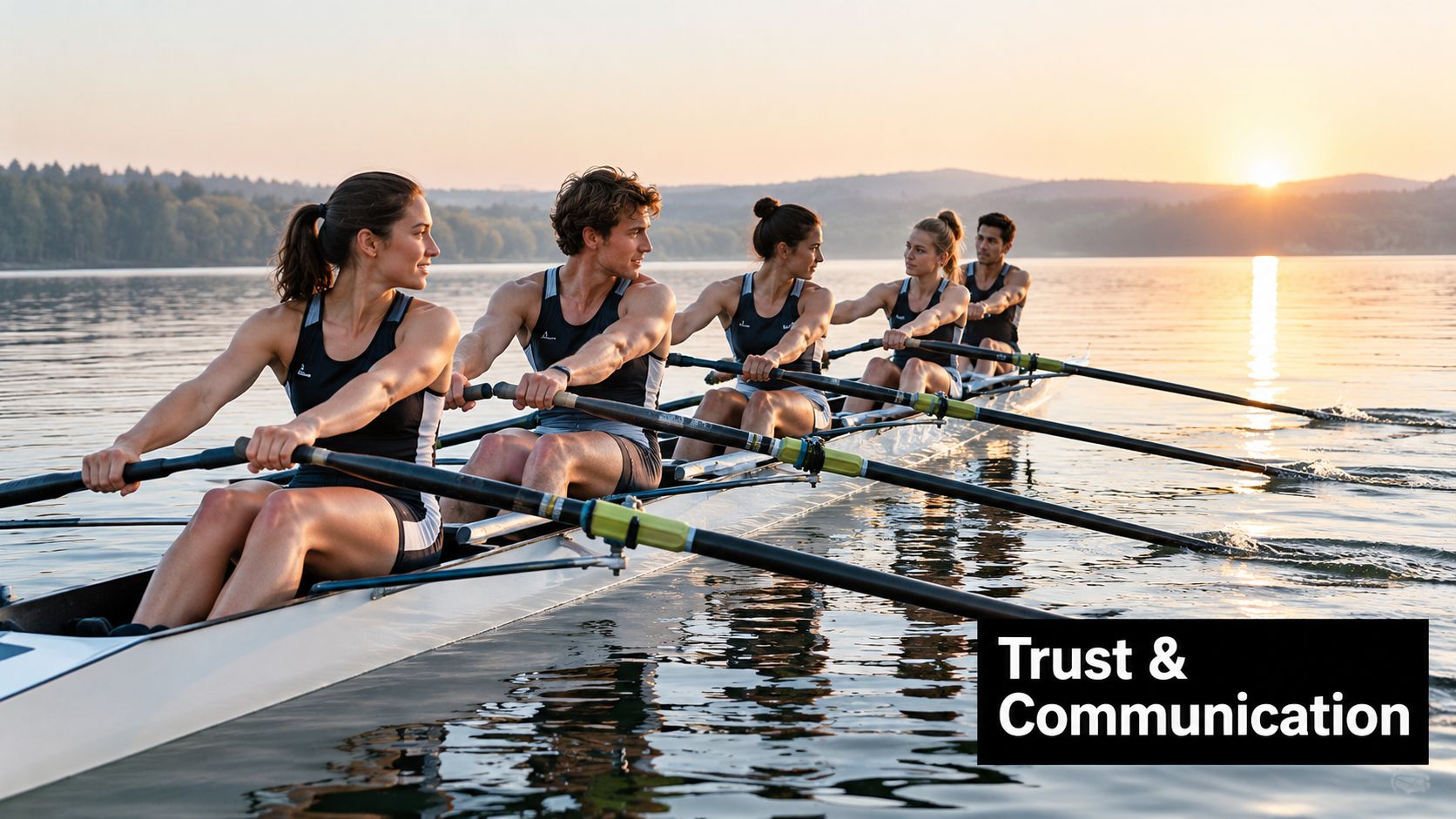
Think about a boat crew leaving the dock. Everyone doesn't perform the same task. One person watches navigation, another manages equipment, others help passengers, and the captain coordinates the whole operation. The crew succeeds because people understand their stations, communicate changes quickly, trust one another's observations, and share responsibility for the passenger experience.
A workplace team works in much the same way. Team building isn't only about getting people into the same room. It gives them structured opportunities to strengthen the behaviors that make coordination possible.
Psychological safety comes first
Psychological safety means people believe they can ask questions, report problems, challenge assumptions, and admit mistakes without interpersonal punishment. Google's Project Aristotle examined more than 180 teams and identified psychological safety as the strongest predictor of team effectiveness among the factors studied (research on psychological safety at work).
Psychological safety is the difference between a team that notices a problem and a team that quietly works around it.
A good activity creates repeated, low-risk practice in speaking up. A facilitator might ask each group to explain its decision, invite the least-heard view, or run a short debrief after a challenge. Managers should respond with curiosity rather than embarrassment or blame. Those reactions teach employees whether candor is safe.
Shared purpose gives effort direction
A group can be friendly and still work inefficiently. Shared purpose connects individual actions to a result everyone understands. On a boat, that might mean delivering a safe, enjoyable experience for every passenger. At work, it could mean completing a customer handoff without missing critical information.
Choose an activity that requires participants to define success together. Afterward, ask what each person contributed, where responsibilities overlapped, and which actions helped the group move forward. That conversation turns a pleasant experience into a clearer operating model.
Role clarity reduces friction
Team building can expose assumptions that stay hidden during normal work. Someone may naturally coordinate information, another may spot risks, and someone else may encourage quieter participants. A short reflection helps the team name those contributions without reducing people to fixed labels.
Use questions such as:
- Who noticed the first risk? Explore how information surfaced.
- Who made the final decision? Discuss authority and accountability.
- Who needed more context? Identify where instructions or handoffs were unclear.
- Who helped the group include different views? Connect participation to everyday meetings.
Trust grows when colleagues see one another act reliably. Shared challenges create evidence that a teammate listens, follows through, asks for clarification, or supports the group when plans change. That evidence is more useful than a forced declaration that everyone must “bond.”
The Measurable Business Case for Team Building
Gallup's analysis of 183,806 business units across 347 organizations found that teams in the top quartile for employee engagement had 18% higher sales productivity, 23% higher profitability, 78% lower absenteeism, and 32% fewer quality defects than bottom-quartile teams (Gallup's engagement and productivity analysis).
For leaders deciding whether to approve an outing, that matters. The case for team building is not that one event produces a guaranteed financial return. The case is that well-run team building can strengthen the workplace conditions that sit closer to those outcomes.
Engagement quartile outcomes at a glance
| Business Metric | Top-Quartile Teams | Bottom-Quartile Teams (baseline) |
|---|---|---|
| Sales productivity | 18% higher | Baseline |
| Profitability | 23% higher | Baseline |
| Absenteeism | 78% lower | Baseline |
| Quality defects | 32% fewer | Baseline |
Here is the practical distinction. These figures compare teams at different engagement levels. They do not mean a single cruise, workshop, or dinner will create the same lift by itself. A team event works more like a practice field than a finish line. It gives people a place to rehearse habits that managers then need to reinforce back at work.
That is where a lot of companies miss the business case. They buy the event and skip the conditions that make it useful. Team building tends to help when participation feels voluntary, managers join in instead of standing apart, and someone follows through afterward with clearer expectations, recognition, or better cross-team routines. Without that follow-through, even a fun outing fades into a nice memory instead of a work improvement.
Translate the data into a leadership proposal
A stronger budget request names the team problem, the behavior you want to practice, and the sign you will check afterward.
- For onboarding: Help new employees meet people across functions, then ask whether they know whom to contact for specific questions.
- For collaboration: Mix departments during the activity, then review handoff quality and repeated communication gaps.
- For recognition: Give managers time to notice contributions during the event, then repeat that recognition in regular meetings.
- For trust: Use a facilitated challenge and debrief, then check whether employees are more comfortable asking for help.
This is why the format matters. A loosely planned social hour may be enjoyable, but it rarely trains much. A structured corporate outing on Lake Travis can do more if the activity requires shared decisions, visible coordination, and manager participation, then ends with a short debrief tied to real work.
Team building is a supporting investment in engagement conditions, not a substitute for fair management, clear priorities, good compensation, or workable processes. It earns budget when the event matches a real workplace need and leaders keep the behavior going afterward.
Best Practices That Make Team Building Actually Work
A team activity works better when it rehearses something the group needs to do on the job. A meta-analysis of 93 effect sizes covering 2,650 teams found that team training had moderate positive relationships across cognitive outcomes, affective outcomes, teamwork processes, and performance outcomes. The analysis also found that training content, team-membership stability, and team size moderated effectiveness (meta-analysis of team training).
That finding supports a simple standard: choose an experience for the behavior it practices, not only for its entertainment value.
Use this planning checklist
- Name one target behavior: Decide whether the group needs better listening, clearer roles, faster decisions, stronger cross-team relationships, or more constructive feedback.
- Keep groups stable where possible: People learn more when they work with colleagues they'll continue to encounter after the event.
- Make the challenge purposeful: Ask participants to solve a problem, coordinate limited information, or reach a shared decision rather than merely compete.
- Include managers as participants: Leaders should listen, contribute, and model the communication norms they expect from others.
- Build in reflection: Ask what happened, why it happened, and how the lesson applies to a real workflow.
- Reinforce the behavior afterward: Add a working agreement to meetings, revisit roles, or recognize employees who demonstrate the desired habit.
A manager shouldn't stand at the edge of the activity taking photographs while employees practice collaboration without leadership. The manager's response to disagreement often teaches more than the game itself. If a participant raises a concern, the leader can thank them, ask a clarifying question, and show the group that useful dissent improves decisions.
Design the follow-through before the booking
Write the post-event action while planning the event. If the goal is better handoffs, schedule a short review of one real handoff after the outing. If the goal is onboarding, assign cross-functional introductions. If the goal is recognition, give managers a prompt for continuing specific appreciation.
Corporate team-building events on Lake Travis can support this format when the cruise includes an intentional group challenge, shared time, and a guided conversation. The boat is the setting. The learning comes from how people participate, what leaders model, and what the organization does next.
Planning test: If you can't describe the workplace behavior that should continue after the event, the activity isn't ready to book.
When Team Building Backfires and How to Avoid It
Team building can create connection, but it can also reduce trust when leaders treat participation as a loyalty test. A University of Sydney review notes that interpersonal closeness may improve through team-building exercises, yet the benefits are jeopardized when participation isn't fully voluntary (University of Sydney review of team-building participation).
Attendance doesn't equal engagement. An employee may show up because a manager implied that attendance matters, then spend the event managing discomfort rather than connecting with colleagues. That reaction is especially likely when organizers ignore disability access, caregiving responsibilities, religious constraints, social anxiety, alcohol-related concerns, or personal boundaries.
Choice is part of good design
Voluntary participation doesn't mean employees should be excluded from meaningful work opportunities. It means leaders communicate the purpose clearly, avoid pressure, and provide reasonable alternatives.
Use practical safeguards:
- Offer more than one way to participate: Include conversation, observation, planning, creative work, and low-pressure group roles.
- Provide alcohol-free options: Make refreshments and social interaction inclusive without making drinking the center of the event.
- Check accessibility early: Ask privately about mobility, sensory, dietary, and medical needs, then confirm what the venue can support.
- Avoid forced disclosure: Personal sharing should be optional, with prompts that allow professional or light responses.
- Explain expectations clearly: Tell employees the schedule, physical demands, clothing guidance, transportation details, and whether participation in each activity is optional.
- Use noncompetitive formats: Collaboration can be meaningful without ranking people or putting anyone on display.
A boat outing, for example, shouldn't require every employee to swim, use a waterslide, or join a high-energy challenge. People can participate through planning, conversation, photography, music, observation, or a quieter social space. The objective is connection with autonomy, not performance for an audience.
Facilitation matters too. The University of Sydney review highlights that successful workplace activities depend on favorable worker attitudes, external facilitation, and multiple coordinated components rather than a one-off event. A capable facilitator can notice exclusion, adjust the pace, explain instructions clearly, and create a debrief where employees can offer honest feedback.
The adult question isn't “Did everyone attend?” It's “Did people experience the event as useful, respectful, and relevant to how they work together?”
Corporate Team Building Ideas That Get People Excited
Different formats solve different problems. A workshop suits a team that needs focused practice in feedback or communication. A volunteer day connects colleagues through shared purpose. An escape room creates a concentrated problem-solving challenge. An offsite outing gives people more room for informal conversation and recognition.
For a corporate group that wants both structure and energy, a fully captained yacht or double-decker party boat on Lake Travis offers a distinctive setting. Lake Travis Yacht Rentals provides chartered boats with rooftop party decks, waterslides, water toys, Bluetooth stereos, coolers, private restrooms, and background-checked captains handling safety. Those features create options for both active participants and employees who prefer to socialize, observe, or contribute in quieter ways.

Why a boat outing fits the research
A boat changes the social pattern of a workday. Colleagues who normally communicate only through tickets, meetings, or departmental channels can talk without the usual workflow interruption. Managers and employees share the same environment, which creates opportunities for recognition and informal conversation across roles.
Gallup reports that managers account for at least 70% of the variance in team-level employee engagement, making active manager involvement important rather than optional (Gallup's analysis of managers and engagement). A captained cruise gives leaders time to participate in the experience instead of managing navigation, equipment, or safety logistics.
You can structure the outing around a simple sequence:
- Welcome and purpose: Explain the workplace goal and participation choices.
- Small-group challenge: Use a noncompetitive activity that requires listening, role allocation, and shared decisions.
- Open cruise time: Let people choose swimming, waterslides, water toys, conversation, music, or relaxed observation.
- Recognition moment: Invite managers to acknowledge specific contributions and team wins.
- Short debrief: Ask what helped people coordinate and what should transfer back to work.
Planning details that protect the experience
Share the schedule and expectations before booking. Ask about accessibility and dietary needs, clarify whether employees can opt out of physical activities, and decide how the group will handle refreshments. Choose team groupings that mix roles without isolating new or quieter employees.
For more ideas that combine structured challenges with a relaxed lake setting, explore team-bonding activities for work. The strongest format isn't the loudest one. It's the one that gives employees meaningful choices while creating enough shared experience for trust and connection to develop.
How to Measure Whether Your Team Building Worked
Enjoyment ratings and attendance tell you whether people were present and entertained. They don't show whether the team became more willing to ask for help, include different views, or communicate across roles.
Use a simple before-and-after routine. Before the event, ask employees whether they feel comfortable raising mistakes, disagreeing with a leader, requesting help, and collaborating with other teams. Afterward, repeat the questions and add prompts about participation quality, perceived inclusion, and the usefulness of the activity.
Measurement matters because more than half of employees worldwide fear consequences for speaking up, while 93% of business leaders believe psychological safety affects performance, according to research from Workplace Options and the International Institute of Risk & Safety Management (research on psychological safety perceptions). Compare leadership expectations with employee experience instead of assuming they match.
Track practical follow-through too. Look for near-miss reporting, idea submission, peer-rated coordination, cross-team communication, willingness to ask for help, and whether managers continue the agreed behaviors. Team building worked when people carry the learning into daily decisions, not just when they leave with photos and good memories.
Lake Travis Yacht Rentals offers fully captained yachts, double-decker party boats, and premium pontoons for corporate outings that combine structured team activities with relaxed time together on Lake Travis. Plan your next research-informed team experience by visiting Lake Travis Yacht Rentals, choosing a vessel that fits your group, and booking your corporate cruise.