Your leadership team has sat through enough ballroom retreats. The branded slides were polished, the coffee was expensive, and everyone nodded at the right moments. Then Monday arrived, inboxes filled up, and the cross-functional tension returned with the calendar invites.
That's why executive team building retreats on Lake Travis deserve a different design. Put the yacht at the center of the day, not at the end of a conference agenda as an optional reward. A moving deck, open water, and a captain-led experience create the kind of shared setting that gets executives away from screens and into the same conversation.
Why Lake Travis Sets the Stage for Executive Team Building Retreats
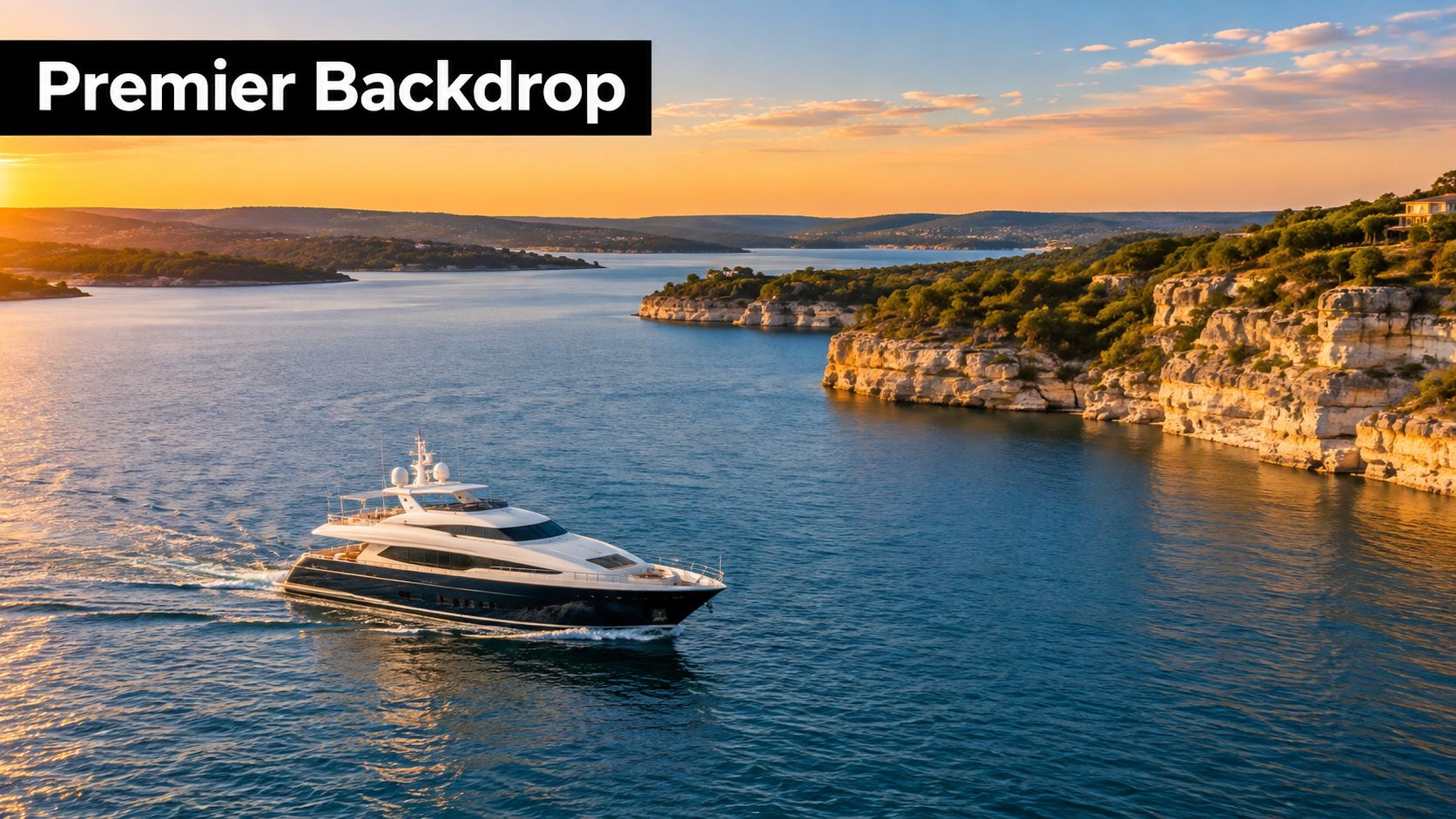
Lake Travis gives an executive retreat something a hotel ballroom can't manufacture. Limestone cliffs rise along the shoreline, nearly 65 miles of open water create room to move, and the Highland Lakes sunset gives the day a natural finish. The setting feels distinctly Austin, but the value is practical. Your team has fewer places to hide behind routine.
Modern retreats need three outcomes: sharper strategic alignment, stronger cross-functional trust, and a measurable lift in team energy that survives Monday morning. A scenic location alone won't produce those results. The agenda, vessel, facilitation, and follow-up must work together.
A yacht charter outperforms a standard ballroom because it forces presence. Executives can't drift into side meetings, disappear behind laptops, or split into familiar departmental corners as easily when the group is sharing one vessel and one route. The lake also creates a clean break from the office, which helps people hear the strategic issue in front of them instead of reacting to the latest notification.
My operating rule: Book the signature experience first. Build the retreat around it, rather than trying to rescue a generic agenda with a boat ride at the end.
Start with the business outcome, then choose the itinerary, budget, fleet, catering, and measurement plan around that anchor. The Lake Travis boating guide is a useful starting point for understanding the setting, marina options, and practical lake logistics. If your group needs alignment and energy, water beats walls.
Defining Goals and Choosing the Right Yacht
Don't open a fleet page before you define the work. A beautiful boat with the wrong layout can undermine a confidential strategy session just as quickly as a cramped meeting room.
Write the retreat brief around three categories:
- Strategic clarity: List the decisions executives must make before docking. That might include priority conflicts, investment choices, operating responsibilities, or the next phase of a company initiative.
- Cultural priorities: Identify the leadership behaviors you want modeled on the lake. Direct feedback, faster escalation, better listening, and shared accountability are more useful than a vague promise to “improve culture.”
- Team dynamics: Name the trust gaps that slow work today. If marketing and operations rarely speak candidly, design time for mixed conversations instead of seating each function together.
Then match the vessel to the conversation. For 6 to 12 senior leaders handling confidential, board-level topics, choose the Day Tripper or a comparable executive-class motor yacht with a climate-controlled cabin and a quiet deck. For 12 to 30 cross-functional directors, a mid-size charter yacht with bow lounges and water-toy access gives you enough room to shift between structured work and social connection.
Use the guide to choosing the right boat before requesting a quote. Bring these questions to the planner:
- How many people will attend, and will everyone need a seat for working sessions?
- Which conversations require privacy or climate control?
- Do you need presentation support, a Bluetooth PA, or another AV arrangement?
- Will swimming, paddleboarding, tubing, or other water activities be central to the day?
- Are there dietary, mobility, restroom, or boarding requirements to solve in advance?
Price matters, but goal fit matters more. The right yacht gives your facilitator the right rooms, your captain the right operating plan, and your executives the right balance of focus and freedom.
Sample Itineraries for Your Lake Travis Retreats
A good retreat itinerary doesn't cram every minute with content. It gives strategy enough protected time to produce decisions, then uses the lake to create connection without forcing another artificial icebreaker.
Half-day executive format
The half-day plan works well for an Austin-based leadership group that wants a focused reset without an overnight program.
- 11:00am, Arrival: Meet at Pointe Tarrytown or Hurst Harbor. Welcome guests aboard with iced drinks, confirm the safety briefing, and settle into the vessel.
- 11:30am, Strategy session: Anchor in a quiet cove for a 60 to 90 minute facilitated discussion. Keep the topic narrow and assign a decision owner for each major issue.
- 1:00pm, Catered lunch: Move from formal discussion to a relaxed meal. Keep seating mixed so executives don't automatically return to functional silos.
- 2:00pm, Water time: Offer swimming, paddleboarding, floating mats, and unstructured conversation. People often surface the most useful objections once the formal session ends.
- 3:30pm, Closing round table: Ask each participant to name one commitment, one owner, and one unresolved question.
- 4:00pm, Dock: Return on schedule with decisions captured before anyone heads back to the office.
Full-day leadership format
For deeper work, run 9:00am to 5:00pm and use the vessel as both meeting room and activity platform.
Begin with coffee onboard, followed by a morning strategy block in the cabin while cruising. Serve a lakeside working lunch in a cove, then shift the afternoon toward captain-led tubing, wakeboarding, and swim stops. End with a sunset reception, cocktails, and informal conversation while the boat drifts.
Weather should shape the sequence, not threaten the program. On hot summer days, move swimming earlier and reserve the shaded deck for the warmest part of the afternoon. In spring and fall, prioritize cabin sessions and use outdoor time as a flexible reward block.
Collect dietary details before boarding, and ask about accessibility needs during registration. Confirm boarding surfaces, restroom access, seating, and activity alternatives so participation doesn't depend on athletic ability.
Budget Planning for Executive Retreats
Budget conversations need clean benchmarks and honest scope. Industry data places standard retreats commonly at $300 to $500 per person per day, while executive retreats often reach $800 to $1,500 or more per person per day, according to retreat market pricing data. Those figures describe broad retreat markets, so a Lake Travis day charter requires a separate quote based on vessel, duration, date, catering, and activities.
The requested planning range for a full-day charter-inclusive experience is $150 to $450 per person, compared with $300 to $700 or more for a hotel ballroom package. Treat those as working estimates, not guaranteed rates. A proposal should itemize the yacht, catering, AV, facilitation, transportation, fuel-related charges, gratuity, and any activity upgrades.
| Line Item | Ballroom Package | Yacht Charter Day |
|---|---|---|
| Venue | Ballroom rental, room fees, service charges | Charter vessel and onboard spaces |
| Catering | Separate meal package and minimums | Catered service coordinated around the cruise |
| AV | Ballroom screens, microphones, production | Bluetooth PA or presentation support, depending on vessel |
| Facilitation | External facilitator or internal leadership team | External facilitator or internal leadership team |
| Transportation | Transfers between hotel, meeting room, and activities | Marina arrival and charter boarding plan |
| Team experience | Separate activity or entertainment booking | Swimming, water toys, cruising, and sunset reception |
A yacht can consolidate the venue, catering kitchen, scenic reset, and entertainment into one central experience. That may replace several separate venue costs, but it doesn't eliminate every expense. Ask how the price scales with vessel size and duration, whether fuel surcharges apply, and how gratuity is handled.
Weekday dates and shoulder-season bookings may offer better value than peak demand periods. Bundle water toys or catering upgrades only when they serve the goal. For a 20-person retreat, a practical planning range is $9,500 to $14,000 for the complete experience, subject to the final proposal. Review Lake Travis yacht rental prices early so finance sees a realistic scope instead of a vague activity allowance.
Comparing the LTYR Fleet for Corporate Groups
Corporate planners can shortlist quickly by asking one question: does this group need a quiet executive room, an energetic open deck, or both?
The Day Tripper suits an intimate 14-person C-suite offsite, especially when privacy, cabin comfort, and focused conversation lead the agenda. The Clever Girl and Clever One fit mid-size leadership groups of 20 to 40, giving planners more space for mixed-format sessions and social time. For larger all-hands retreats of 40 to 75 people, the Atlantis and Stargazer offer the open-deck footprint needed for movement, group activities, and a more celebratory atmosphere.
| Vessel | Capacity | Best For | Key Feature |
|---|---|---|---|
| Day Tripper | 14 | Intimate C-suite strategy retreat | Executive-focused cabin and quiet deck |
| Clever Girl | 20 to 40 | Leadership alignment and social bonding | Balanced meeting and deck configuration |
| Clever One | 20 to 40 | Mid-size cross-functional retreat | Flexible space for mixed-format programming |
| Atlantis | 40 to 75 | High-energy corporate reward retreat | Large open deck for group activities |
| Stargazer | 40 to 75 | Larger all-hands gathering | Expansive social layout and presentation-friendly setup |
Check climate-controlled cabins first if the group needs confidential breakouts or presentation work. Then assess deck space, onboard restrooms, sound system capability, and whether the galley can support your catering style. A quiet cabin favors the Day Tripper or Clever Girl. A reward-focused day with swimming, music, and open movement favors Atlantis or Stargazer.
Before you request proposals, shortlist two vessels. Pick one that matches the agenda exactly and one that gives you more room for weather, movement, or last-minute guest additions. That keeps the decision fast without turning vessel selection into a beauty contest.
On-Water Activities That Build Executive Teams
Generic ballroom icebreakers ask executives to perform connection on command. Lake activities create a shared situation first, then let connection develop through action. Shared novelty and mild adrenaline can lower the polished behavior people bring into boardrooms, revealing communication habits, comfort with uncertainty, and natural leadership patterns without staging a trust fall.
Use each activity with a defined outcome:
- Swim stops at Devil's Cove: Mix departments before guests enter the water. The informal setting gives finance, sales, product, and operations a reason to talk without an agenda.
- Tubing rotations: Change the pairings between runs. Executives see who communicates clearly under pressure, who checks on others, and who keeps the group moving.
- Wakeboarding: Make participation optional and provide a strong spectator role. The value comes from encouragement and shared novelty, not from requiring everyone to perform.
- Shaded-deck strategy sessions: Use catering and the lake's changing scenery as an attention reset between decisions. Keep the work block focused, then let the group move.
- Sunset cocktails: Reserve the final reception for informal networking. People can connect across functions without another slide, worksheet, or forced prompt.
The onboard details determine whether the experience feels polished or improvised. Use the premium sound system for curated background music, the Bluetooth PA for announcements, and lily pads or water mats for low-pressure participation. Galley setups support plated service or a coordinated catered meal, while private restrooms and large coolers keep the day comfortable.
Don't let activities take over the business purpose. A strong sequence is morning strategy followed by afternoon co-captained pontoon challenges. Put executives in mixed teams, give each group a practical navigation or coordination objective, and let the captain manage safety and operations. The activity becomes a living version of the leadership behavior you discussed earlier.
Measuring Success and Booking Your Charter
Measure the retreat while the conversations are still fresh. Within two weeks of disembarking, collect evidence in three categories and tie each signal to a moment from the itinerary.
Qualitative signals include executive NPS, trust scores, and examples of cross-functional conversation that didn't happen before the retreat. Ask participants which discussion on the shaded deck changed their view of a priority, and which informal exchange created a useful connection.
Operational signals focus on the top three priorities set onboard. Track whether owners confirmed next steps, whether decisions moved forward, and whether unresolved issues reached the agreed decision-maker. Don't measure the boat day as entertainment. Measure whether the conversations on the boat changed what people did afterward.
Engagement signals show whether the team sustained the rhythm. Record attendance at the follow-up cadence meeting, review the commitments captured during the closing round table, and ask leaders to identify where accountability has stalled. The primary care retreat evaluation found a useful workflow: participants reported stronger personal and professional familiarity afterward, the mean score was 4.7 out of 5 across 368 participants, and 78% of teams submitted SMART goals tied to high-functioning team behaviors, as reported in the published team-building evaluation. A separate faculty retreat study found that gains in job satisfaction and group cohesion appeared on the retreat day but weren't maintained by semester-end follow-up, as documented in the challenge-course retreat study. Your follow-up cadence is what keeps the Lake Travis experience from becoming a pleasant memory.
Corporate planners should start several months ahead when dates, preferred vessels, catering, and facilitators matter. Send the inquiry with your group size, preferred date range, retreat objective, privacy needs, activity preferences, and dietary or accessibility requirements. Ask what proposal, fleet recommendation, and availability response you'll receive within 24 hours, then place the deposit as soon as the plan fits.
The charter is the anchor, not an add-on. Peak spring and fall corporate seasons create date pressure, so early deposits protect the preferred vessel and schedule.
Lake Travis Yacht Rentals offers captained yachts, party boats, and premium pontoons for corporate groups, with onboard sound, restrooms, coolers, lily pads, water mats, and activity options that support a structured retreat. Visit Lake Travis Yacht Rentals now with your group size and preferred date, and book the yacht before another ballroom agenda takes the slot.