A corporate event is a planned business gathering with at least 10 participants that lasts at least four hours and serves a clear organizational purpose. A yacht charter on Lake Travis qualifies when the group is organized around an objective such as team development, client relationships, employee recognition, or strategic planning.
You may be staring at a hotel ballroom quote right now, wondering how a room with beige walls, fluorescent lighting, and a portable screen became the most expensive line item in your event plan. Your attendees don't need another passive meeting. They need a reason to show up engaged, talk to people they don't normally work with, and remember why the company brought them together.
A corporate event isn't defined by banquet chairs or conference badges. It's defined by purpose, planning, participants, logistics, and measurable outcomes. The venue should support that purpose. For certain goals, a Lake Travis yacht charter does more than provide a scenic backdrop. It changes how people interact.
Picture This Before You Start Planning
You're in a conference room trying to make a familiar format feel fresh. The agenda is crowded, the stakeholders want more participation, and the room somehow makes a group of employees feel disconnected. The hotel can provide the chairs, coffee, screens, and microphones, but it can't provide much of a sense of occasion.
Move the same group onto a private deck on Lake Travis. The water replaces the presentation screen as the visual anchor. Conversations continue over a hosted meal, teams have space to interact naturally, and the setting gives the event a clear identity before the first agenda item begins.
The practical definition matters. The Events Industry Council executive summary describes a business event as an organized gathering of at least 10 participants, lasting a minimum of four hours, in a contracted venue. That framework includes meetings, conventions, incentive programs, exhibitions, launches, networking events, and team-building activities.
Use the event self-test
Before you compare venues, answer three questions:
- What must change afterward? Name the business result, whether that's stronger client relationships, better collaboration, employee recognition, or qualified sales conversations.
- Who needs to be there? Identify employees, executives, customers, partners, suppliers, investors, or prospects. A client hospitality cruise needs a different guest list from an internal retreat.
- How will you measure success? Choose a practical indicator, such as meetings completed, feedback, opportunity value, renewal conversations, or team-performance observations.
If you can't answer those questions, you aren't ready to book a venue. You're shopping for entertainment.
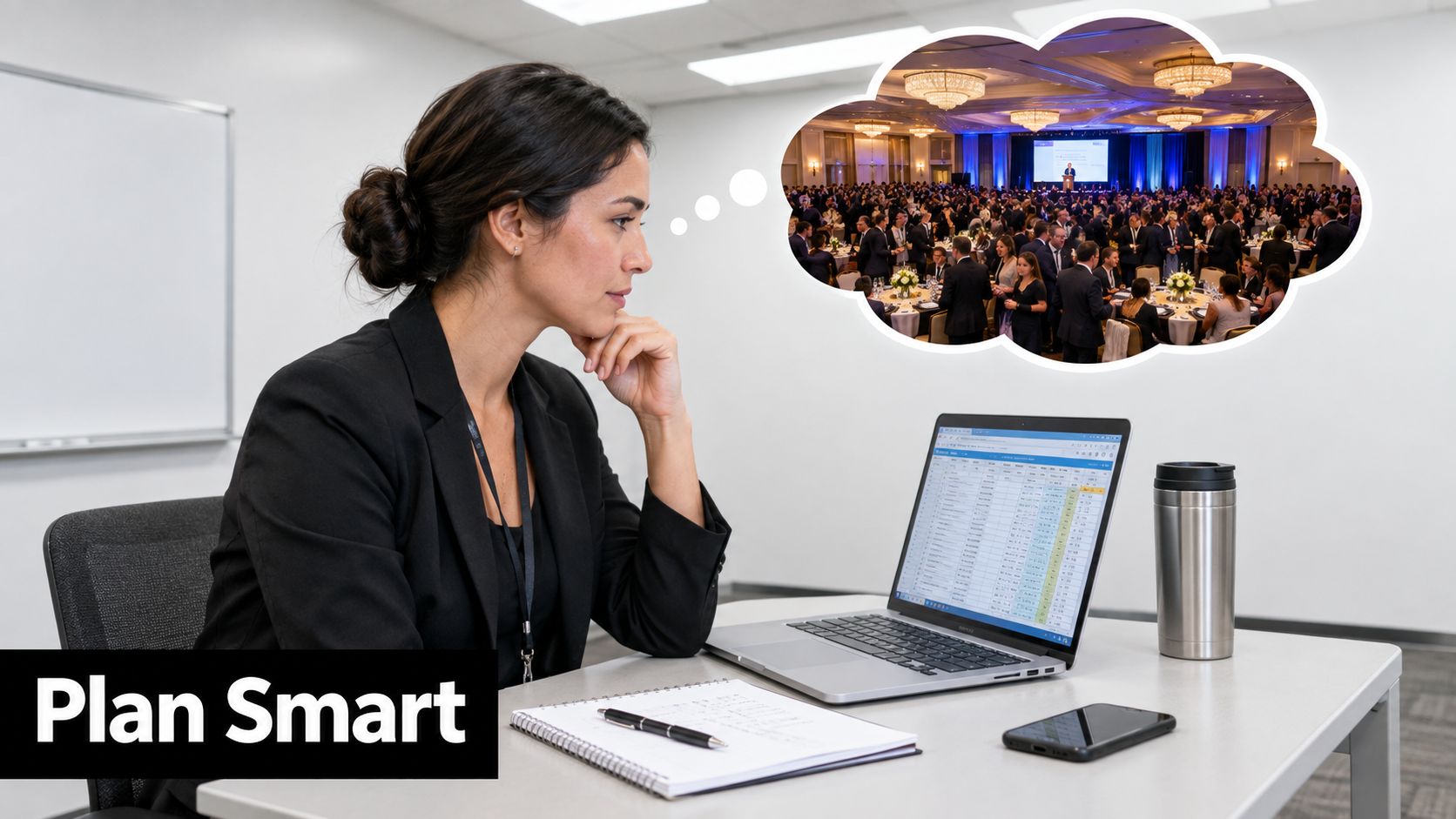
Choose the format that reinforces the objective. A boardroom signals information transfer. A private yacht signals attention, access, and shared experience. That distinction becomes valuable when your priority is trust, recognition, or relationship-building rather than delivering slides.
The Main Types of Corporate Events Worth Knowing
Start with the outcome, not the event label. A conference might build authority, while a client cruise might protect and expand an existing relationship. Calling both “corporate events” is accurate, but it doesn't help you plan either one well.
Conferences and seminars
Use a conference or seminar when the goal is thought leadership, education, or strategic alignment. The dominant KPI should reflect knowledge transfer or market authority, such as attendance quality, session engagement, follow-up meetings, or stakeholder feedback. Hotels remain the sensible choice when you need extensive audiovisual production, breakout rooms, exhibitor space, or a formal presentation environment.
A yacht works better for the smaller, high-value portion of the program. Host an executive discussion, speaker reception, or private networking cruise after the main conference, where guests can continue conversations without the usual ballroom distractions.
Trade shows and product launches
Trade shows focus on pipeline creation and market visibility. Product launches focus on attention, positioning, and qualified conversations. A traditional venue offers controlled branding, demonstrations, and visitor flow. A private boat creates a more selective environment for priority prospects, partners, or media contacts.
Incentive trips and reward retreats
These events exist to support recognition, motivation, and retention. The experience should feel earned, not routine. A captain-led Lake Travis cruise fits naturally because the venue itself becomes part of the reward, while swimming, sightseeing, dining, and conversation can be arranged around the company's recognition program.
Team-building offsites
A team-building outing should address collaboration and relationship quality, not just provide a group activity. Use facilitated prompts, mixed-team challenges, and deliberate seating changes so people interact beyond their usual departments. The water creates a shared environment, but the organizer still needs a designed agenda.
Client entertainment events
Client events support relationship deepening, renewal, referrals, and account expansion. A private charter gives sales and account teams time with customers in a setting that feels generous without forcing a formal sales presentation. Keep the guest list focused, brief the hosts, and give every attendee a reason to have a useful conversation.
Match the first business objective to the format. Then choose a venue that makes that objective easier, not one that merely has a convenient room available.
Yacht Charter Versus Traditional Venue
A hotel ballroom is the right tool for scale, structure, and production. A Lake Travis yacht is the better tool for intimacy, distinction, and relationship-led outcomes. Don't choose the boat because it looks impressive. Choose it because your event depends on how people connect.
| Metric | Hotel Ballroom / Conference Room | Lake Travis Yacht Charter |
|---|---|---|
| Venue logistics | Strong capacity, fixed rooms, established audiovisual infrastructure, and familiar catering workflows | Private setting, controlled guest list, captain-led operation, onboard amenities, and a route built around the experience |
| Attendee experience | Predictable, formal, and efficient for presentations | Scenic, social, memorable, and naturally suited to conversation |
| Business outcome | Strong for information transfer, training, and large-group alignment | Strong for trust-building, client hospitality, recognition, and team connection |
The water gives attendees sensory variety that a standard meeting room can't provide. Guests have a shared view, a common activity, and natural conversation points between agenda items. That doesn't guarantee a commercial result, but it gives hosts a more productive environment for the human exchanges that influence trust.
Planning rule: Use the ballroom when the content is the event. Use the yacht when the relationship is the event.
Quarterly all-hands meetings, large training sessions, and presentation-heavy conferences still belong in a conference room. A yacht isn't a substitute for every corporate format. It wins decisively for incentive outings, client entertainment, employee recognition, and executive retreats where the quality of interaction matters more than room capacity.
For a concrete Lake Travis option, review the corporate boat cruise experience and ask one question before requesting a quote: Will this event succeed because people received information, or because people built trust? The first answer points toward a traditional venue. The second points toward the water.
Planning Variables That Make or Break the Day
A boat event feels effortless to attendees only when the organizer has made firm decisions in advance. Lock down these five variables before you request a final proposal.
Headcount
Start with the exact guest list, then account for hosts, crew requirements, and any accessibility needs. Don't book a vessel based on its maximum capacity if your objective requires everyone to hear, move, and participate comfortably. A smaller group often produces better conversation than a crowded deck.
Agenda length
Build the cruise around the business purpose. A four-hour sunset format can accommodate welcome remarks, a facilitated activity, hosted food, open networking, and a closing message, but it won't support a full conference program with several technical sessions. Keep the formal portion short enough that the experience still feels like an outing.
Catering
Decide whether food is a working component, a hospitality feature, or both. Confirm menu style, dietary requirements, non-alcoholic options, service timing, refrigeration, and cleanup. Food should support conversation, not force guests to balance plates while moving through a crowded space.
Audio and visual needs
Ask what the event requires. A Bluetooth PA may support announcements and background music, while a formal presentation may require a projector, screen, power access, and a protected setup area. Confirm the equipment rather than assuming a boat can replicate a hotel ballroom.
Transportation
Give guests a precise arrival window, parking instructions, marina location, and boarding process. Coordinate shuttles when several departments arrive together. The event starts at check-in, so a confusing arrival can damage the experience before the vessel leaves the dock.
For a structured leadership outing, compare the planning requirements of executive team-building retreats with your intended agenda. Then put headcount, duration, catering, equipment, and transportation into one booking document. That single step prevents most event-day surprises.
Measuring the Business Value of an Event
Treat the event budget as an investment with an owner, a baseline, and a follow-up plan. Entertainment can be part of the experience, but it shouldn't be the only explanation for the spend.
The PCMA summary of business-events research reports that survey respondents attributed 22% of new-customer acquisition to participation in in-person events, estimated that 28% of revenue would be lost without that participation, and calculated approximately $11 in incremental revenue for every $1 invested in attending or exhibiting. These are survey-based benchmarks, not promises for an individual cruise.
Use the benchmarks as a reason to measure, not as a forecast. For a Lake Travis event, define the business proxy before the invitations go out.
| Metric | Industry Benchmark | Yacht Charter Result |
|---|---|---|
| New-customer acquisition | Survey respondents attributed 22% to in-person event participation | Track qualified conversations, follow-up meetings, and opportunities influenced |
| Revenue exposure | Respondents estimated 28% of revenue would be lost without participation | Connect attendees to renewals, referrals, and active account plans |
| Incremental revenue | Approximately $11 for every $1 invested in attending or exhibiting | Compare attributable opportunity value with the complete event cost |
A simple scorecard can include attendance, meaningful conversations, meetings completed, participant feedback, opportunity value influenced, and internal outcomes such as manager observations or team-performance indicators. Record the baseline before the cruise, then review results after the event through a defined follow-up period.
For employee-focused events, Gallup reports 31% of U.S. employees were engaged at work in 2025, compared with 20% globally, and says managers account for at least 70% of the variance in team engagement. The Gallup workplace engagement data supports involving managers in the experience rather than treating the outing as a disconnected perk.
Safety, Accessibility, and Weather Must-Haves
A corporate event on Lake Travis carries a duty of care. Safety, comfort, accessibility, and weather planning belong in the proposal review, not in the last email before boarding.
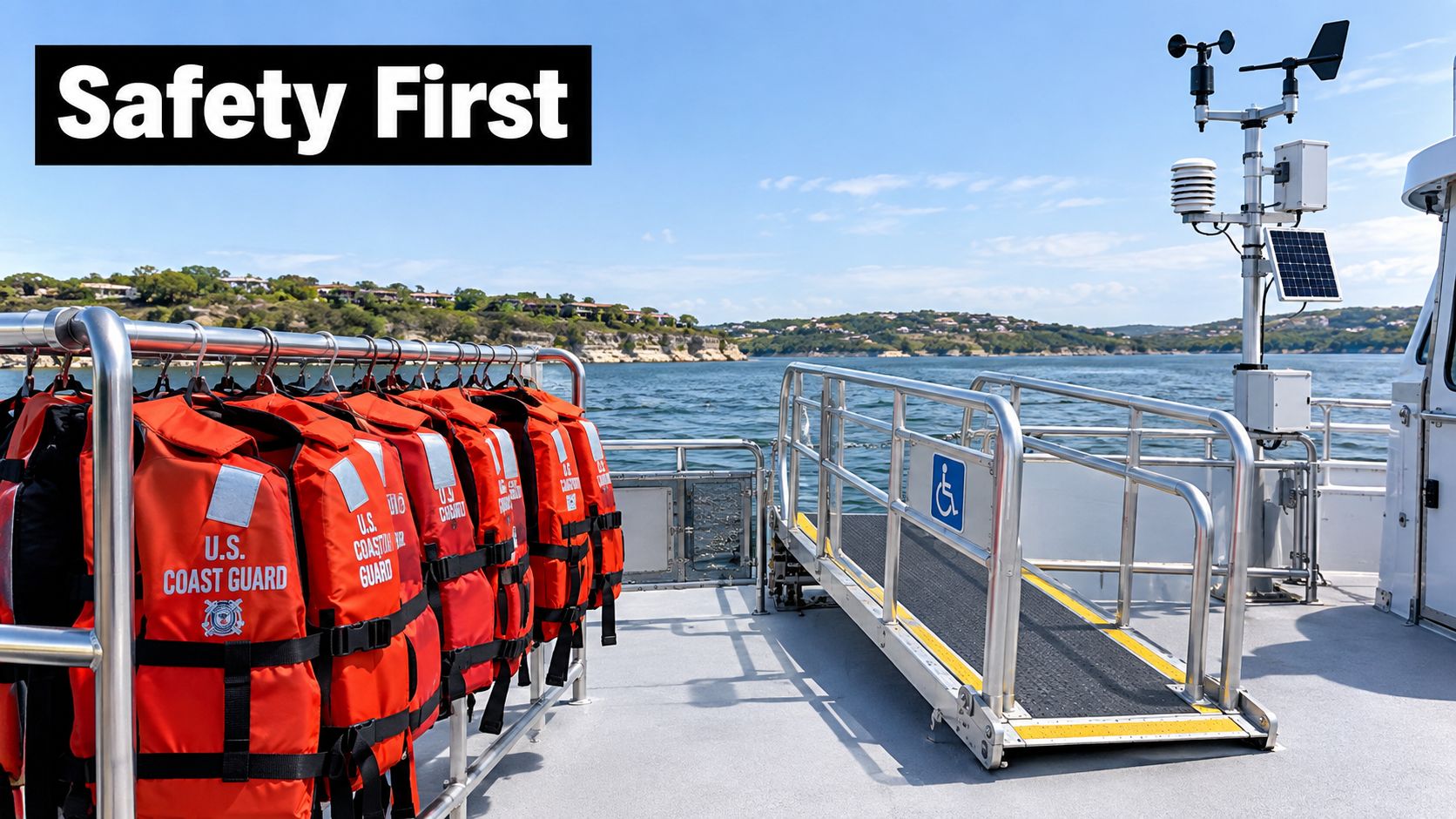
Texas Parks and Wildlife states that children under 13 on recreational vessels under 26 feet while underway, including while drifting and not anchored, must wear a U.S. Coast Guard-approved life jacket. Adults must have a properly fitting life jacket readily accessible, and Texas guidance requires a wearable approved life jacket for each person aboard plus a Type IV throwable flotation device on boats 16 feet or longer. Review the Texas Parks and Wildlife life-jacket guidance with the captain before booking.
Federal guidance likewise requires each person onboard to have an appropriate, serviceable, Coast Guard-approved wearable life jacket. Boats longer than 16 feet must also carry an approved throwable device, as explained by the U.S. Coast Guard boating FAQ.
Confirm the operating plan
Ask the charter company to document:
- Equipment: Confirm jacket sizes, onboard flotation gear, first-aid supplies, communication equipment, and emergency procedures.
- Access: Verify boarding routes, restroom access, seating, and accommodations for guests with differing physical abilities.
- Crew: Confirm the captain, crew responsibilities, passenger procedures, and who manages boarding.
- Weather: Establish the decision process for lightning, high winds, unsafe conditions, delays, cancellations, or a route change.
- Guest comfort: Provide sun protection guidance, hydration, shade options, non-alcoholic beverages, dietary choices, and a clear alcohol policy.
Don't promise an indoor marina backup unless the operator confirms it in writing. Give guests an arrival window that prevents a crowd at the dock, and assign one company contact to coordinate the group. Good planning keeps the safety briefing clear and the agenda on schedule.
Why Smaller Experiential Events Are Winning
The strongest corporate event formats create participation instead of asking people to sit passively through another presentation. Research summarized by Forrester on the next era of B2B events reports that a majority of organizations planned more intimate networking events and in-person events with fewer than 200 attendees, while only 18% planned more large hosted events. The same research found that two-thirds planned more workshops, roundtables, and structured networking.
That shift makes sense. Smaller groups give hosts more opportunities to introduce people, surface useful conversations, and notice who is being left out. A yacht charter reinforces that format because the setting creates shared context without requiring a stage-sized production.
Attendee expectations point in the same direction. The Hire Space event trends report cites 42% of surveyed attendees wanting more interactive sessions, 40% wanting more social activities and networking, and 37% wanting more personalized experiences. The report also says nearly one in four meeting professionals reported that attendees were actively demanding visible sustainability measures.
Design for participation
A boat-based event should never be “just a cruise.” Give the group a practical reason to interact:
- Mix departments or accounts during seating and activities.
- Use a short facilitated prompt tied to the business objective.
- Create time for hosts to speak with priority guests.
- Offer quiet space for people who need a break from music and activity.
- Explain the schedule so guests know when networking, food, and water activities will occur.
The boat works best when the guest list is intentionally selected and the experience has a clear purpose. Shared scenery helps people remember the day, but thoughtful hosting turns that memory into stronger relationships.
Book Your Lake Travis Corporate Event Today
Choose the business outcome before choosing the venue. A yacht charter suits relationship-building, recognition, and collaboration better than a hotel ballroom because the setting creates shared experiences and gives guests room for genuine conversation.
Request a complete proposal before you commit. It should specify the vessel, captain and crew, cruise duration, catering, sound system, marina details, safety procedures, weather policy, and optional activities. If any item is unclear, ask for a revision before approving the event or its cost.
A private Lake Travis charter fits client appreciation days, executive retreats, incentive outings, team-building events, and product-related hospitality. Each format supports a distinct result: client appreciation strengthens relationships, retreats give leaders uninterrupted time together, incentive outings recognize performance, team-building activities improve collaboration, and product hospitality creates a memorable setting for important prospects or customers.
Decide whether the gathering needs information transfer or trust transfer. Identify the people who must attend, request a date-specific quote, and confirm the vessel and operating plan while your preferred date remains available.
Visit the Lake Travis Yacht Rentals website to review available yachts, party boats, and pontoons for a captain-led corporate gathering on Lake Travis. Request a custom quote for your team-building event, client appreciation day, executive outing, or product launch, then reserve the date once the boat, agenda, and safety plan align.
Lake Travis Yacht Rentals offers fully captained yachts, party boats, and pontoons for organized corporate gatherings, with options for hosted conversation, team activities, catering, and time on the water. Visit Lake Travis Yacht Rentals now, choose the format that supports your business objective, and request your corporate-event quote.