The most popular advice about a 16 pontoon boat is also the least useful: count the seats and assume that's how many people you can bring. A boat's length doesn't tell you its safe passenger limit, and a full boat isn't always the best boat for a fun day out. The smart plan starts with the capacity plate, then leaves room for the gear and activities that make the outing enjoyable.
A well-chosen 16-footer can be a nimble, welcoming platform for a small group on calm water. The trick is knowing what its numbers mean, when its size is a good fit, and when a larger boat makes more sense.
What a 16 Pontoon Boat Really Carries
"16 pontoon" describes overall length, roughly 16 feet of boat, and nothing else. Length works like a car's wheelbase: it fixes the platform's footprint while the seating count and cargo allowance depend on the specific build. Read the capacity plate, the dry weight, and the maximum horsepower rating as a set before deciding whether a 16-footer suits your group.
The plate lists the manufacturer's maximum number of people and maximum combined load, and that load counts everything aboard: passengers, coolers, bags, water toys. Dry weight describes the boat before its operating load goes in. The horsepower figure caps the engine you can mount. None of these numbers promise a comfortable day at the limit.
Three separate loads are worth keeping apart, because they answer different questions. The plate maximum is the legal ceiling. Under it sits a comfortable cruising load, where every passenger gets a real seat and the hull keeps reserve buoyancy. Under that sits the active-day load, the lighter headcount that leaves room to swim, climb back aboard, and reach the cooler without stepping over knees. A lightly loaded 16-footer gets on plane with less fuss, boards easier, and feels bigger on the water than the same hull packed to its rating.
Two documented models show how little the "16" in the name predicts. South Bay's 16-foot model listing describes a boat 16 feet long and 102 inches wide, weighing 1,405 pounds dry, rated for six passengers with a 915-pound passenger-and-gear limit and a 40 hp maximum. Legend Boats' 2024 16 Fun specifications list a maximum of six people and 840 pounds, plus 20 U.S. gallons of fuel capacity. Same nominal length, different load math.
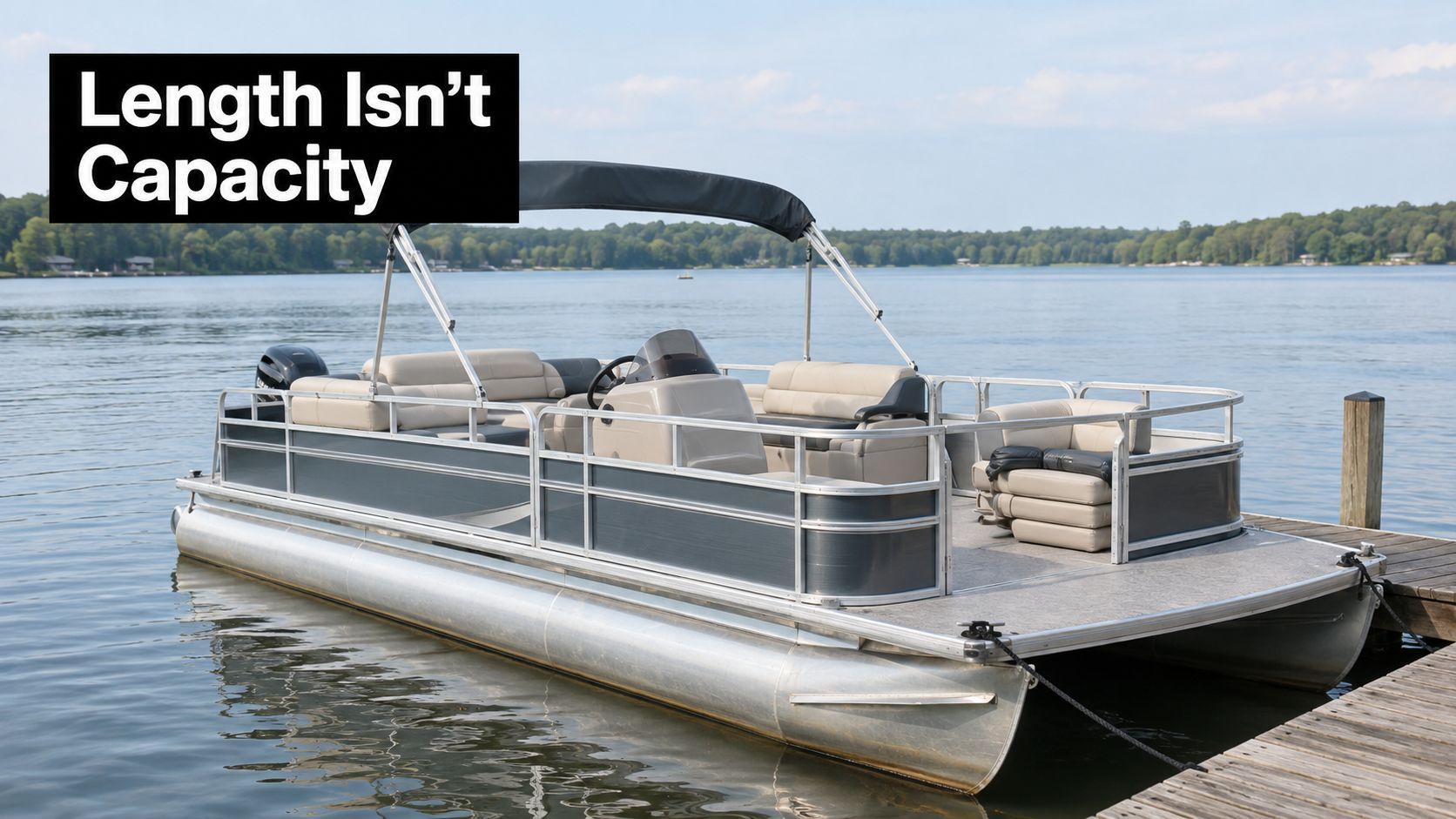
Compare the plate, not the headcount
Ratings diverge because beam, tube diameter, construction, engine rating, and seating layout all feed the calculation. A headcount quoted for some other 16-foot boat can never substitute for the plate bolted to the one you're boarding.
| Real 16-foot pontoon capacity ratings | Passenger count | Maximum load | Maximum engine |
|---|---|---|---|
| South Bay 16-foot pontoon | 6 | 915 lb passengers and gear | 40 hp |
| Legend 16 Fun (2024) | 6 | 840 lb | Not stated |
Treat the manufacturer's plate and manual as the final authority. An advertised passenger count won't tell you whether everyone gets a comfortable seat, where bulky equipment will ride, or how much load remains once the cooler is full. For a swim-and-lounge day, plan around the active-day load rather than the ceiling, and you'll enjoy the roomiest version of the boat. Read the plate first; size the guest list second.
How 16 Pontoons Are Built and What Their Specs Mean
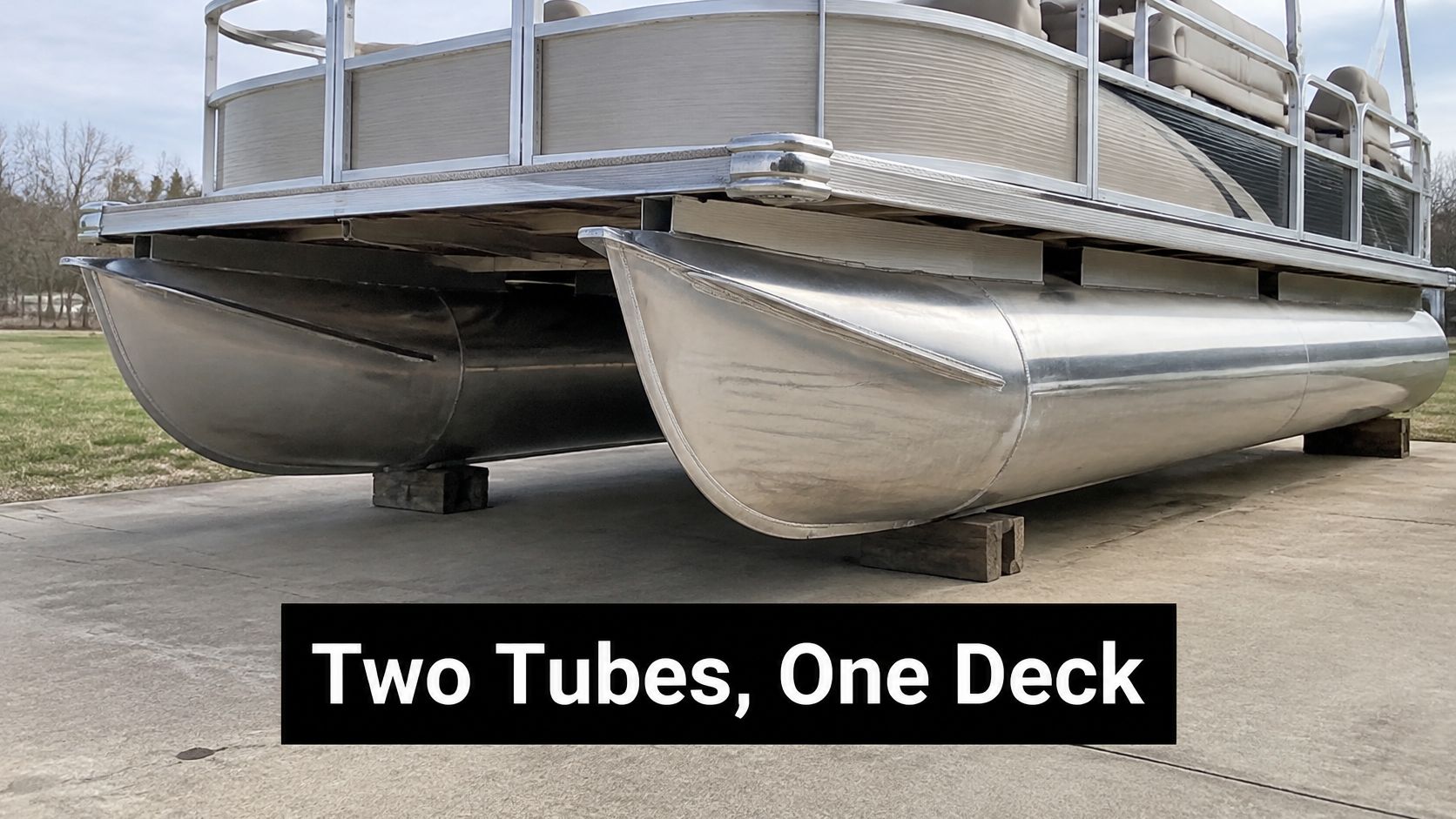
Two long floats supporting one deck explain the pontoon's roomy feel: buoyancy sits along the boat's length rather than inside one conventional hull. Early Midwest builders used welded steel barrels beneath plywood decks, and aluminum pontoons gained attention after an all-aluminum boat appeared at the 1958 Chicago Boat Show, offering a lighter alternative that resisted rust, as Chesapeake Bay Magazine's history of pontoon boats recounts.
Modern compact pontoons keep that twin-tube layout and add features such as molded seating, an outboard mount, navigation equipment, and engineered capacity ratings. Tube diameter matters because it affects buoyant volume. When comparing models, look at the whole build, not one headline specification: a wider beam or extra tube can add deck room and buoyancy, while added structure and equipment also add dry weight.
Read the spec sheet as a set
The table compares the published details for three 16-foot models. A blank means the figure isn't stated in the listing, not that the boat has no such specification. Ask for missing details before comparing layouts or making a purchase decision.
| Key specifications of 16-foot pontoon models | Length | Beam | Dry weight | Engine or fuel |
|---|---|---|---|---|
| South Bay 16-foot pontoon | 16 ft | 102 in | 1,405 lb | Up to 40 hp |
| Montego Bay C8516 DLX (2024) | 16 ft | Not stated | 1,325 lb | 40 hp Mercury |
| Berkshire SE 16 (2025) | 16.33 ft | 8 ft | Not stated | Not stated |
| Legend 16 Fun (2024) | Not stated | Not stated | Not stated | 20 U.S. gallons, fuel |
The South Bay dimensions come from its published model listing; Viking Marine's 2024 Montego Bay listing gives its weight and engine, while Boatzon's 2025 Berkshire SE 16 listing gives its length and beam. The table's Legend fuel figure is listed by Legend Boats in its specifications above.
Length and beam describe the deck's footprint. Dry weight helps you understand how much weight the boat itself uses before passengers and gear are aboard. Engine rating sets the maximum permitted horsepower, not a shortcut to more carrying capacity. More powerful engines can add weight, so don't assume a bigger motor means more payload.
For a broader size comparison, see our 18-foot pontoon guide. A model with more deck space may suit a different kind of outing, but the right choice still depends on its own plate, equipment, and intended use.
Safe Capacity Limits Before You Load a Group
Three numbers decide whether a group day goes well, and the capacity plate only gives you one of them. The legal maximum, the load that cruises comfortably, and the smaller group that stays safe once swimming and boarding begin are different figures. Blurring them together is how 16-footers get into trouble.
Start with the plate. A 16-foot boat falls into U.S. Coast Guard Class 1, covering vessels from 16 feet to under 26 feet, and boats at least 16 feet long must also carry at least one throwable Type IV flotation device alongside the required wearable life jackets, per the North Dakota boating regulations summary of federal requirements. The plate lists two limits, a maximum person count and a maximum total weight, and the lower one always wins. Total weight means everything aboard: passengers, engine, fuel, coolers, water toys, and equipment.
Exceeding either limit reduces freeboard and stability. Piling passengers on one side or crowding the stern makes the boat list, and a single wake rolling through at the wrong moment can turn a list into swamping.
Use the formula only as a rough estimate
For a boat with no capacity plate, a common rule of thumb puts the estimate at maximum persons = boat length × beam ÷ 15, assuming 150-pound occupants. A 16-footer with an 8-foot beam works out to 16 × 8 ÷ 15, roughly 8 people. Run the same math with a 102-inch beam (8.5 feet) and you get about 9.
| Rough rule-of-thumb estimate for a 16-foot boat without a capacity plate | Length | Beam | Estimated persons |
|---|---|---|---|
| Example with 8-foot beam | 16 ft | 8 ft | 8, rough estimate only |
| Example with 102-inch beam | 16 ft | 8.5 ft | 9, rough estimate only |
The formula ignores hull displacement and volume, so it can overstate what a lightly built deck carries well. If a plate is present, the plate wins. If the plate is missing, get the figure from the manufacturer rather than treating the estimate as permission to load up.
A useful planning distinction: the legal maximum, a comfortable seated-cruising load, and a safe active load for swimming and boarding are three different numbers.
Here is how I apply those three numbers in practice. Take the plate's total-weight limit, subtract the passengers' combined weight, then account for coolers, toys, batteries, and gear. What remains is your margin, and I keep that margin honest rather than planning right to the ceiling. The cruising load is the count where everyone has a real seat and nobody is perched on a rail. The active load is smaller still, because swimming and boarding move weight around dynamically. One person hauling themselves over the deck edge loads a corner hard, and two people climbing aboard at once is a very different stability problem than two people sitting still.
A lightly loaded 16-footer beats a crowded one with the same plate rating. More freeboard, less list, quicker response to the wheel, and a deck where guests can actually relax. Spread passengers across the deck instead of stacking them at the stern, and in Texas, make sure children younger than 13 wear a U.S. Coast Guard-approved PFD while underway, with properly fitted jackets ready for everyone, as Texas Parks and Wildlife's boating safety guidance explains. For the on-water rules that apply once you leave the dock, see our Lake Travis boating rules guide.
Family, Party and Lake Travis Outings Done Right
A calm morning cove, a family picnic on deck, a small birthday group sharing snacks and music: those are the kinds of outings where a 16-footer can shine. It suits a small group looking to cruise, relax, and enjoy the water without managing a large vessel. A bigger celebration, more seating, extra shade, or substantial party gear may call for a longer deck or a double-deck boat instead.
Local conditions matter just as much as the boat's size. After the July 2025 floods, Lake Travis authorities warned boaters about submerged debris, damaged navigational buoys, fast-moving flows, and high bacteria levels; shifting lake levels can also expose trees, drop-offs, and shallow areas, as described in the Lake Travis conditions overview. A compact pontoon may be a good match for calm-water cruising, but it offers less reserve for heavy chop, sudden weather, crowded waterways, or low visibility.
Make the day smooth and predictable
Keep a proper lookout, adjust speed to conditions, and avoid creating a hazardous wake. Head-on vessels keep right; an overtaking vessel may pass on either side but must give way. Stay at least 100 feet from a displayed diver-down flag, following Lake Travis boating rules. LCRA rules also govern speed on the Highland Lakes.
Before leaving, check the weather window, passenger mix, water conditions, launch setup, and towing vehicle. A trailer needs to support the boat's total loaded weight, maintain suitable tongue weight, and stay within the tow vehicle's capacity. If those pieces don't match, postpone or choose a different setup rather than forcing the plan.
When moving between water bodies, clean, drain, and dry the boat, trailer, and gear. Texas requires draining water, and possessing or transporting zebra mussels is illegal; the Texas Parks and Wildlife Lake Travis guidance covers those precautions and local operating rules.
One local detail can shape the itinerary: pontoon boats go to Hippy Hollow, but yachts do not. Check that your boat type fits the places your group wants to visit before setting the route.
Renting or Buying a 16 Pontoon Compared
Rent for an occasional group day; consider buying if you'll use the boat frequently and can handle the ownership routine. A rental suits visitors, a one-off birthday, or anyone who wants a lake outing without taking on a boat, trailer, storage, and upkeep. Buying gives you control over when and how you go, but it brings responsibilities that continue after the day on the water.
| Renting versus buying a 16-foot pontoon | Renting | Buying |
|---|---|---|
| Upfront cost | Pay per outing, no purchase price | A 2025 Berkshire SE 16 was listed at $29,950 |
| Trailer and tow vehicle | Not needed | Trailer must match loaded weight; vehicle needs sufficient towing capacity |
| Storage and maintenance | Handled by the provider | Owner's responsibility |
| Capacity control | Follows the legal maximum set by inspection | Owner plans loads within the capacity plate |
| Best fit | One-off parties, visitors, trying the lake | Frequent use and a committed calendar |
The listed price for the Berkshire is an example, not the full cost of ownership; it doesn't include any trailer or towing setup. Before buying, verify that the trailer supports the boat's total loaded weight and that its tongue weight and the vehicle's towing capacity suit the combination. Boatzon's listing for the 2025 Berkshire SE 16 gives the listed price.
For rentals, visible seating isn't the same as an approved passenger limit. Texas law prohibits a party boat from carrying more passengers than it can safely accommodate as determined by inspection, under Texas Parks and Wildlife Code Section 31.174. Confirm the posted limit and keep the guest list within it. Owners can choose their own outing and manage their own loading, but that freedom comes with responsibility for staying within the boat's rating.
If you're weighing ownership costs and priorities, this guide to finding the best pontoon boat for the money can help frame the decision. The simple rule holds: rent for a one-off group day; buy only if your calendar, storage, towing setup, and maintenance plan support frequent use.
Book Your Lake Travis Pontoon Day
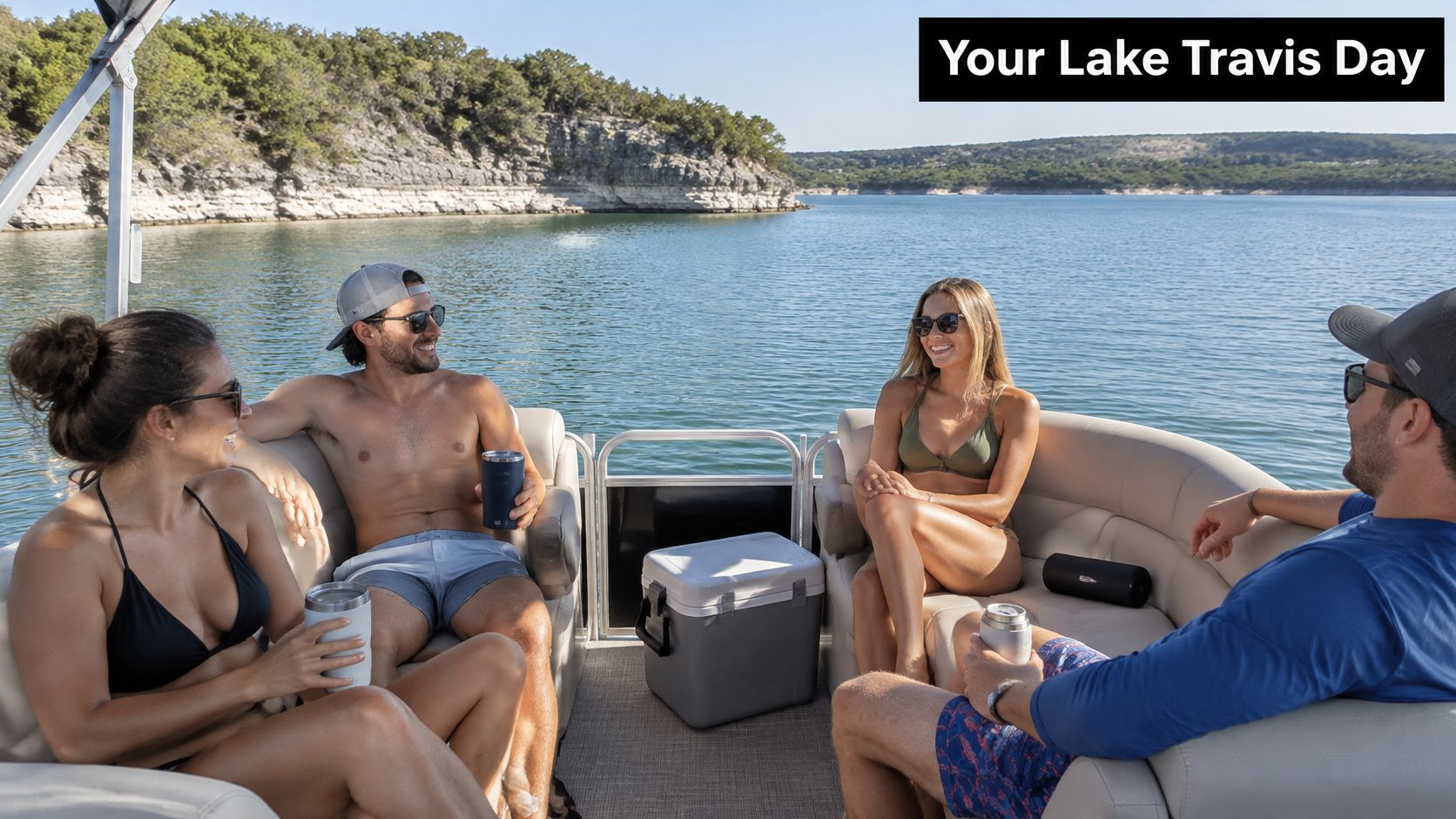
A calm cove, friends relaxing on deck, a cold cooler, and music over the stereo: that's the payoff of choosing a boat that fits your group and getting the details settled ahead of time. Start with the posted passenger count, then choose a boat type that matches the outing, whether that means a relaxed cruise or more room for swimming and celebration.
Booking online is straightforward:
- Click the red Check Availability and Pricing button.
- Choose Regular Pontoons, Double-deck Pontoons with Slides, or Luxury Yachts.
- Pick the specific boat that suits your group.
- Enter your passenger count and date, staying within the posted legal capacity.
Every boat comes with a captain, a 150-quart cooler, a lily pad, pool noodles, dry storage, and a Bluetooth stereo with LED speakers and a subwoofer. Rentals are listed for 3 to 8 hours. The service isn't intended for guests under 18. Adult life jackets are supplied, so families bringing children should bring properly fitted, child-sized Coast Guard-approved PFDs.
Choose a date, confirm the boat's capacity, and get your group ready for the lake. Booking this week gives you a chance to secure the date and boat type you want before you finalize the rest of your plans.
Make your Lake Travis outing easy to plan with a captained boat, a lily pad, noodles, dry storage, a cooler, and a Bluetooth stereo included. Visit Lake Travis Yacht Rentals to choose your boat, enter your group size, and book your day on the water.