The group chat is already louder than the lake. A birthday, a bachelor or bachelorette weekend, or a team afternoon is on the calendar, and the only idea everyone agrees on is a waterslide. You don't need another mood board. You need a pontoon with slide rental that fits the actual headcount, the swimmers who will be on board, and one written total you can send before anyone pays a deposit.
Treat the slide as a logistics decision. Posted capacity, flotation, the path from the car to the deck, and the full quote all get checked before the booking path. Do that this week, while the date is still open, and the party stops living in a thread.
What a Pontoon With Slide Rental Includes
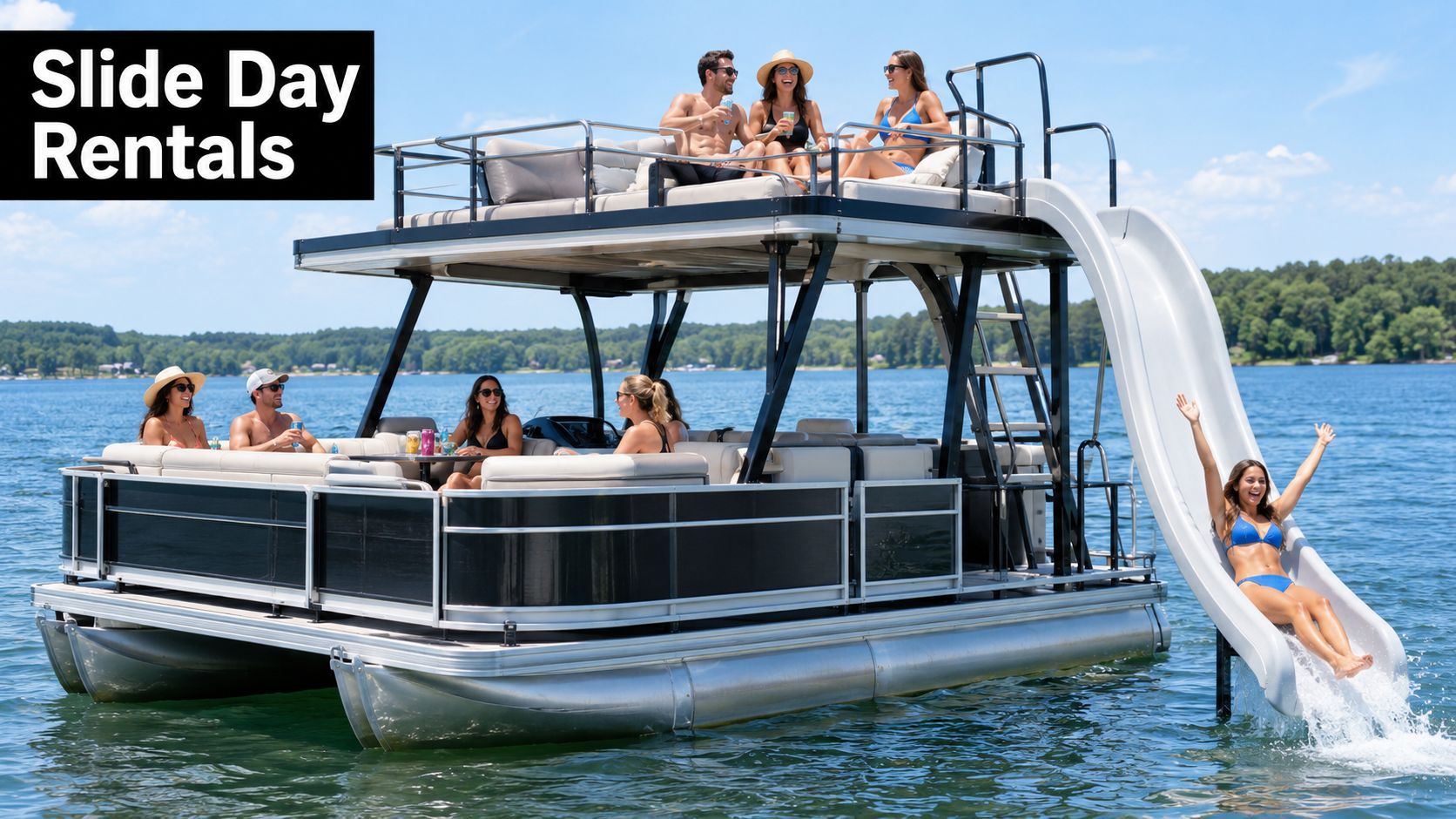
A pontoon with slide rental is a captained group boat with a rooftop or sun deck and a waterslide, used for birthdays, bachelor and bachelorette weekends, family outings, and corporate afternoons. A slide is not standard on every boat. Match the type to the reason for the trip before you chase a lower hourly rate.
Pontoon and party boat types compared
| Boat type | Typical group size | Slide and deck | Best fit |
|---|---|---|---|
| Regular pontoon | Smaller groups, roughly 6 to 12 guests | No slide | Relaxed cruise, swimming, lake lunch |
| Double-deck pontoon with slide | Mid-size groups, about 13 to 19 guests | Rooftop deck and waterslide | Birthdays, bachelor and bachelorette parties |
| Large party boat | Large groups, about 15 to 19 guests | Rooftop deck, slide on some models | Corporate events, big celebrations |
| Luxury yacht | Smaller premium groups | Usually no slide | Private, upscale outings |
What the listing still has to answer
On any listing, confirm posted capacity, deck height and how guests reach the slide, the sound system, cooler size, a lily pad or swim platform, a restroom, and whether a captain is included. If a line is missing, it is still an open question. Deck height? Slide access from the upper seats? Cooler big enough for the whole group? A photo of a slide is not a spec sheet.
We run the largest fleet of new and late-model yachts and pontoons on Lake Travis. High Tide is a 26-foot, 15-passenger customer favorite with a rooftop waterslide, and Islander is a 36-foot, 19-passenger boat with seating up top and two waterslides. A captain is on every charter. Pontoons can go to Hippy Hollow. Yachts do not. If that cove is the plan, the yacht is the wrong category even when it looks more polished.
Lake Travis is a working reservoir, not a theme park. It sits approximately 13 miles northwest of Austin in Travis County and extends into Burnet County. The Texas Water Development Board reservoir profile records that the Lower Colorado River Authority operates it for flood control, water supply, electrical power generation, and recreation. The U.S. Department of the Interior authorized a low dam at the former Marshall Ford crossing in December 1936. Marshall Ford Dam construction began in March 1937 and was completed in July 1939. Impoundment began in September 1940, the first power unit came online on January 27, 1941, and a larger concrete, earth, and rockfill dam was finished in May 1942. Recreation shares the lake with those other jobs, so weather and water conditions stay part of the day.
Practical rule: Pick the boat for the party first. A cheaper pontoon with no upper deck can ruin a slide-focused celebration before the first hour is billed.
Planning Capacity and Group Roles on Slide Day
The number on a listing is a legal capacity. The space you can use is smaller once coolers, floats, the slide structure, and people moving between decks are on board. If you book the posted maximum and then add a lily pad, a speaker, and a conga line to the ladder, the deck stops working.
Collect the actual group before you choose a boat. You need headcount, ages, swimming ability, mobility needs, and whether alcohol will be served. Match that list to the certified capacity, and leave margin. Split guests into alternating slide and swim groups. Set one captain-controlled boarding route. Write the emergency plan in plain language: man-overboard response, first aid, who calls, and the rule for heading back to the dock.
The Safe Boating Campaign facts page reports that 69% of reported deaths occurred on boats where the operator had no boating-safety instruction. That is why a captained charter, a pre-departure head count, and a deck check before every launch beat any vague claim about how often slide days "go fine."
Group scenarios and the plan that works
| Group | Main risk | Plan that works |
|---|---|---|
| Bachelorette party, 12 adults with mixed swim ability | Slide used while others swim | Two rotating groups and a sober adult liaison |
| Family birthday with toddlers and grandparents | Small children unsupervised on the upper deck | Keep young children on the lower deck and name one lookout |
| Corporate team-building, 20 mixed-age staff | Crowding at the slide and boarding gate | One boarding route and staggered slide turns |
| Kids party with non-swimmers | Water entry without a fitted jacket | Jackets fitted before anyone leaves the deck |
Who watches what
The captain runs the boat. A captain cannot watch the slide, the swim platform, and the traffic at the same time. Texas Parks and Wildlife safety tips say to have a passenger serve as a lookout in addition to the operator, and to carry extra personal flotation devices in both adult and child sizes. Name that lookout before you leave the marina. Name a sober adult liaison who answers guest questions and steps in early when drinking gets sloppy.
A 16-foot pontoon is a different day from a double-deck slide boat. Don't stretch a small hull around a 20-person staff outing because the photo looked roomy.
Don't count on slide-specific success rates. Count people, split the activity, and refuse to depart with an unresolved weather or mechanical issue.
Safety Gear and Flotation Rules You Must Know
Texas law is the baseline, not a suggestion you discover at the ramp. Under the Texas Parks and Wildlife Code on life preserving devices, every motorboat, including one carrying passengers for hire, must carry at least one U.S. Coast Guard-approved wearable personal flotation device for every person aboard, placed so it is readily accessible. On a vessel under 26 feet that is underway, including while drifting, every passenger younger than 13 must wear a wearable life jacket. A life belt or ring buoy does not satisfy that rule. A vessel 16 feet or longer also needs at least one immediately accessible Type IV throwable device.
Texas flotation requirements by situation
| Situation | Requirement | Why it matters |
|---|---|---|
| Every person aboard a motorboat | At least one Coast Guard-approved wearable PFD, readily accessible | Sets the per-person equipment count |
| Child under 13 on a vessel under 26 ft, underway or drifting | Must wear a wearable life jacket | A life belt or ring buoy does not count |
| Vessel 16 ft or longer | At least one immediately accessible Type IV throwable device | Required in addition to wearable PFDs |
| Guest entering the water | Properly fitted, fully fastened life jacket | The jacket is on before anyone leaves the deck |
The risk you are actually managing
The U.S. Coast Guard's 2024 recreational boating statistics verified 3,887 recreational-boating incidents involving 556 deaths. Drowning caused approximately three-quarters of boating deaths, and alcohol was the leading known contributing factor in fatal incidents, accounting for 20% of fatalities. Those figures are not slide-specific. They are the reason a mixed-experience group should be on a captained boat, in fitted jackets, with a sober plan.
Fit every jacket before the boat leaves the dock. Confirm child sizes in advance, because an adult jacket on a small kid is the wrong tool. Keep people clear of the propeller and the swim platform while the engine runs. The slide is a supervised activity, and the lookout is assigned to it, not chatting at the cooler.
Jetskis are banned. If anyone in the party shows up with a jetski rental, the charter ends immediately. Tell the group that before they book a side toy "for later."
Ask the operator which alcohol or conduct rules can end the trip early, and get that answer in writing. Ask how the captain runs the safety briefing, whether it happens on every trip, where the throwable device is stored, and what triggers a return to the dock. Our boats carry life jackets for adults, so child sizes still need to be requested before the day. Read the fuller life jacket requirements and then confirm the count against your guest list.
Accessibility and Who Can Use the Slide
An accessible boat and an accessible experience are different things. A vessel can take a guest aboard while the dock, the restroom, or the water entry still blocks them. The U.S. Access Board boating facilities guide says accessible boating facilities should provide an accessible route connecting buildings, slips, boarding piers, and other required elements. A wide deck photo does not answer that.
Walk the route before you promise anyone a seat
Go in order, and ask a yes or no at every stop.
- Parking area: Where do you stop, and how far is the walk with a wheelchair or a tired grandparent?
- Route to the dock: Is it paved, gated, or a slope that changes after rain?
- Gangway: What is the slope, and is a ramp or lift available?
- Boat gate: What is the gate width, and is there transfer help at the step-up?
- Restroom: What are the dimensions, and is it on the boat or back at the marina?
- Seating: Where can a wheelchair be stored, and is there a shaded lower-deck seat with a view of the slide?
- Water entry: Can that guest stay comfortably onboard while others swim?
The slide is optional. Guests who can't use it should not be parked out of the party. Give them shade, a drink within reach, and a clear view of the action. Don't promise universal access. Ask for specific answers, and get them in writing before the day so nobody discovers a barrier at the gangway.
Send a short note with each guest's needs: "Wheelchair user, can transfer with one helper. Needs lower-deck seating, no slide. Please confirm gate width, gangway, restroom, storage, and whether they can stay aboard during swim time." A yes or no on each line is the reply you want.
If the marina path fails, the boat's wide deck never gets a chance to matter.
Pricing, Add-Ons and When to Book
Price moves with boat size and capacity, rental length, day of week and season, add-ons, and fees such as parking, marina entry, or a captain gratuity. A low hourly rate can hide a minimum block, a separate tip, or a toy that was never included. Read every line, then turn the quote into a per-guest, per-hour figure inside the 3 to 8 hour window each listed boat is rented for.
Cost drivers and the question to ask
| Cost driver | How it changes the quote | Question to ask |
|---|---|---|
| Boat size and capacity | Larger boats cost more per hour | Does the quote cover my full guest count? |
| Rental length | Charters often bill in minimum blocks | What is the minimum block and the overtime rate? |
| Day and season | Weekends and holidays cost more and sell out | Is there a holiday or peak-season surcharge? |
| Add-ons | Each extra adds a line item | Which items are included at no extra cost? |
| Fees and gratuity | Parking, marina or captain tips may be separate | Is every fee in the final total? |
| Cancellation and weather | Refund rules vary widely | Is a weather cancellation refunded, moved or charged? |
Timing and the weather trap
Summer weekends, spring break, and holiday weekends such as July 4 fill first. Book several weeks ahead and hold a backup date. A weekday morning is usually the calmer lake and the easier quote. Find out whether a weather cancellation is refunded, moved, or charged, and who makes that call. If the operator won't write it down, you don't have a policy. You have a hope.
Parking and marina entry with us is completely free, so a quote that adds a lot fee is not our quote. Still put that in the written total so the group isn't arguing about a gate charge on the way in. See how to book in advance before peak dates disappear.
The test I use is simple. One number covers every fee. That number names the exact guest count. You know what happens if someone is added on the day, because overtime and extra passengers are priced before you pay the deposit. Compare that single total with the other boats, not the teaser hourly rate.
Book Your Slide Day Step by Step
Run this in order. Skip a step and you will pay to discover it at the dock.
- Count the whole group. Include children, non-swimmers, and anyone with mobility needs. Pick the boat type that covers every guest with room to spare, not the hull that matches the listing photo.
- Lock a date and a block. Choose a half-day or a full day. Weekday first if you want a calmer lake. Check wind and storms before you fall in love with a sunset slot.
- Demand the inclusion list in writing. Captain, lily pad, noodles, cooler size, and life jackets in adult and child sizes. If it isn't on the list, it isn't included.
- Write the slide rules. Who may use it, any weight or height limit, and a hard stop: nobody slides while the boat is moving.
- Send the access questions. One yes or no for parking path, gangway, gate, transfer help, restroom, storage, and a lower-deck seat. The slide stays optional.
- Read cancellation and weather terms before any deposit. You want one total with every fee inside it, plus the rule if the headcount grows on the day.
- Name the people. Lookout, sober adult liaison, and a guest list with jacket sizes so the right jackets are at the dock, not in a bin you sort while the clock runs.
Why the jackets are part of the booking, not a footnote
The CDC's summer swim safety guidance reports that approximately 85% of people who drowned while boating in 2022 were not wearing a life jacket. Children and adults are best protected on open water by a properly fitted, U.S. Coast Guard-approved jacket that is fully fastened. Tell guests their sizes ahead of time. Kids wear child-sized jackets, not adult ones. Anyone who slides or swims stays in that jacket.
Book it on the site today
On our site, click the red Check Availability and Pricing button. Choose a boat type: Luxury Yachts, Double-deck Pontoons with Slides, or Regular Pontoons. Then pick the specific boat, the passenger count, and the date.
If every step above has a written answer, book the slot now. Open summer dates do not wait for a second poll in the group chat. If any answer is still open, hold a backup date and keep asking until the total, the capacity, and the slide rules are on one page.
Lake Travis Yacht Rentals charters captained party boats and double-deck pontoons with waterslides on Lake Travis for the birthdays, bachelor and bachelorette weekends, family days, and corporate afternoons you're already planning. Bring the headcount, the jacket sizes, and the questions, and leave with one written total instead of a surprise at the dock. Visit Lake Travis Yacht Rentals and check availability before that Saturday gets claimed.