Stop shopping for the lowest sticker. That's the fastest way to overpay for a pontoon day. The best pontoon boat for the money isn't the cheapest hull in an ad; it's the package that still feels good with your guests, coolers, and gear aboard, on the lake you use, as often as you'll go. Price it loaded, price it for a full season, and be honest about whether you want to own a boat at all or just want the day.
Why the Cheapest Pontoon Rarely Wins
You're standing on a dock with two numbers in your head. One is a quoted purchase price that looks like a steal. The other is what a great day costs when the boat's full, the wind picks up across open water, and everybody's looking at you to get them home comfortably. Those two numbers rarely match, and the gap is where regret lives.
An advertised hull price is rarely the contract price. Engine size, trailer, furniture upgrades, electronics, and delivery all move the final figure, and they move it before you've bought a single gallon of fuel. A boat that looked like the bargain of the lot can close thousands higher once it's equipped to leave the dock the way you pictured it.
The Underpowered Boat Tax
The cruelest version of cheap is an underpowered boat. It runs fine with two people on a calm morning. Load it with friends, drinks, and swim gear, add a headwind on the ride back, and you're pushing a small engine hard just to hold a modest pace. You didn't save money. You bought a slower, louder, less relaxing version of the day you wanted.
Price only counts after capacity, power, safety gear, and how often the boat will actually leave the dock are in the same picture.
That's the test to carry through every quote you get. Capacity means the people you'll really bring, not a brochure maximum you'll never use well. Power means performance when loaded, not empty. Safety gear means what's aboard on day one, not what you'll get around to buying.
Two honest paths come out of that test. Path one is buying a properly supported pontoon sized for your real season, with an engine matched to your load. Path two is skipping ownership entirely and booking a captained party pontoon for the days that matter. Neither is a consolation prize. The right one depends on your calendar.
If you're a bachelor or bachelorette host, a birthday planner, a corporate coordinator, a family organizing a reunion, or an Austin visitor with one free Saturday, your definition of value is different from a retiree who fishes three mornings a week. Any guide that crowns one universal winner for all of you isn't advising you. It's ranking boats. You'll get situational picks here, including the moments when renting beats owning outright, because a boat you use twice a year is an expensive way to store fiberglass and vinyl.
What Real Pontoon Value Looks Like
Pontoons now dominate new outboard boat sales in the United States, and that scale pays you back directly. A category this big means dealer access, replacement parts, accessories, financing options, and a deep pool of future buyers when you sell. An obscure budget brand can leave you stranded waiting on parts or explaining an unknown name to every prospective buyer.
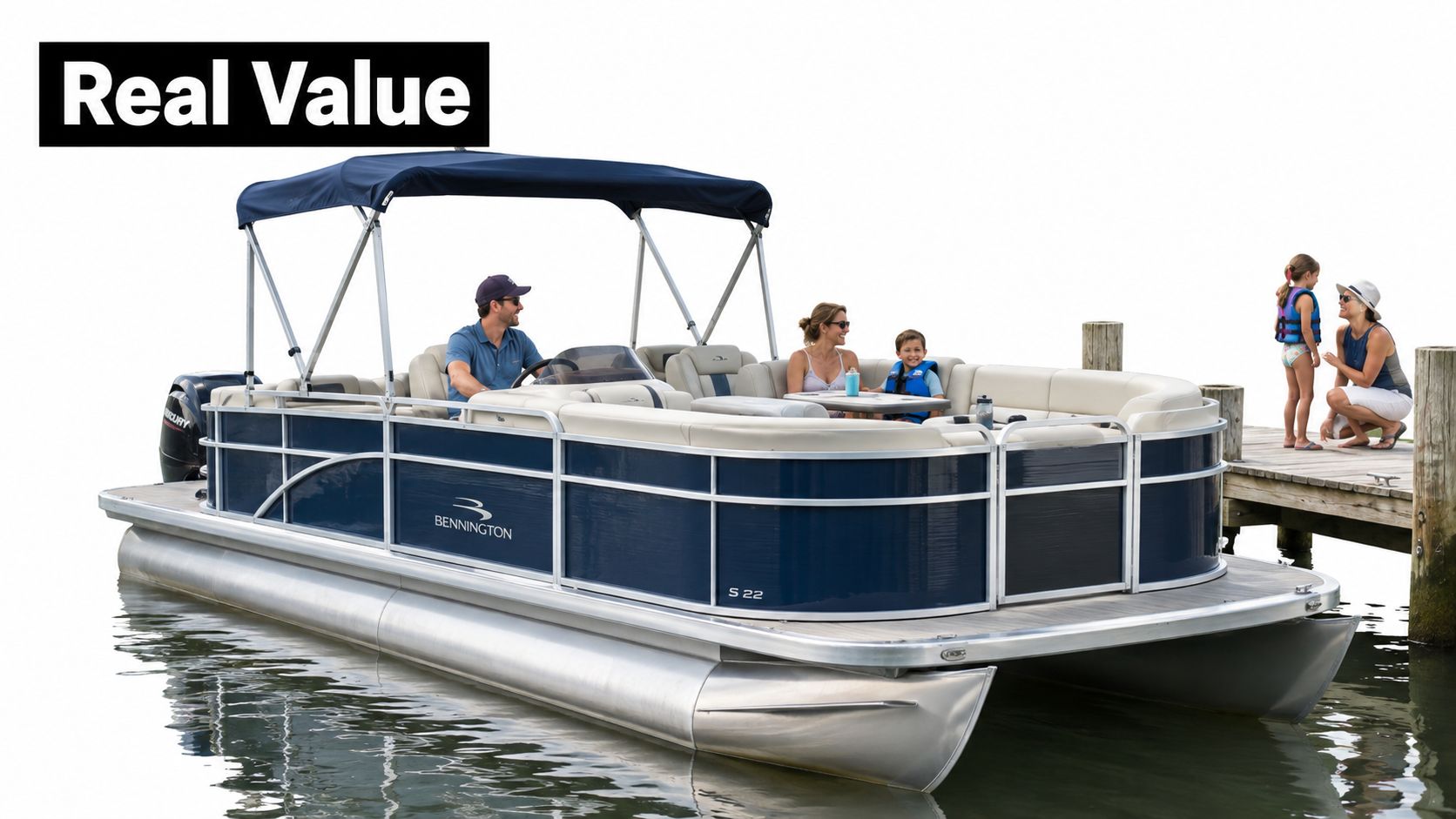
That last point carries real money. Resale demand is part of what a boat costs you across the years you own it, and two pontoons at the same sticker price can end up far apart the day you list them. Buy into the segment buyers shop, and you keep more of your money at both ends of ownership.
A Category That Has Held Up
The staying power shows in the longer arc. Retail sales of aluminum powerboats, primarily fishing and pontoon boats, rose in 2011 to 77,150 units, up 4 percent per an NMMA report on industry sales. Demand then surged through the pandemic years and held firm after the frenzy cooled. Categories that survive both slow years and boom years tend to support their owners better.
Why do buyers keep choosing them? Wide, flat decks. Families get room to spread out, anglers get a stable casting platform, swimmers get an easy climb back aboard, and groups get a floating patio. Usable space is the product, and speed is secondary for most pontoon owners.
Run Your Own Cost-Per-Day Math
Here is the concrete version of value. Take the purchase price, add a realistic first year of ownership costs, and divide by the days the boat will leave the dock. That cost per day is your real number, and it punishes both extremes. A stripped-down hull that sits unused loses just as surely as an oversized tritoon you never fill.
Three tests sharpen that math before you compare tiers:
- Warranty coverage: What's covered, for how long, and who honors it near you?
- Dealer proximity: Can you get service without trailering hours each way?
- Resale demand: Will the next buyer recognize and want this boat?
A cheap pontoon that fails on service or resale isn't cheap. And if your season is a handful of big group outings rather than weekly use, run the same math against a captained party boat rental before you sign anything. Chartering the days that matter can put you on the water for less than owning a boat that mostly sits.
Comparing Budget Mid-Range and Premium Pontoons
Start at the budget end with a concrete benchmark, not a vague price range. The Sun Tracker Party Barge 20 DLX measures 20 feet, carries up to 10 passengers, takes a 60 to 90 hp Mercury outboard, and runs about 24 to 26 mph with the 90 hp engine, with a purchase target below approximately $36,000 per a Winnisquam Marine roundup of value pontoons. That's honest lake-cruising value built on standard equipment and moderate power. It is not a watersports machine, and you shouldn't buy it expecting tritoon acceleration.
Mid-Range Means Loaded Weight
Mid-range shopping should start with weight, not headcount. The practical sizing rule is roughly 40 to 50 hp per 1,000 pounds of fully loaded displacement, counting boat, fuel, passengers, and gear, so a 22-foot pontoon near 4,000 pounds generally benefits from about 115 to 150 hp according to an independent pontoon buying guide on engine sizing. At the low end of that range you'll cruise normally. At the high end you've got reserve for a full guest list, a headwind, and towing a tube without straining.
If you're deciding between two engine sizes for the same hull and you regularly carry guests, buy the reserve power. You'll feel it every single trip.
Where Premium Money Actually Pays
Premium value lives in the third tube. Twin-tube pontoons are generally rated to no more than 225 hp, while some tritoons accept a single 400 hp outboard and exceed 60 mph, figures noted in the Winnisquam comparison above. Don't pay for that ceiling unless you'll use what comes with it, which is greater buoyancy, higher capacity, better loaded acceleration, and a more composed ride in chop. Top speed alone is the least useful reason to upgrade. A tritoon that planes easily with ten people aboard earns its price. One bought for a speedometer number doesn't.
Set a fourth option beside those tiers. A captained charter gives you the big deck, the power, and the gear for one specific day, with no storage, no maintenance, and no trailer. For buyers whose real need is a handful of group outings a year, that's not a rental compromise. It's the tier that fits.
Pontoon Value Tiers at a Glance
| Option | Power and pace | Best when | Money trap to avoid |
|---|---|---|---|
| Budget twin-tube | Modest outboard, relaxed cruising | Calm lakes, small families, slow days | A marginal engine that struggles loaded |
| Mid-range twin or tritoon | Stronger power with real reserve | Regular guests, bigger water, towing | Paying for seats you can't power properly |
| Premium tritoon | High horsepower, confident loaded pace | Watersports, rough water, frequent hosting | Buying top speed you'll rarely use |
| Captained charter | Captain handles power and boat | Parties, reunions, visiting groups | Owning a boat for two outings a year |
Reject any quote that pairs a big passenger rating with a small engine and calls it a deal. That combination is the budget trap in its purest form.
What a Pontoon Costs After the Sale
The sticker is the down payment on a season, not the season's cost. Ownership estimates suggest the purchase price may represent only 60 to 70 percent of first-year costs, with insurance at roughly 1 to 2 percent of boat value annually, dry storage commonly $800 to $2,000 per year, and routine maintenance about $800 to $1,500, per a breakdown of pontoon purchase timing and ownership expenses. None of those line items show up in a dealer's headline ad.
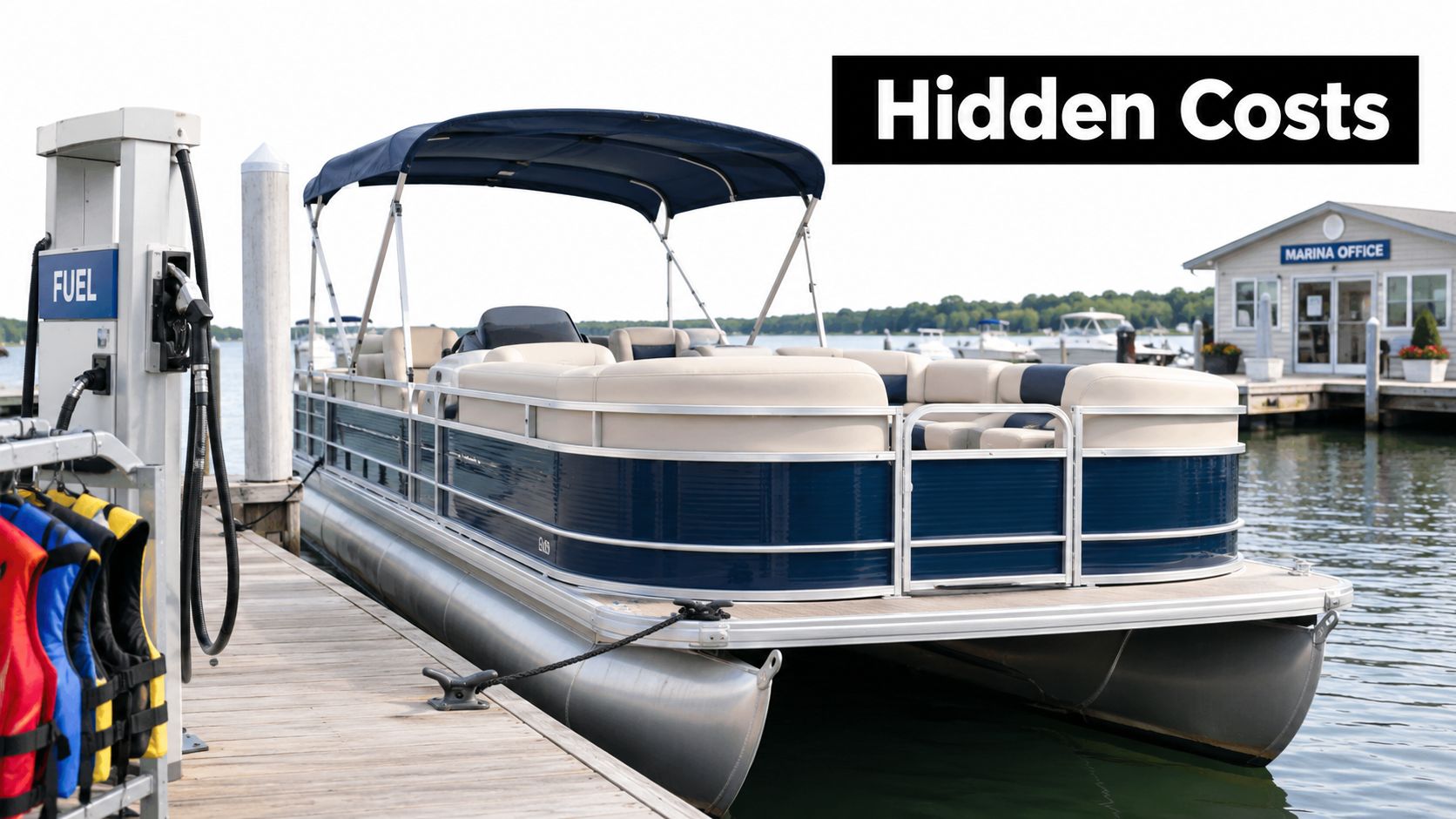
Fuel is the variable that humbles people. Active use may consume 200 to 300 gallons per season, and a 115 hp pontoon running 60 hours at 7 gallons per hour could use about 420 gallons, roughly $1,890 at $4.50 per gallon, using the fuel model in that same ownership breakdown. An underpowered bargain doesn't dodge this bill. It can run harder for longer to move the same load, which is how a cheap engine gets expensive.
Four Ways a Season Adds Up
Run your own pattern before you rank boats:
- Family cruising: Moderate hours, moderate loads. Storage and maintenance dominate, fuel stays manageable, and a sensible mid-power package shines.
- Party weekends: Heavy loads and long idle-to-cove days. Reserve power and deck comfort matter more than shaving the purchase price.
- Fishing: Fewer passengers, earlier hours. A simpler boat kept close to home water can be economical.
- Occasional use: A few outings a year. Fixed costs get spread across so few days that renting usually wins on arithmetic alone.
If you want the fuller math before signing anything, work through a detailed look at what boat ownership really costs with your local storage and insurance quotes in hand.
Distance belongs in the spreadsheet too. A boat stored far from a dealer, or one that needs winterization and trailer storage you haven't priced, adds a cost every season. That's purchase economics colliding with experience economics, the part where shade, a good sound system, swim space, and a restroom aboard can matter more to your guests than another mile per hour. Sketch your full first year, line by line, before you call any pontoon the best for the money. The boat that wins that sketch is your answer, whatever the ad said.
Matching the Boat to the Lake Day
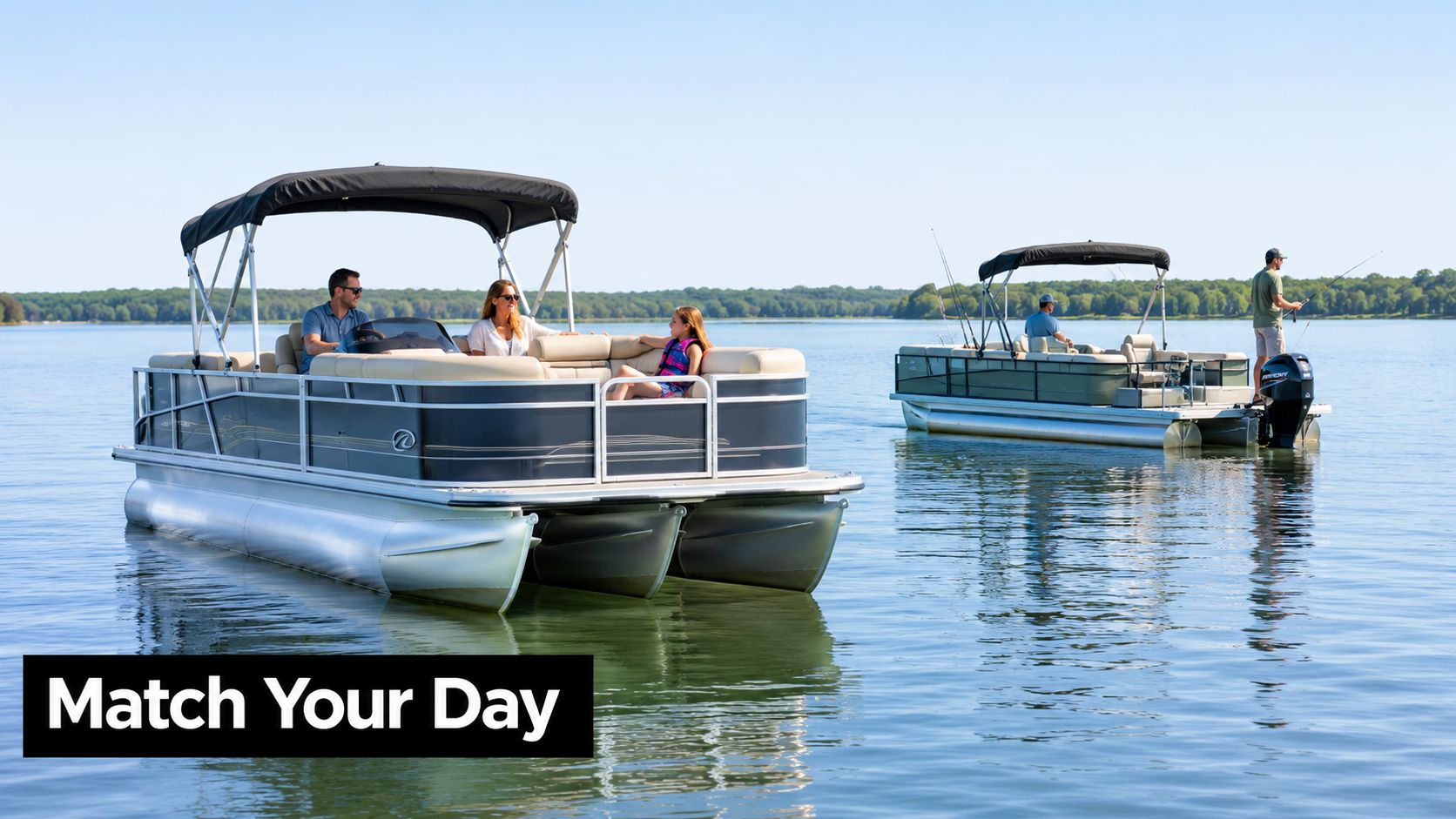
A quiet family cruise is the easiest day to equip. A moderate twin-tube with real shade, an easy swim step, and enough power to get home against the afternoon breeze will make everybody happy. You don't need a rooftop deck to watch your kids cannonball off the stern.
A fishing morning asks for even less drama. A stable deck, a sensible engine, and room to cast beat premium upholstery every time. A straightforward owned boat, kept ready near your home water, earns its keep across a whole season of small trips.
When the Day Is the Event
Birthdays, bachelor and bachelorette parties, and corporate outings flip the priorities. Now you're asking how many people can stand, talk, dance, and move around comfortably. You want music that carries, water toys in the water fast, a private restroom so nobody's strategizing around a marina stop, and somebody else driving so the host can attend the party.
That's the gap Lake Travis Yacht Rentals fills on Lake Travis in Austin, with more than 15 years on the lake and a fleet of new and late-model luxury yachts, double-deck party boats, and premium pontoons. Each vessel is fully captained and comes with Bluetooth stereos and subwoofers, private restrooms, lily pads, pool noodles, water toys, and large coolers, and many double-deckers add a rooftop party deck and waterslide. Captains are background-checked and drug-tested, reviews are public, and booking happens online. You bring the people and the playlist.
Lake Travis Rewards Planners
Local conditions argue for booking early. Texas Parks and Wildlife puts Lake Travis conservation pool at 681 feet above mean sea level with a high fluctuation range of 10 to 20 feet, per the agency's Lake Travis lake profile, so coves, shorelines, and access change across seasons. Confirming current conditions with your outfitter beats discovering them at the ramp. Austin's event calendar adds pressure, since a Formula One weekend was expected to push hotel occupancy to 92 to 95 percent with about $1 billion in projected economic impact according to KXAN reporting on Formula One weekend demand. Treat the boat like the hotel room. Reserve it before you arrive, not after.
Safety Equipment That Belongs in the Budget
Safety gear is part of the purchase price, and a comparison that ignores it rewards the dealer who quoted bare. The cheapest boat on your list often assumes you already own fitted life jackets, a charged fire extinguisher, an anchor, and a horn. First-time owners usually don't. Price the kit before you crown a winner.
Coast Guard accident reporting consistently puts open motorboats well ahead of pontoons in reported incidents, as noted earlier. Read that the right way. Incident totals reflect fleet size, weather, usage patterns, and operator behavior, and pontoons draw the group outings where overloaded decks and passengers riding the rails cause damage. The data doesn't crown one brand safer than another, and it doesn't excuse an under-equipped boat.
Budget for the Full Kit
Price these into any purchase from the start:
- Capacity plate compliance: Know your rated load and treat it as a hard limit. A dozen adults plus a cooler wall changes how a pontoon rides.
- Navigation lights and flotation: Working, current, and sized for your actual passengers.
- Railings and emergency equipment: Checked before the season, not during an emergency.
- Engine controls and operator training: The cheapest safety upgrade is a prepared driver.
A boat that needs immediate safety purchases to be legal and sensible isn't the bargain in the comparison. Add the kit to the quote, then compare.
The Texas Rule Every Host Should Know
On Texas recreational vessels under 26 feet that are underway, including drifting while not anchored, every child younger than 13 must wear a U.S. Coast Guard-approved life jacket, and adults must have a properly fitting jacket readily accessible, as spelled out in Texas Parks and Wildlife life jacket guidance. If you're gathering your own kit, a checklist of safety equipment needed on a boat is worth printing before the first trip.
Before anyone boards, ask one question out loud. Are there approved, correctly sized life jackets for every guest, and does the operator know this boat?
If the answer takes more than a few seconds, you're not ready to leave the dock.
Choose Ownership or Book the Party Boat
Own the boat when your calendar justifies it. If you'll be on the water most weekends, if storage is solved, and if you're willing to fund fuel, maintenance, and an engine with real reserve for your load, ownership pays you back in spontaneous Tuesday evenings and quiet mornings no rental calendar can match. Use the budget benchmark and loaded mid-range power target from the comparison above, buy from a supported brand with a dealer you can reach, and you'll own well.
Rent when the calendar says otherwise. A party, a reunion, a corporate day, or a visiting group that wants one perfect afternoon doesn't need a trailer, a winterization appointment, or a driving lesson. It needs a date, a headcount, and a boat that shows up ready.
Know What a Licensed Rental Guarantees
Texas draws a bright line here. Licensed rental businesses must provide required safety equipment, explain how to operate the vessel, review applicable boating laws, obtain the operator's signed acknowledgment, and carry liability insurance, according to Texas Parks and Wildlife guidance on vessel livery requirements. That's a documented standard, not a handshake on a borrowed boat. Verify it before you book anything.
From there the steps are simple. Match your guest count to a captained boat, confirm life jackets for everybody including the kids, ask about current lake conditions, and lock the date before Austin's event weekends eat the calendar. If you want to rent a pontoon boat on Lake Travis with the captain, stereo, restroom, and water toys already aboard, that's a few clicks, not a loan application.
The best pontoon boat for the money is the one matched to your real life. For frequent boaters, that's a correctly powered, well-supported purchase. For everyone planning the big day, it's the captained boat you book today while your date is still open, with the music up, the lily pad out, and somebody else at the helm. Don't spend another weekend comparing stickers. Spend it on the water.
Your crew deserves the loaded, ready-to-party version of this day, not a storage bill, so book a fully captained premium pontoon, double-deck party boat, or yacht with the stereo, restroom, and water toys already aboard. Pick your date now before prime Austin weekends fill up and reserve with Lake Travis Yacht Rentals.