You're organizing a lake day, the group chat is filling up, and someone suggests trying a kneeboard. It sounds fun until you start wondering which board to choose, how the towing works, and whether everyone needs to be athletic. Choose the whole riding setup, not just the board. A suitable kneeboard, a prepared boat team, and room to learn make a much better starting point than enthusiasm alone.
What Beginning Kneeboarding Involves
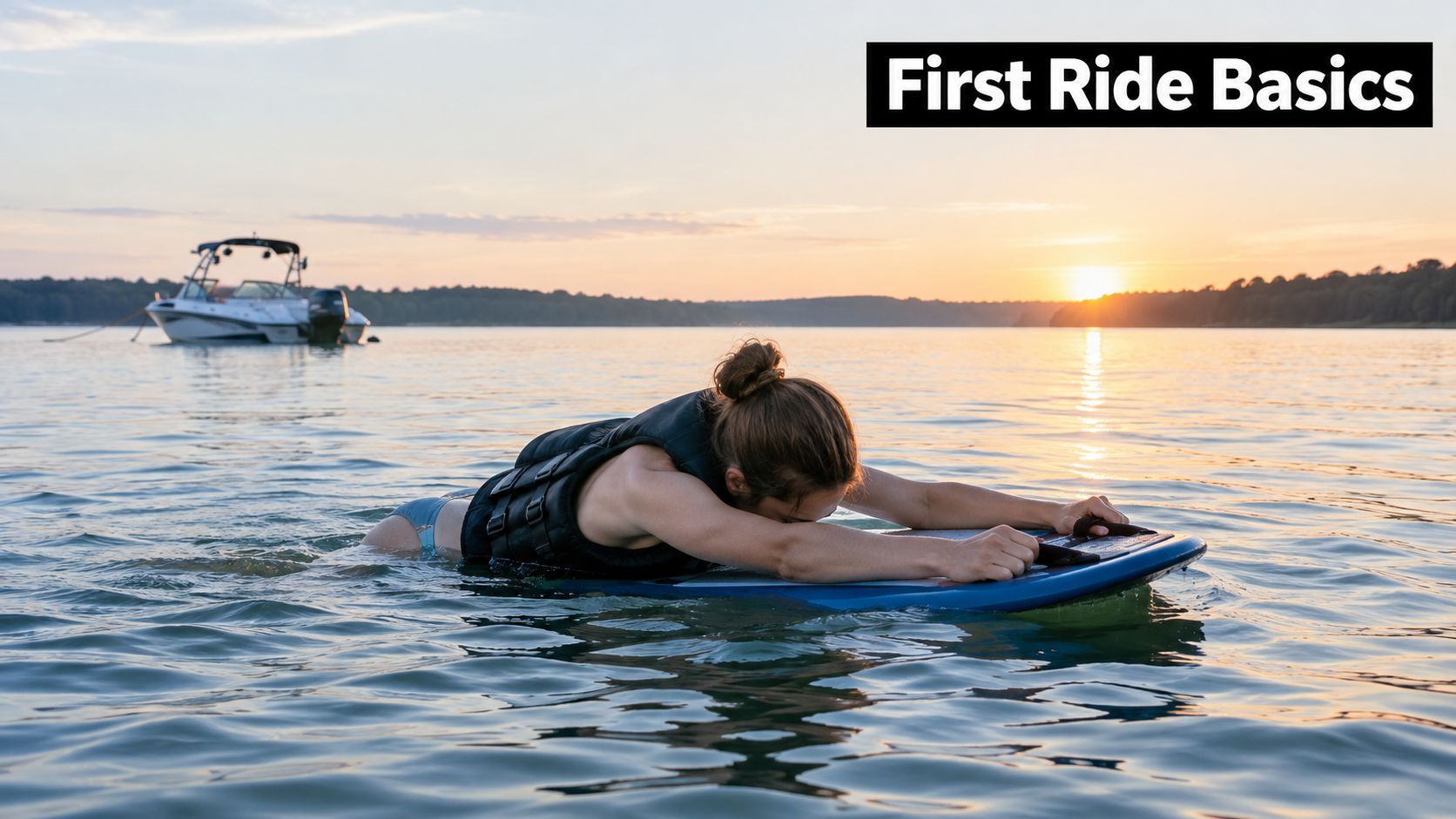
You walk toward the rental boat carrying towels, watching someone lower a board into the water. Your first question might be whether you're supposed to stand up. You aren't. A kneeboard rider stays kneeling on a buoyant board, with the lower body supported by its padded surface, while holding a handle connected to the towing boat.
The exciting part is moving across the water without needing to master a standing launch. The important part is letting the boat's controlled pull do the work rather than trying to muscle yourself upright.
Think of It as a Coordinated Tow
Your job is to maintain a compact position and communicate. The driver manages the boat, while the observer watches your ride. Nobody should be improvising those responsibilities once you're already floating behind the stern.
Preparation matters more than showing off. Your first successful ride can mean settling onto the board, traveling comfortably, and finishing when you choose.
A good beginner session leaves you eager for another attempt, not pressured into a harder one.
Kneeboarding became a distinct commercial tow sport in the early 1970s, with the Knee Ski introduced in 1972 and the activity becoming widespread by the middle of that decade, according to this historical account of kneeboarding). That background explains why you should choose purpose-built equipment rather than improvise with another type of board.
You don't need a trick list before getting started. You need equipment that fits, an agreed operating plan, and permission to progress at your own pace.
Choosing the Right Beginner Kneeboard
Start with a wide, soft-edged rotomolded kneeboard. Discover Boating's beginner guidance recommends that design for greater stability and smoother turning than a performance-oriented shape. For a first outing, those qualities deserve priority over aggressive handling.
Don't choose by graphics or promises about tricks. Check whether the rider can settle comfortably onto the padded area, reach the handle without awkward stretching, and understand how the board's features work.
Beginner Kneeboard Features Compared
| Board Feature | What a Beginner Needs | When It Matters | Trade-Off |
|---|---|---|---|
| Shape and edges | A wide platform with soft edges | Learning balance and gentle direction changes | Performance handling isn't the priority |
| Knee support | Comfortable padding that suits the rider | Settling into the riding position | A shared board may not suit everyone equally |
| Usable surface area | Space appropriate to the rider's body | Moving from the starting position onto the pad | Bigger isn't automatically a better fit |
| Handle connection | A setup the operator understands and checks | Preparing the tow | Extra features require explanation |
| Strap adjustment | Accessible adjustment suited to the learning stage | Progressing beyond initial practice | Fastening it isn't automatically appropriate |
| Visibility | Equipment the observer can readily identify | Monitoring starts and resets | Bright graphics can't replace attentive observation |
Treat those comparisons as inspection priorities, not promises that a feature will make the ride safe. Ask the equipment provider to confirm suitability for the intended rider and towing arrangement.
Fit the Person and the Outing
Rider size matters, but so do swimming confidence and willingness to try. A nervous adult shouldn't receive a more demanding setup because they're bigger than an enthusiastic teenager.
- For a quiet learning outing: Favor comfortable fit and an unhurried introduction.
- For a busy celebration: Be prepared to postpone towing rather than compensate with a different board.
- For a mixed-age group: Assess each rider individually instead of declaring the board suitable for everyone.
For example, brief an adult about their preferred pace and any discomfort before they enter the water. Ask a teenager to demonstrate the stop signal rather than assuming confidence means understanding. Give a child a simple explanation, involve their responsible adult, and make declining the ride an easy option.
The right beginner board is the one that suits the rider in the conditions available. If the conditions aren't appropriate, change the plan, not the safety standard.
Build a Safe Beginner Gear Checklist
Treat this as a boating activity with a rider behind the boat, not merely a balance exercise. In 2023, the U.S. Coast Guard recorded 3,844 recreational-boating accidents, 564 deaths, 2,126 injuries, and approximately $63 million in property damage, figures that are not kneeboard-specific, in its Recreational Boating Statistics report.
Those totals don't predict an individual kneeboarder's risk. They do justify taking the pre-ride routine seriously.
Start With Flotation That Suits Towing
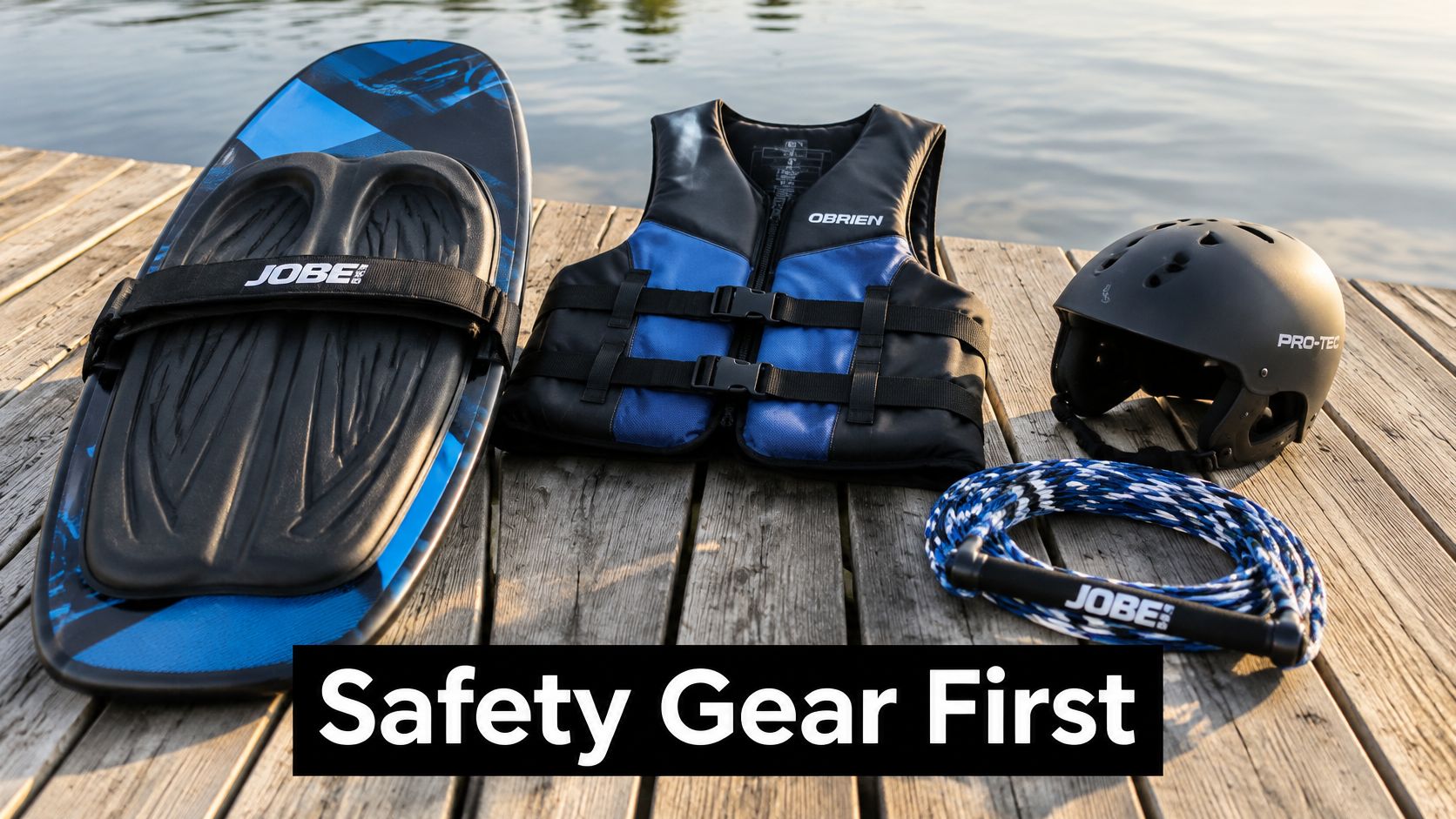
Wear a properly fitted, U.S. Coast Guard-approved life jacket labeled for tow sports. Texas Parks and Wildlife warns that some jackets aren't approved for towing activities and that inflatable personal flotation devices aren't suitable for tow-sport participants. Its life-jacket guidance also states that children younger than 13 must wear an approved, properly fitted jacket on recreational vessels under 26 feet while underway, including while drifting.
Don't assume the nearest vest is appropriate because it fits over someone's head. Read its label, check its fit, and resolve any uncertainty before departure. Review the life jacket requirements while organizing the group so guests know what needs checking.
Complete the Boat-Team Check
- Inspect the towing equipment: Use a dedicated kneeboard rope, examine the handle and line, and have the operator confirm the connection.
- Assign the driver: This person operates the vessel, assesses the route, and decides whether conditions permit towing.
- Designate a sober observer: Give that person an uninterrupted view and no competing hosting duties.
- Brief the rider: Confirm readiness, communication, and the planned finish before anyone enters the water.
- Organize passengers: Keep guests and loose belongings from interfering with the operator or observer.
The engine cut-off connection belongs in this routine too. Texas Parks and Wildlife's engine cut-off guidance states that operators of motorboats shorter than 26 feet must have the device attached to themselves, their clothing, or their life jacket when operating above idle speed.
Have the operator control the boarding and retrieval procedure, including reducing to idle before anyone enters or exits the water. Nobody should jump in because the rider appears ready.
Pre-ride standard: If anyone can't explain their role, pause the launch and finish the briefing.
A relaxed outing isn't an unstructured outing. Get these decisions settled early, and your group can enjoy the anticipation without sorting out responsibilities over engine noise.
Prepare the Boat and Waterway
A suitable board doesn't make a crowded cove suitable for towing. Before launching the rider, the driver and observer should agree on a route with clear water, room for predictable turns, and space for retrieval.
Look beyond the boat's immediate path. The rider can swing outward during a turn, so the driver must consider the whole towing area, not just whether the bow will clear an obstacle. Bart's beginner kneeboard guidance emphasizes awareness of surrounding traffic and clearance from shorelines, docks, swimmers, and other hazards.
Separate Departure From the Tow
Lake Travis guidance requires no-wake operation within 50 feet of marinas, docks, ramps, anchored boats, and swimmers, as explained in the lake's boating rules. No wake means moving slowly enough to produce no appreciable wake.
That boundary isn't a recommended towing distance. Leave congested departure areas behind and select an appropriate operating area before preparing the start.
- Agree on communication: The rider, observer, and driver should recognize the same readiness and stop signals.
- Begin conservatively: Use the lowest practical speed that maintains a tight rope and stable board.
- Wait for control: Increase pace only after the rider has settled and the conditions permit it.
- Keep movements predictable: Choose broad turns rather than sudden direction changes.
Keep the Party Away From the Controls
Consider a birthday outing with music playing, floating toys beside the boat, guests watching from the stern, and another group near the dock. That isn't the moment to start towing. Gather the toys, separate swimming from the tow activity, reduce distractions, and let the operator establish clear water.
An experienced captained operator can be particularly useful when the organizer is also hosting friends or supervising children. The captain should operate, not entertain while towing. Give the observer the same freedom from distraction.
The rider still needs a separate technique briefing, but the boat team should already know how it will respond to a stop or fall. If another vessel enters the route or spectators block the observer's view, stop the attempt and reset. Protecting that operating space is more important than keeping the activity moving.
Master Your First Kneeboard Ride
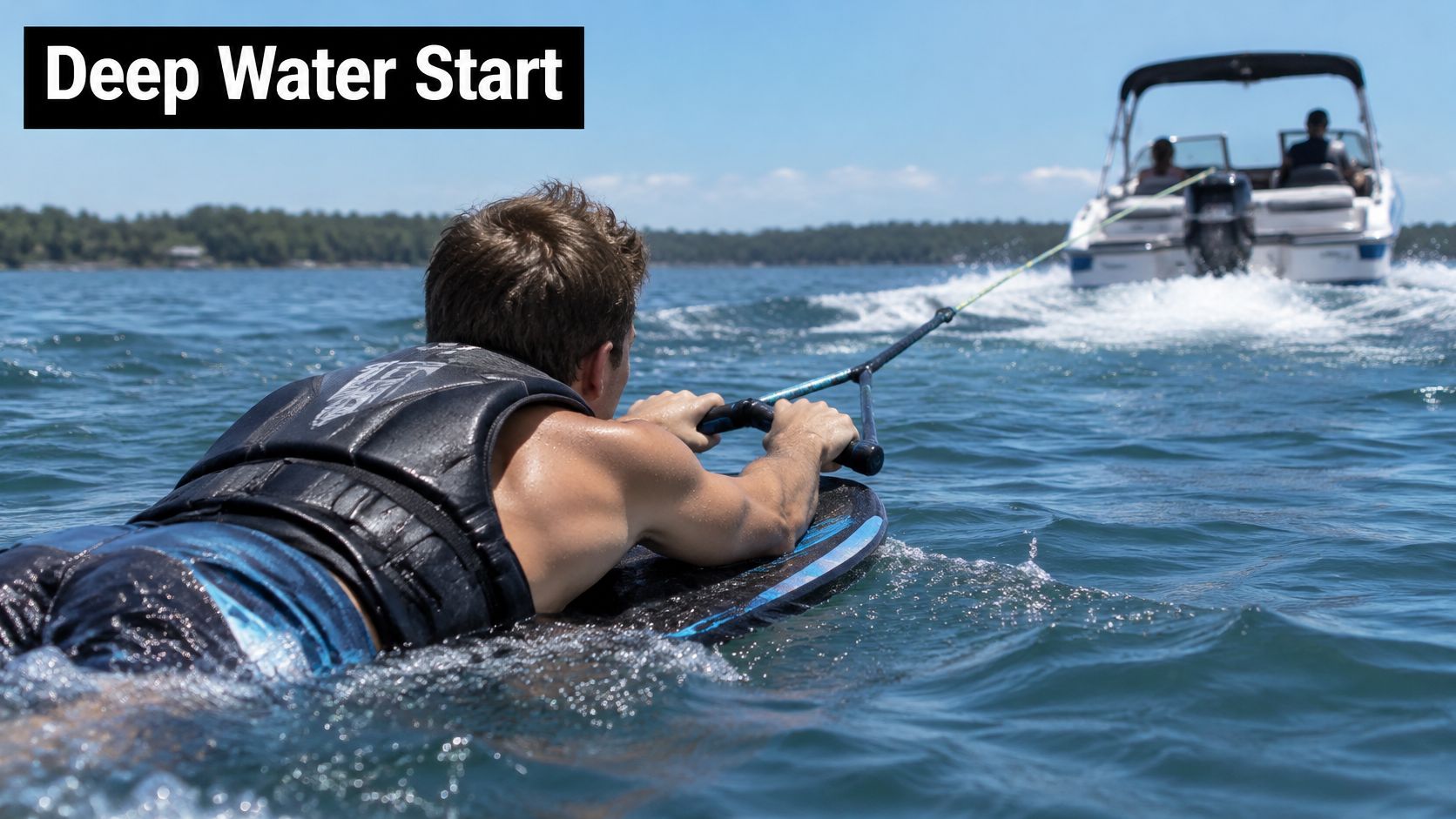
The instinct to kneel immediately is understandable. Resist it. Let the board rise onto plane before bringing your knees forward, rather than trying to force the riding position while the board is still pushing through the water.
Start stomach-down with your torso toward the board's front. Hold the tow handle with extended arms and let the boat take up the pull gradually. With the strap unfastened for initial practice, keep yourself free to separate from the board.
Let the Start Develop
As the board begins riding across the surface, draw your knees onto the padded area. Avoid lunging forward or trying to pull your body up with the handle. Settle your weight slightly rearward while finding a centered, low position.
Where the equipment's approved technique involves placing the arms beneath the strap, the hand transfer comes after the board is stable, moving a hand at a time above it. Don't interpret that sequence as permission to fasten a novice into the board. Follow the equipment's instructions and the supervised strap progression described below.
Once settled, bring the handle near your hips and keep your elbows responsive rather than locked. LCRA's Highland Lakes safety guidance supports controlled towing, clear communication, and releasing the handle when balance is lost.
Ride at a Learning Pace
Common beginner references place introductory speed around 10–15 mph and kneeboard-specific rope length at roughly 60–70 feet, as summarized in the waterskiing review and beginner guidance. Treat those as reference ranges, not automatic settings: rider size, water conditions, visibility, and actual control govern the tow.
- Hold a straight line first: Stay compact and let the boat team maintain a predictable pull.
- Steer through small weight shifts: Apply gradual pressure toward the side you want to travel.
- Avoid handle jerks: Abrupt pulling isn't a substitute for balanced positioning.
- Use rearward pressure cautiously: A modest shift can help stabilize the board, but request a slower tow when needed.
Don't chase a wobble with increasingly large movements. If you can't regain a comfortable position, release the handle and let the operator carry out the retrieval plan. A reset is a useful part of learning, not a failed outing.
If your group is comparing activities, tubing on a pontoon boat is another planning option. Don't assume the same vessel, equipment, or operating arrangements apply to kneeboarding. Confirm the activity you intend to do before booking.
Handle the Strap and Avoid Beginner Mistakes
A new rider gets onto the pad and immediately asks someone to tighten the strap. It feels like the obvious way to become more secure. For an inexperienced rider, that isn't automatically the right next step.
Published beginner-board guidance reflects conflicting advice: some recommendations favor a snug strap for stability, while a kneeboard manual warns that inexperienced riders and small children shouldn't use it. Equipment-specific warnings take priority over a general tutorial.
Earn the Next Stage
My recommendation is to begin with starts and falls without fastening the strap. Introduce strap use only when the rider can control the board, communicate, release the handle, and follow the equipment's instructions under direct supervision.
Fit isn't universal. A loose strap may offer little support, while an overly tight strap can restrict movement or cause discomfort. Don't ask someone to tolerate a poor fit just to keep the session moving.
More attachment isn't the same as more safety. Prioritize flotation, supervision, and an uncomplicated exit.
Diagnose the Attempt, Not the Person
Suppose an adult repeatedly tips forward during the transition. Don't label them uncoordinated. Check whether they're rushing to kneel or pulling sharply against the handle.
- Kneeling too early: Return to a patient start and wait for the board to plane.
- Riding too high: Rehearse the compact position before another attempt.
- Turning abruptly: Remove turning from the next pass and restore straight-line control.
- Feeling overpowered: Ask the driver to reassess the tow rather than urging the rider to hang on.
- Holding on after balance goes: Practice the decision to release, not a desperate recovery.
A confident teenager may need permission to slow down. A cautious child may prefer watching before participating. Both are reasonable choices, and neither should be rushed by spectators.
Praise specific decisions: a clear stop signal, a calm release, or an honest request to rest. Those are signs of a rider learning control.
Practice Drills and Book Your First Lake Ride
Plan for small successes, not a compulsory milestone. Some guests will enjoy practicing their position and making a short attempt. Others may be ready for a gentle direction change. Nobody needs to reach the same stage during the outing.
Begin with a posture rehearsal while the boat is stationary and the operator approves the location. Without towing tension, practice bringing the hands near the hips and staying compact. The point is familiarity, not a strength test.
Give Each Attempt a Clear Purpose
- Posture rehearsal: The rider can describe and comfortably demonstrate the intended position.
- Straight-line practice: The driver uses the lightest practical acceleration, and the rider concentrates only on settling.
- Gentle direction change: Add a small steering movement only after straight travel feels manageable.
- Planned finish: The rider communicates the stop, then follows the agreed procedure.
- Calm reset: After a fall, the observer maintains attention while the operator manages retrieval.
Stop while the group is still enjoying the process. A relaxed reset, a drink of water, and encouragement from friends can be a better choice than another immediate attempt.
Book the Experience You Actually Want
For a family gathering or celebration, a captained rental may suit organizers who don't want to divide their attention between hosting and operating. But a captained yacht booking isn't automatically a kneeboarding booking. Confirm towing permission, vessel suitability, equipment arrangements, and any instruction needs before paying.
Use the water sports rentals information to begin that conversation. Give the booking team a clear description of your group and the activity you hope to include.
Your ready-to-book checklist should cover:
- Rider fit: Appropriate board and tow-sport flotation for each participant.
- Equipment arrangements: Rope, approved connections, and who supplies and checks everything.
- People and communication: Rider briefing, observer assignment, readiness signal, and stop plan.
- Conditions and space: Weather review, suitable water, and an operator-approved towing area.
- Alternative plans: An enjoyable lake outing if towing isn't available or conditions don't cooperate.
For a birthday group with adults, teenagers, and children, that might mean reserving a captained outing first and arranging a separately confirmed kneeboard session where suitable. Get those details settled before arrival, then look forward to a lake day built around enjoyment rather than last-minute guesswork.
Lake Travis Yacht Rentals offers fully captained vessels and easy online booking for birthdays, family gatherings, bachelor and bachelorette parties, and corporate events. Visit Lake Travis Yacht Rentals today to choose your celebration outing, confirm whether your intended kneeboarding arrangements can be accommodated, and reserve your Lake Travis experience with clear expectations.