
You're standing on a Lake Travis yacht with your favorite playlist queued, drinks chilling, and friends already moving toward the dance floor. The first bass hit arrives. Instead of a muddy thump that swallows the vocals, you feel a clean pulse through the deck, the kick drum stays distinct, and the whole boat seems to move with the music.
That moment is the difference subwoofer sound quality makes. Great bass doesn't play louder. It gives a party rhythm, weight, and excitement without turning every song into the same blurry rumble. On an open deck, that balance matters even more because the boat, the water, the wind, the speakers, and the guests all become part of the listening experience.

By the end of this guide, you'll know what clean bass sounds like, why a giant driver isn't automatically the answer, and how placement, crossover settings, and calibration shape the party. You'll also understand what to listen for when choosing a boat rental, so you can spend less time fighting the sound system and more time enjoying Austin's lake experience.
What Subwoofer Sound Quality Really Means
A subwoofer handles the low-frequency foundation of music. You may not always identify each low note as a separate sound, but you feel its effect in a kick drum, a bass guitar, a synth line, or the deep impact of a movie soundtrack. Good subwoofer sound quality makes those elements feel present and energetic while leaving room for vocals, guitars, keyboards, and percussion.
Think about the difference between a drummer striking a kick drum in a well-controlled room and the same strike echoing around an empty garage. The first sound has shape. You hear the initial hit and the controlled decay that follows. The second sound hangs around, overlaps the next beat, and makes the rhythm feel slow even when the song itself isn't.
Extension is only the beginning
Bass extension describes how low a system can play. Deeper bass can add weight, but depth alone doesn't guarantee musical bass. If the response rises and falls dramatically across the low range, one note may dominate while another almost disappears.
A well-tuned subwoofer can hold roughly plus or minus 2 decibels from 18 to 200 hertz, a practical example of controlled response rather than exaggerated one-note bass, according to Sound On Sound's speaker specification guidance. You don't need to memorize that range to enjoy a party. The listening test is simpler: bass should support the song instead of announcing the subwoofer on every beat.
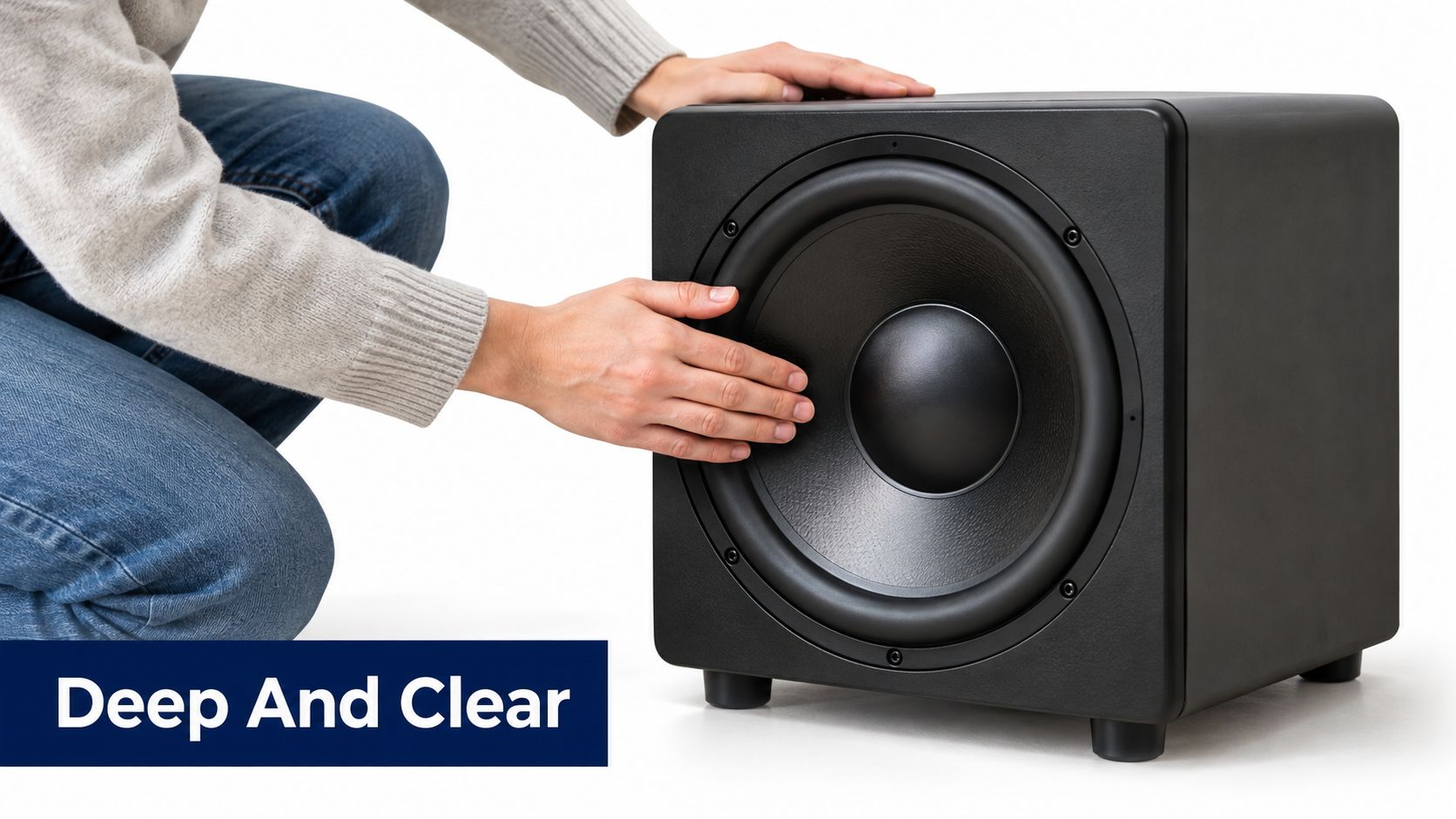
Power should create ease, not strain
Power gives a subwoofer headroom. That means it can reproduce peaks without working so hard that the driver, amplifier, or enclosure starts to sound stressed. A powerful system at a sensible level often sounds cleaner than a smaller system pushed to its limit.
Enclosure design also shapes the result. The cabinet controls how the driver moves and how efficiently it produces low notes. A sealed design may emphasize controlled movement, while a ported design can use its tuned opening to produce more output in a selected range. Neither approach wins automatically. The boat, the available space, the amplifier, and the desired listening level all matter.
Good bass also has to connect with the main speakers. If the subwoofer takes over too much of the low-midrange region, the music can feel hollow above it. If it's set too low, the party loses body. Integration is the test, and the best system sounds like one coordinated arrangement rather than a speaker plus a separate box.
Key Factors That Shape Bass Performance
A subwoofer's published wattage catches attention, but it doesn't tell the whole story. Clean performance comes from several parts working together. The following factors help you separate useful information from impressive-looking marketing language.
Frequency response and flatness
Frequency response shows how evenly the system reproduces different low notes. A flatter response generally produces more consistent bass across different songs. If the response has a large peak, every track may seem to contain the same heavy thump, even when the recording has a more varied bass line.
Measurement guidance treats frequency response, phase response, and group delay as core specifications because each one affects how the bass behaves, not just how much of it you hear. A controlled response gives a DJ or host more freedom to change playlists without constantly correcting the system.
Amplifier power and headroom
Power matters when the music gets energetic and the deck fills with people. A subwoofer with useful headroom can handle kick drums and bass drops without audible distress. That doesn't mean you should choose the largest amplifier available. Extra capacity only helps if the enclosure, driver, power supply, and tuning can use it properly.
Practical rule: More output is valuable when it preserves composure. It isn't automatically valuable when it only makes distortion louder.
Enclosure design
The cabinet controls the driver's behavior. A sealed enclosure often prioritizes a smooth, controlled response, while a ported enclosure can deliver strong efficiency around its tuning region. Bandpass designs use internal chambers and openings to focus output into a narrower range.
On a boat, enclosure decisions also affect footprint, power draw, mounting, and protection from the elements. A technically impressive cabinet that occupies the wrong part of the deck may create a worse party experience than a smaller model positioned and tuned properly.
Crossover and phase
The crossover decides which frequencies go to the subwoofer and which remain with the main speakers. A sensible setting creates a handoff that sounds continuous. A poor setting can leave a hole between the sub and satellites, or make both systems compete in the same region.
Phase alignment helps the speakers' sound waves arrive together. If the subwoofer and main speakers work against each other at the listening position, the bass may become thin even though both components are operating.
Group delay
Group delay describes how the timing of different frequencies changes through the system. In subwoofer systems, it can rise to 20 to 100 milliseconds around 30 hertz, and lower-frequency cutoffs produce higher delay, according to ProSoundWeb's practical exploration of subwoofer group delay.
Room acoustics and listening context can mask some delay, but excessive delay may smear transients and make it harder for the subwoofer to blend with satellite speakers. Placement and crossover choices can reduce that problem.
Distortion and artifacts
Distortion appears when the driver, amplifier, enclosure, or signal chain can't reproduce the requested waveform cleanly. At a party, distortion often sounds like blur. The bass loses pitch, vocals become harder to follow, and the entire mix feels tiring.
The strongest choice is usually the system that stays composed at the level you want, not the one with the most dramatic maximum-output claim.
Sealed Versus Ported and Other Enclosure Choices
The sealed-versus-ported debate sounds like it should have one clear winner. It doesn't. Each enclosure type makes a different tradeoff between control, efficiency, size, and maximum output, and a boat adds practical limits that a living room doesn't.
A sealed cabinet traps air behind the driver, giving the cone a form of pneumatic control. Many listeners associate that behavior with tight, natural bass. A ported cabinet uses a tuned opening to reinforce output in a chosen region, which can create stronger bass from the available amplifier power. The result may feel more forceful, especially for dance music, but the design needs careful tuning.
Bandpass cabinets place the driver inside one or more chambers and release sound through a port. They can produce strong output over a targeted band, though their focused behavior may offer less flexibility across varied music. For a boat party that moves from pop to hip-hop to country and electronic tracks, the broader system design matters more than the enclosure label alone.
Enclosure Type and Party Bass Tradeoffs
| Enclosure Type | Bass Character | Best For On a Boat |
|---|---|---|
| Sealed | Controlled, smooth, and often easy to blend | Hosts who value musical detail and a compact, predictable setup |
| Ported | Efficient, energetic, and capable of strong output around its tuning | Dance-heavy playlists and open-deck energy |
| Bandpass | Focused and forceful within a tuned range | Systems designed around a specific output goal and installation |
| Integrated marine subwoofer | Purpose-built for its stereo and mounting environment | Guests who want a coordinated system without managing separate components |
For open-deck use, space and tuning can matter more than theoretical extension. A subwoofer has to fit securely, work with the boat's amplifier and speakers, and deliver even energy where guests stand. Lake Travis Yacht Rentals lists vessels with high-powered Bluetooth stereos and subwoofers, including systems described with JL Audio or Infinity speakers paired with 10-inch or 12-inch subwoofers, depending on the vessel. The practical advantage is that the audio equipment is part of the boat setup rather than an improvised addition taking over the deck.
The right question isn't “Which enclosure is superior?” Ask instead, “Which design is tuned for this boat, this space, and this kind of celebration?”
Placement, Tuning, and Calibration for Clean Bass
A powerful subwoofer can sound weak or messy in the wrong position. On a boat, shifting it even a short distance changes how low-frequency energy reaches the seating area, swim platform, and dance space. Placement is part of the sound design, not merely a storage decision. The deck acts like a moving listening environment, so the goal is even, controlled bass rather than maximum output from one spot.
Start with the physical position
Aim the subwoofer toward the main activity area, keeping seats, coolers, and structural features from blocking its output. Avoid placing it deep in a corner, where nearby surfaces can make certain notes pile up. Keep the enclosure stable and protected from water beyond its intended marine rating.
Use a familiar track with a steady bass line. Walk through the areas where guests will gather, including the edges of the dance space. Bass that feels huge in one location and vanishes a few steps away points to a placement problem before it points to a power problem.
Set the crossover and level
Begin with the subwoofer level turned down. Raise it gradually until the bass supports the main speakers without becoming the loudest element in every song. A well-balanced setting may seem modest during a quiet passage, then feel full when the rhythm arrives.
Set the crossover where the subwoofer covers the lowest range while the main speakers retain vocals and instruments. If the handoff sounds hollow, make a small crossover adjustment. If the result becomes thick or boomy, reduce the overlap or lower the subwoofer level. The transition should resemble two musicians passing a melody cleanly, not competing for the same notes.
Align phase and use DSP carefully
Phase controls can improve the timing relationship between the subwoofer and satellite speakers at the primary listening area. Change one setting at a time and replay the same musical passage, so you can hear what helped. If app-based DSP or parametric EQ is available, use narrow cuts to reduce obvious peaks instead of boosting every weak spot. Boosting can consume amplifier headroom without fixing uneven coverage across the deck.
Professional setup can still help an open-deck system. If you would rather skip the tuning process, this Bluetooth speaker boat setup guide explains how a pre-configured onboard system can handle placement and calibration. Before departure, ask about the boat's controls, including which adjustment changes volume and which changes balance, so the party playlist stays consistent.
How Room Acoustics and Open Air Change Everything
A living room gives bass walls, corners, floors, and ceilings to bounce from. A yacht deck gives it open air, hard surfaces, railings, seating, movement, and changing wind conditions. That difference explains why a subwoofer that sounds overwhelming indoors may feel balanced outside, while a system that seems perfect in a showroom may need adjustment once guests spread across the boat.
Inside a room, standing waves can create strong peaks and deep nulls. A listening position near one part of the room may receive far more bass than another. In low-frequency localization research, direction judgment was negatively affected by the minimum-pressure node of a standing wave, while another setup maintained strong left-to-right discrimination down to 25 hertz, as discussed in research on low-frequency auditory localization.
Open air removes some problems and adds others
The absence of enclosing walls can reduce room reinforcement, so the system may need enough clean output to feel full across the deck. At the same time, you don't want to solve that challenge by turning the level up until the nearest guests feel overwhelmed.
Wind, boat orientation, seating arrangements, and guest movement all change the experience. One person near the subwoofer may hear powerful bass, while someone farther away hears a lighter balance. This is why even coverage matters more than making one favorite spot thunder.
Low-frequency sound also isn't automatically non-directional. An auditory localization study found that listeners could detect directional changes as small as 10 degrees for pink-noise bursts at 31.5 hertz and pure tones at 63.5 hertz, according to the Aalto University auditory localization study. That finding reinforces a useful boat-party lesson: subwoofer placement can affect not only impact, but also whether the system feels integrated with the rest of the stereo image.
A professionally equipped and captained vessel can take much of this work off your plate. A Bluetooth audio boat setup lets you focus on your guests while the onboard system, placement, and controls support the open-deck environment.
Bring Your Playlist to Life on Lake Travis
You don't need to become an audio engineer to recognize great bass. Listen for a kick drum that starts cleanly, a bass line that remains tuneful, and vocals that stay easy to follow when the music gets energetic. That combination creates excitement without the fatigue of a system that shouts the same low note through every track.
A quality boat stereo should make your playlist feel larger, not more complicated. Your guests should notice the rhythm, the movement, and the atmosphere. They shouldn't spend the afternoon asking why the bass is booming beside one seat and missing beside another.
The boat itself becomes part of the celebration. Friends can move between the shaded seating, open deck, swim platform, and upper level while the music keeps its momentum. Add floating equipment and other boat fun accessories to turn a playlist and a swim day into a full Lake Travis outing.
Peak weekends and popular celebration dates can disappear from the calendar well ahead of departure. The global boat rental market is projected to grow from USD 18.41 billion in 2025 to USD 19.46 billion in 2026, reaching USD 25.65 billion by 2031, with a projected 5.68% CAGR from 2026 to 2031, according to Mordor Intelligence's boat rental market outlook. Charter booking data also shows that about three-quarters of charters were reserved four to twelve months before departure, with six to nine months the most common lead time, as reported in Boataround's yacht charter trends.
Short-term rentals lasting one to fourteen days account for 73.1% of the peer-to-peer boat rental market, while peak-season leisure rentals commonly last three to seven days, according to MarketIntelo's peer-to-peer boat rental report. For your celebration, that means securing the date, vessel, captain, and sound setup early can protect the experience you're planning.
Lake Travis Yacht Rentals offers captained luxury yachts, double-deck party boats, and premium pontoons with Bluetooth stereo systems, subwoofers, water toys, coolers, and private restrooms. Visit Lake Travis Yacht Rentals now to choose your boat, secure your celebration date, and bring your playlist to life with clean, energetic bass on the water.