Three days into the group chat, the plan has a date, a headcount, and one unresolved argument: which boat.
One friend wants a sundeck and a quiet cove where the swimming is easy. Another has already built a playlist for a rooftop deck. The sensible one wants to know what happens if it storms and who decides whether the boat leaves the dock at all.
Those three questions are the whole decision. Mood, then headcount, then weather. Get them in that order and the yot boat rental choice stops being a debate and becomes a checklist. Skip straight to the prettiest boat on the page and you'll spend the deposit explaining to eleven people why the waterslide isn't happening.
Yot Boat Rental Options at a Glance
Three boats can sit at the same marina and deliver three completely different days.
The luxury yacht is the private option. A sundeck for golden hour, an interior to escape the afternoon heat, a pace that stays calm when the guest list is small or half of it is a client roster. Right pick for a milestone birthday with a seated dinner, an anniversary, a proposal, or corporate hosting where the conversation is the whole point.
The double-deck party boat is built for the opposite brief. Rooftop deck, waterslide, a stereo loud enough to be the soundtrack instead of the background. Bachelor and bachelorette parties, big birthdays, reunions where nobody has seen each other in a year. You don't book this boat to cruise. You book it to be in the middle of something.
The pontoon is the boat you choose when the guest list spans three generations. One level, easy boarding, room to spread out, a pace that leaves space for actual conversation. Family outings, gentle birthdays, groups where somebody's grandmother and somebody's toddler are both on the manifest.
Across all three, one thing is standard rather than an upgrade. Crewed charters accounted for 80.3% of the global yacht-charter market by contract type in 2025, and vessels from 20 to 50 feet made up 62.7% of that market, according to Grand View Research. Captain-led is the norm, and mid-sized boats are the commercial core. Every rental in this category comes with a professional at the helm, so the decision isn't who drives. It's what kind of afternoon you're buying.
| Boat type | Best for | Feel on the water | Choose it when |
|---|---|---|---|
| Luxury yacht | Intimate celebrations and corporate hosting | Quiet, upscale cruising with a sundeck | Comfort and privacy matter most |
| Double-deck party boat | Bachelor and bachelorette parties, big birthdays | Music, rooftop energy and social fun | The group wants to party on the water |
| Pontoon | Family outings and relaxed groups | Open, easy-going and sociable | The pace should stay gentle and everyone can join in |
The mood test: describe the day in one sentence. If the sentence contains the word "rooftop," you're not booking a pontoon. If it contains "my mother-in-law," you probably are.
Pick the mood first. The boat follows. Then match it to the people in the group chat.
Season, Weather and Plans That Change
Summer is when Lake Travis does the thing everyone pictures: warm water, long afternoons, a swim platform crowded with people who refuse to get out.
Typical surface temperatures make the window obvious, per the lake's seasonal guide:
| Month | Typical surface temperature | Best fit for the group |
|---|---|---|
| May | 73°F | Cooler water suits cruising and light swimming |
| June | 83°F | Warm water suits swimming and water toys |
| July | 85°F | Peak warmth for floating and swim stops |
| August | 86°F | Hottest water for full aquatic days |
| September | 86°F | Still warm, strong for swimming |
| October | Noticeably cooler than September | Cooler swims, check conditions before booking |
July through September holds the warmest water on that list, which is exactly why those weeks go first. May and October are the sleeper months: easier dates, cooler water, quieter coves, and a lake that still looks like a postcard.
The Two-Outcome Rule
Almost every weather question a guest asks resolves into one of two outcomes, and confusing them leads to bad booking decisions.
Outcome one: the trip proceeds safely. Grey sky, passing shower, a bit of breeze. Boats run in rain constantly. Guests stay dry under a hardtop or get wet on purpose.
Outcome two: the itinerary or the swim stop changes. Lightning in the area, hard wind, floating debris, a lake level moving fast, or water that isn't safe to swim in. The boat may still leave the dock. The route, the cove, or the swimming probably won't survive the original plan.
In 2026, flooding on Lake Travis produced floating debris, submerged hazards, changing river flows, and temporary restrictions on recreational use between mile markers 27 and 37, and officials urged visitors to keep a contingency plan in place, CBS Austin reported. The same outlet noted the lake sitting 75% full ahead of a rainy Memorial Day weekend (CBS Austin). Conditions move quickly, and a call made on Wednesday can be wrong by Saturday morning.
Four questions settle where your booking stands, and each has an answer you should hear before paying.
- Will we still go if it rains? Usually yes. Rain alone rarely stops a trip.
- Who decides whether the boat departs? The captain. That is the practical reality of running a vessel with a group aboard.
- Can the captain change the route? Yes. A cove gets crowded, wind picks up, debris drifts into a channel, and the plan adjusts.
- What happens if the lake is temporarily restricted? Ask how those days get handled before you pay, and get the answer in writing.
Ask before you book: how and when will you tell us if the captain changes the plan? A text the night before beats a sign on the dock.
Reliability means knowing who makes the call and how quickly you'll hear about it. Get that pinned down, and a shifting forecast stops being a reason to panic.
How to Match a Boat to Your Group
Seven decisions settle the boat choice. Run them in order and you book once instead of second-guessing.
The dock is where the plan either works or gets interesting, so start with a crew that knows what to expect.
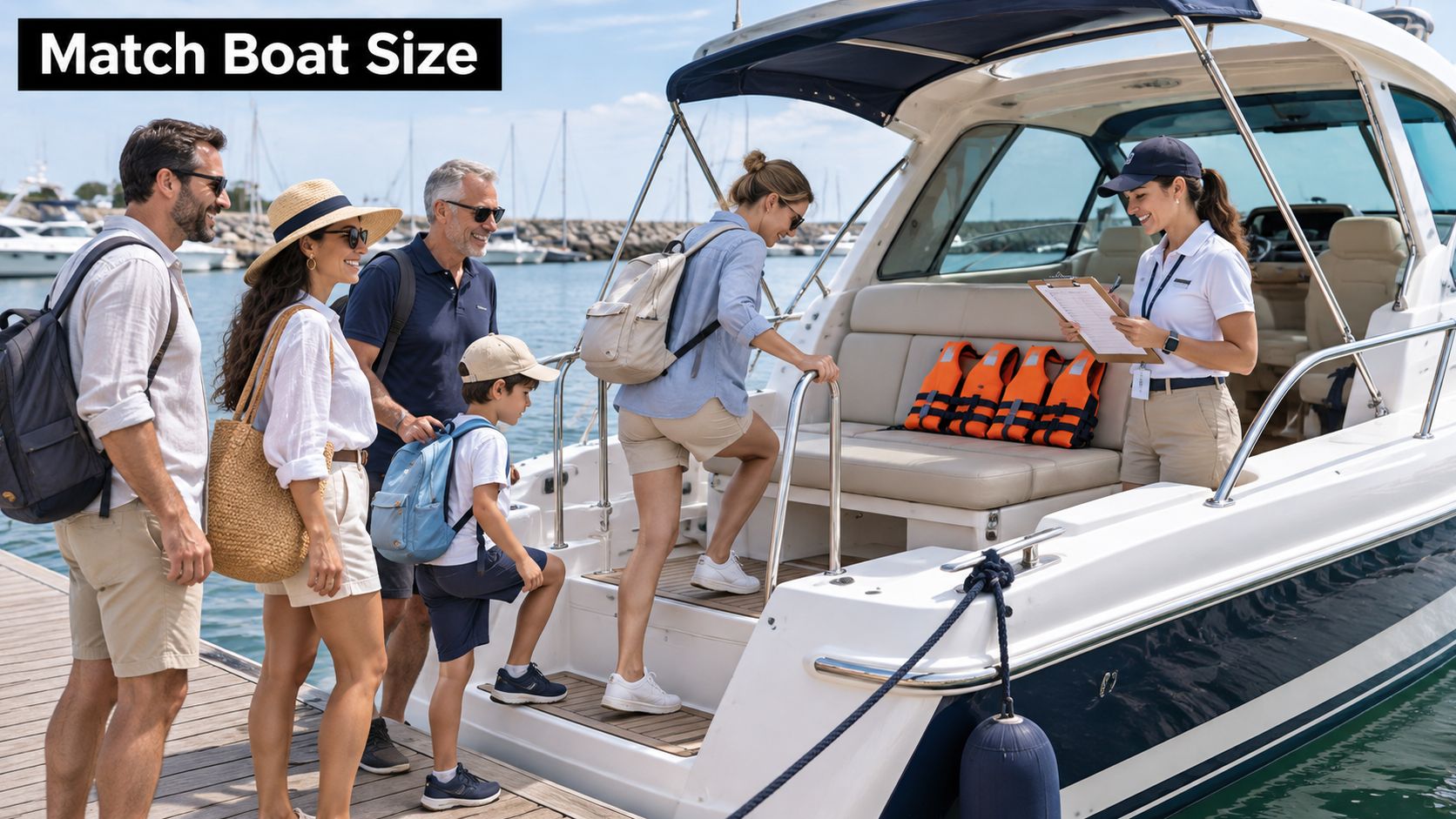
- Count confirmed guests, small ones included. Headcount drives boat size and the number and sizes of life jackets aboard. Children and non-swimmers count as full passengers, not fractions.
- Confirm the organizer is 18 or older. Our services are not intended for individuals under the age of 18, so the person holding the booking has to be the adult in charge.
- Name the mood in one sentence. Intimate, loud, or easy. That single sentence eliminates a third of your options immediately, which is the point.
- List the activities that can't be cut. Swimming, waterslide, music, sunbathing, sightseeing. Lake Travis alone is served by 15 parks operated by the Lower Colorado River Authority and Travis County Parks, many with beaches, picnic areas and boat ramps, according to Texas Parks & Wildlife, so a cruise-and-swim-stop plan is realistic. If the group skews young or elderly, start with our family-friendly boats.
- Choose a time window and a backup date. Weather shifts, dates fill, and a backup turns a cancellation into a reschedule.
- Shortlist two boat types and ask for the legal passenger capacity. Not the number in the marketing copy. The one on the vessel's capacity plate.
- Send the plan to every guest. Include what to expect at the dock, and the rule that guests riding on the bow of a yacht must be seated while the boat is under way.
Here's the quick test. If the boat, the headcount, and the must-have activities all agree, you've got the match. If any one of the three is a compromise, change the boat, not the plan.
Why a Captain Makes the Trip Easier
A captain is a designated driver for the whole lake day, except this one comes with a credential and the legal responsibility for everyone aboard.
Texas makes that more valuable than it sounds. Anyone born on or after September 1, 1993 who operates a motorboat powered by more than 15 horsepower must complete a TPWD-certified boater-education course and carry valid photo identification, per Texas Parks & Wildlife. The same education requirement covers windblown vessels longer than 14 feet and personal watercraft. Texas also prohibits operating faster than what's reasonable and prudent, or faster than a rate that lets the operator stop within the assured clear distance ahead.
Distance is the other half of the job. TPWD advises boaters to keep 50 feet from other personal watercraft, vessels, people, shorelines and stationary platforms unless they're traveling at headway or idle speed, according to TPWD safety guidance.
Now stack the duties. Navigation. Speed. A constant lookout. Weather checks before departure and again at the cove. Separation from swimmers and other boats. Loading, unloading, docking. That's a full-time job before anyone hands out a single drink.
A professional captain handles all of it while your group swims, plays music, takes photos and talks to each other. Judgment is the part you're really paying for, and it's worth knowing how to spot it before you book, which is why what makes a good captain is worth five minutes of your time.
Vetting the Captain and Vessel Before You Pay
Illegal charters get stopped. In one Miami operation, the U.S. Coast Guard and its Sector Miami partners shut down six illegal charter trips in a single enforcement push. The pattern behind cases like that is a boat taking paying passengers without a licensed captain or an inspected vessel, and it is exactly the category you screen out with six questions asked before money changes hands. A good operator welcomes every one of them. Vague or defensive answers are your cue to walk away from the deposit.
- Who drives, and under what credential. Every yacht and party boat at Lake Travis Yacht Rentals goes out with a captain aboard. For any operator, ask for the captain's license before you book, not on the dock.
- A written safety plan that states what happens when someone goes overboard.
- A Coast Guard Certificate of Inspection if the boat is large or carries more than six passengers.
- The legal passenger capacity, confirmed in words rather than inferred from a photo of a crowded deck.
- The emergency briefing. Ask when it happens and what gear is aboard: radio, flares, first aid, flotation.
- The event cap and the call-maker. The number the captain will run for your group, often lower than the legal maximum, and who decides when weather changes the route or cancels the swim stop.
The question that sorts operators fast: what's the legal passenger capacity on this vessel, and how many guests will you actually let us bring?
Why Capacity Is a Stability Number
Capacity is a physics number long before it is a comfort spec. Extra guests, stacked coolers, inflatables and a crowd on the upper deck raise the center of gravity and shrink the stability margin, exactly when the boat is turning, taking a wake, boarding, or sending someone down a waterslide.
A disciplined charter separates the advertised maximum from the safer event plan and puts the captain in charge of loading. The conduct rules work the same way. On a yacht, guests can ride the bow but stay seated while the boat is under way, and swimming or slide runs happen under the captain's direction. Onboard rules keep the boat upright, so treat them as part of the vetting rather than fine print.
Life Jackets, Kids and Non-Swimmers
Start with the numbers, because they earn the attention they get. Drowning was the recorded cause of death in 76% of U.S. recreational-boating fatalities in 2024, and 87% of drowning victims were not wearing a life jacket, according to Texas Parks & Wildlife.
In Texas, every person aboard needs a properly fitted, U.S. Coast Guard-approved wearable life jacket, and children younger than 13 must wear one while a recreational vessel under 26 feet is underway. That's not a strong suggestion. It's the rule.
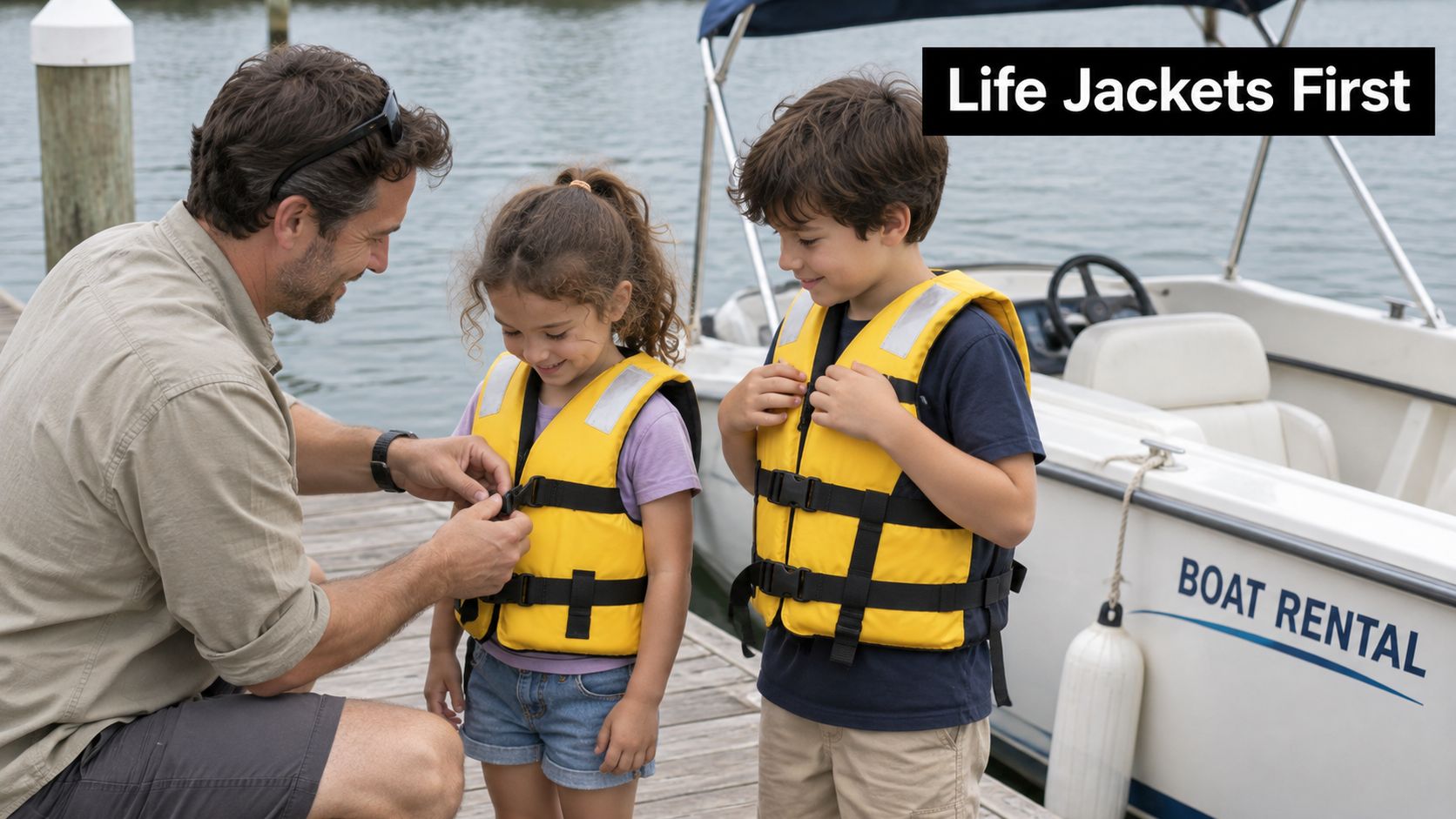
The mechanism is simple and worth saying out loud. A life jacket holds an unexpectedly immersed person's airway above the water while the captain stops, turns and comes back for them. It removes the reliance on swimming ability, on sobriety, or on somebody reacting fast enough in a crowded party crowd.
The Float Plan for Your Group
- Inventory by count and size before departure. Not "we have jackets." Enough jackets in the sizes the guest list needs.
- Brief location and fit at the dock. Where they are, how they buckle, who checks the kids.
- Continuous wear for children, weak swimmers, and anyone on the water toys. The lily pad and noodles are fun. They are not flotation devices.
- Keep drinking and swimming separate. We can't supply liquor, beer or wine because we don't hold a liquor license and must follow Texas Alcohol and Beverage Commission laws, so groups bring their own. Plan the swim block before the drinks, not after.
Our life jacket requirements spell out what needs to be aboard and who wears what.
Book Your Yacht Outing Before Summer Dates Fill
Picture the good part: the boat anchored in a cove, music up, eight people on a lily pad and two more on the sundeck who have no intention of moving. That's the afternoon waiting at the end of this list.
The path from here to there is short. Open our booking page, tap the red Check Availability and Pricing button, then pick a boat type from Luxury Yachts, Double-deck Pontoons with Slides, or Regular Pontoons. Choose the specific boat, the passenger count and the date. Check pricing and availability on that boat's own listing, because each vessel runs its own calendar.
Rentals run 3 to 8 hours, and boats go out only at the scheduled times shown in the booking system. No overnight stays. If you'd rather talk it through, call (512) 981-6409 and our office is open 9am to 8pm CST.
Before You Pay, Ask These Five Things
- The total price. Everything included, nothing discovered later.
- Deposit terms. How much, when, and what triggers a refund.
- What's aboard already. Coolers, ice, water toys, stereo, restrooms.
- The weather process. Who calls it, how you're notified, and what rescheduling looks like.
- The alcohol policy. Ours is simple, since we can't supply it, so plan your own.
Then run the vetting checklist, confirm the life jacket plan for the youngest and weakest swimmers, and lock a backup date.
Why now instead of next month? The U.S. boat-rental market reached an estimated USD 4.0752 billion in 2025 and is projected to reach USD 5.6353 billion by 2033, a 4.5% compound annual growth rate from 2026 through 2033, according to Grand View Research. Demand is climbing, the warmest water lands between July and September, and the best summer Saturdays are always the first to disappear.
Lake Travis Yacht Rentals runs the largest fleet of new and late-model yachts, double-deck party boats and pontoons on the lake, and every one of them comes with a captain, a lily pad, noodles, a big cooler and a stereo built for a party. If the weather questions above are what's holding your group back, call us and get a straight answer about how we handle changing conditions, then lock your date before the summer calendar closes. Visit Lake Travis Yacht Rentals to see what's still open this season.