You're probably comparing a double decker party bus with another group transportation option right now, trying to make a birthday, bachelor party, bachelorette weekend, family gathering, or corporate outing feel bigger than an ordinary night out. The bus seems obvious: music, lights, drinks, and a moving venue. But once you picture everyone packed into a narrow interior, crawling through traffic and watching the same city streets pass by, the upgrade starts to look less impressive.
For an Austin celebration, the smarter move is to leave the road entirely. A double-deck party boat on Lake Travis gives your group open air, Hill Country scenery, swimming, rooftop space, and a professional captain. You won't just transport guests between venues. You'll give them a floating destination they can enjoy from the moment the boat leaves the dock.
Rethinking the Ultimate Mobile Party Venue
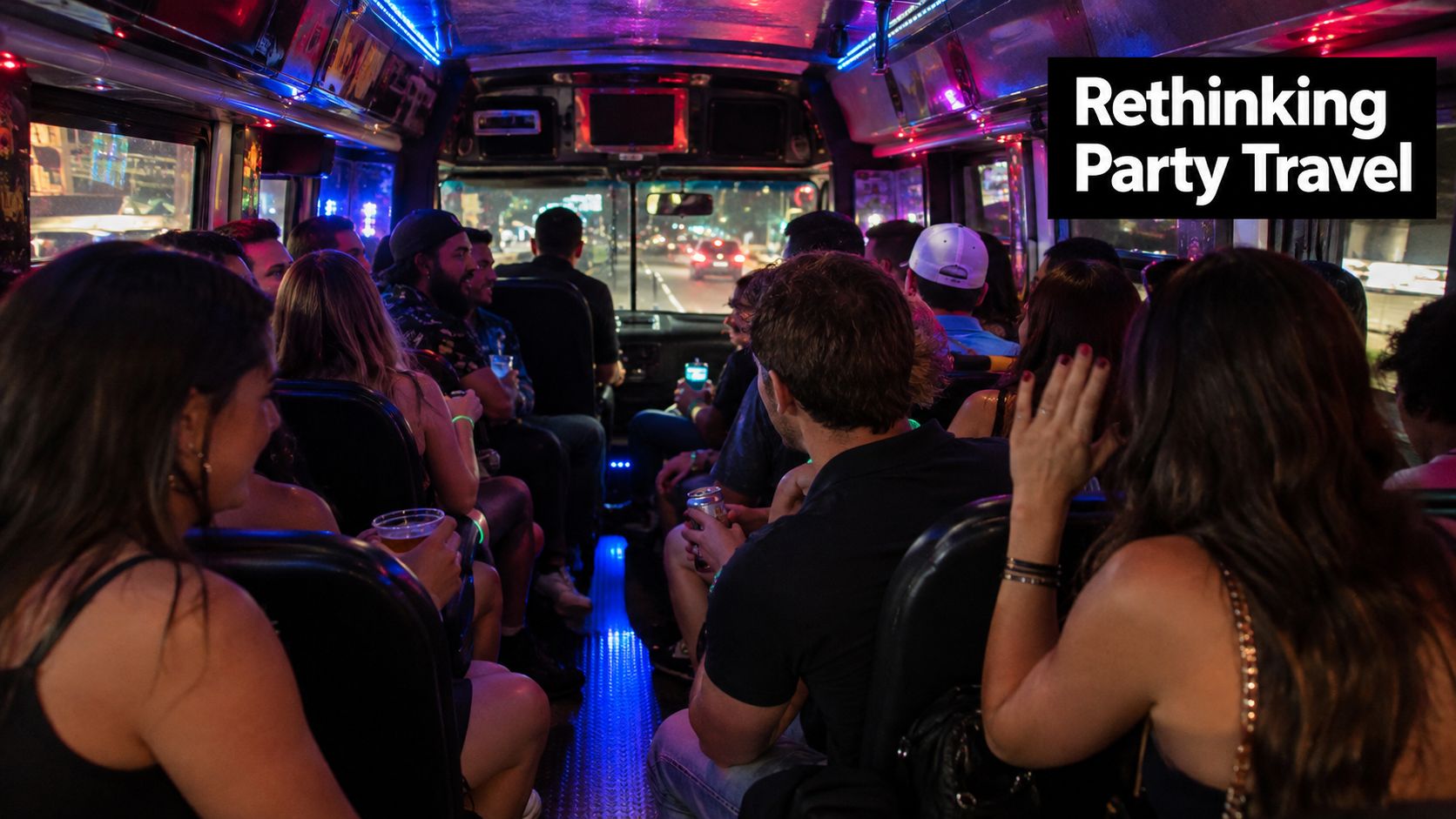
You've seen the familiar double decker party bus formula. Colored lights wash over upholstered seats, music competes with road noise, and guests squeeze around a bar or dance area while the driver works through downtown congestion. It can be entertaining, but the vehicle still dictates the experience. Everyone remains inside a long, enclosed structure with limited room to spread out, limited scenery, and no way to turn the journey into the main event.
That's why Austin planners should question the assumption that a road vehicle automatically makes the better mobile party venue. A bus can move your group, but movement alone doesn't create a memorable celebration. A premium boat changes the setting, the pace, and the way guests interact.
Trade traffic for open water
A double-deck party boat puts the lake at the center of the celebration. Guests can move between levels, step into the breeze, take in the Texas Hill Country, and use the vessel as a private base for swimming and lounging. Instead of staring through tinted windows at intersections, they get changing views, open sky, and a setting that feels like an occasion from the first minute.
The difference matters for group energy. On a bus, the route controls the mood. On Lake Travis, the captain can create a relaxed rhythm that lets guests settle in, enjoy the sound system, share refreshments, and spend time in the water when conditions and the itinerary allow.
My planning rule: If the venue itself is supposed to be part of the celebration, don't choose a vehicle that makes the scenery an afterthought.
The historical double-decker format was developed to move more passengers without increasing vehicle length or road space. The earliest documented double-decker appeared in Paris in 1853, motorized versions emerged in the early 1900s, and Great Britain popularized the design during the first decades of the 20th century, according to the history of the double-decker bus. That architecture works well for transportation, but a party deserves more than efficient passenger movement.
A Lake Travis boat gives you the same appealing two-level concept with a better environment. The upper deck becomes a lookout, lounge, and photo setting. The lower level becomes a comfortable retreat with practical amenities. The water becomes the scenery, the activity, and the reason guests keep talking about the event afterward.
Comparing the Double Decker Party Bus to a Yacht
The choice becomes straightforward when you compare the actual experience rather than the novelty of the vehicle. A road-based double decker party bus offers a controlled interior, a driver, and a route through the city. A double-deck yacht offers separate levels, open-air circulation, waterfront scenery, and the ability to stop in a suitable area for swimming and relaxation.
| Planning priority | Double decker party bus | Double-deck boat on Lake Travis |
|---|---|---|
| Space | Narrow interior divided by seats and fixtures | Open decks with room to circulate and lounge |
| Scenery | Streets, traffic, buildings, and parking areas | Water, shoreline, sky, and Hill Country views |
| Main activity | Music, conversation, and transportation | Music, swimming, sunning, sightseeing, and socializing |
| Destination | A club, restaurant, or another stop | The vessel and the lake are the destination |
| Atmosphere | Enclosed and road-bound | Expansive, scenic, and open air |
A bus also has to manage the practical limitations of a tall road vehicle. Double-deck vehicles have a long history of bridge collisions caused by unfamiliar routes, wrong turns, or drivers forgetting the required vertical clearance, as documented in federal commercial-vehicle guidance on double-decker safety. Professional route planning and qualified driving matter, but those constraints remain part of the experience.
The lake creates more ways to celebrate
A boat can anchor in a suitable cove, giving guests a chance to lounge, swim, and use approved water toys instead of just parking outside a crowded venue. The group isn't waiting for traffic to clear or deciding which bar has enough room. The group is already inside a private setting designed around the celebration.
A road bus has a single basic purpose: carry guests. A Lake Travis yacht combines transportation with a destination, a backdrop, a social space, and access to the water. For organizers comparing the practical details, the double-decker pricing information helps frame the boat as an experience rather than a simple ride.
This is especially important for large celebrations. A bus can feel exciting for a short transfer, but the novelty fades when guests are seated in the same confined space for the whole outing. A double-deck boat keeps changing the experience without requiring the group to split up. Guests can gather upstairs, cool off below, swim beside the vessel, or move between conversations as the mood changes.
Premium Amenities on a Lake Travis Double-Decker
The best double-deck boats don't rely on a flashy exterior to carry the party. Their layouts are built for active use. Your guests can arrive with music already in mind, settle into the main deck, move upstairs for sun and views, then head toward the water when they want a more energetic break.
Start with the sound. A high-powered Bluetooth stereo with subwoofers gives the group a proper soundtrack without forcing everyone into one cramped corner. Music travels across the open deck, while the lake and shoreline create a natural sense of occasion that a sealed bus interior can't reproduce.
Build the day around movement
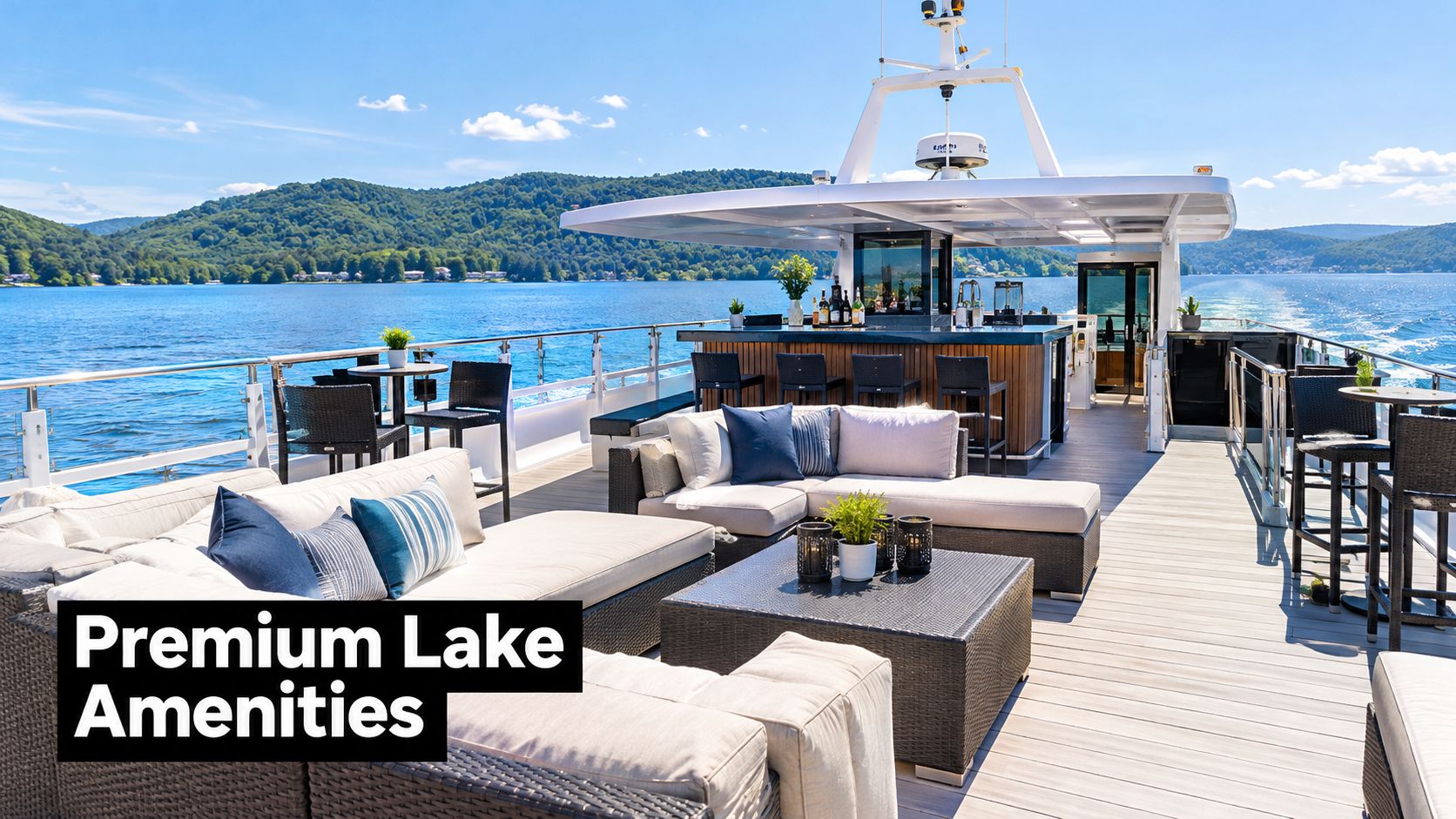
The rooftop party deck is where the format really separates itself from a double decker party bus. Guests can spread out, enjoy the sun, take photos against the lake, and watch the shoreline change as the vessel moves. Those who prefer shade or a quieter conversation can use the lower level instead of competing with the main dance area.
Then comes the water. On a suitable vessel and itinerary, a waterslide sends guests directly into Lake Travis, turning a familiar celebration into a full aquatic adventure. Lily pads and pool noodles give swimmers and loungers a place to relax, while large coolers make it easier to keep refreshments organized throughout the outing.
A practical boat setup should include:
- Music: Bluetooth connectivity and powerful speakers keep the group's playlist central to the event.
- Rooftop space: The upper deck gives sunbathers, photographers, and social groups their own area.
- Water access: Slides and floating accessories create activities beyond conversation and drinking.
- Restrooms: A clean private restroom adds comfort without requiring a stop on shore.
- Refreshment storage: Large coolers help organizers manage drinks, food, and ice more efficiently.
The experience feels different because guests aren't forced to do one thing. Someone can sit with a drink and enjoy the view. Someone else can dance near the speakers. Another guest can use a lily pad, while a child stays close to family members on the lower deck. That flexibility is what makes a double-deck boat effective for mixed groups.
For organizers choosing between a plain vessel and a more active setup, the double-decker pontoon with a slide shows how the layout can combine social space with direct access to the water. Confirm the exact features, capacity, and operating rules for the boat you're considering before you promise a specific amenity to guests.
Perfect Celebrations for a Floating Party Venue
A double-deck boat earns its place when the celebration needs more than transportation. It works particularly well when guests have different ideas of fun, because the vessel creates separate zones without separating the group completely.
For a bachelor or bachelorette party, the formula is simple. Start with music and refreshments on the main deck, move upstairs for views and photos, then use the water for a memorable change of pace. The group gets a lively setting without needing to coordinate multiple downtown stops, rideshares, cover charges, or crowded venues.
Birthday celebrations benefit from the visual setting. A milestone deserves more than another private room with predictable lighting. Lake Travis provides an open backdrop for group photos, sunset conversations, and a day that feels deliberately planned. The boat also gives the guest of honor a natural center of attention without requiring everyone to sit at one table.
Match the vessel to the guest list
Corporate groups should choose the boat when they want colleagues to interact away from office routines. An open-air setting makes informal conversation easier, while the separate levels let people move between socializing, quiet discussion, and group activities. A captain handles the operation, so the organizer can focus on timing, food, communication, and the people attending.
Families get a different benefit. Adults can relax on the upper deck while children enjoy supervised water activities, provided the vessel's rules and the captain's instructions allow them. Older relatives or guests who don't want to swim can still participate from a comfortable deck with views and conversation. That range makes the boat more adaptable than an itinerary built around a loud, single-purpose bus.
Choose the setting before the decorations. A strong backdrop, useful layout, and activities for different energy levels will do more for the event than extra themed props.
Before booking, match the vessel to four practical questions:
- Who is attending? Consider children, older guests, swimmers, non-swimmers, and anyone who needs step-free access.
- What should guests do? Decide whether the priority is music, swimming, sightseeing, conversation, or a balanced mix.
- How much privacy matters? A private charter gives the group control over the atmosphere and schedule.
- What does the day require? Confirm food arrangements, restroom access, weather policies, boarding details, and water-activity rules.
Accessibility deserves a direct conversation, not an assumption based on photographs. Federal transportation standards address lifts or ramps, securement areas, and other requirements for covered buses, including at least two securement positions on vehicles longer than 22 feet and a lift design load of at least 600 pounds, as described by the U.S. Access Board vehicle standards. Ask the operator whether the lower deck is step-free, whether a wheelchair can remain safely on board, how the restroom is accessed, and whether the upper deck is optional.
Safety and Professional Captaincy on the Water
A boat celebration should feel carefree because the right professionals handle the operational details. Don't ask a guest to steer, dock, monitor traffic, manage changing conditions, and stay sober while also trying to enjoy a major celebration. Book a fully captained vessel and make the captain responsible for the boat.
Texas Parks and Wildlife warns that the probability of being killed in a boating accident doubles when alcohol is involved, according to its boating safety guidance. That makes captaincy more than a luxury. It separates the job of operating the vessel from the job of celebrating.
Put safety decisions in the right order
Before departure, give the captain an accurate passenger count and mention children, inexperienced swimmers, mobility limitations, and planned water activities. The crew can then explain where guests may sit, when swimming is allowed, how flotation equipment works, and what to do if conditions change.
Texas Parks and Wildlife requires children younger than 13 to wear a U.S. Coast Guard-approved life jacket on recreational vessels under 26 feet while underway, including while drifting. Adults must have a properly fitting life jacket readily accessible, and the agency advises carrying appropriately sized jackets, including child sizes, as explained in its life-jacket guidance.
Use this departure checklist:
- Confirm the headcount. The operator needs an accurate passenger total, not an estimate from an early invitation list.
- Discuss flotation equipment. Ask how child sizes are handled and where adults can access properly fitting jackets.
- Follow the captain's instructions. Water activities, movement between decks, and swimming depend on the vessel, location, and conditions.
- Designate an event lead. One sober organizer should help communicate with guests and keep the schedule organized.
- Respect unsafe decisions. A captain must be able to pause swimming, restrict movement, or refuse participation when a guest creates a danger.
A professional captain also manages docking and navigation, which allows the entire group to participate instead of assigning one friend to work. Lake Travis Yacht Rentals lists captained options with background-checked and drug-tested captains, but you should still confirm the exact crew, vessel, passenger limit, and onboard procedures during booking through its captain information.
The same discipline applies to alcohol. Ask who supplies it, whether glass containers are prohibited, how intoxicated guests are handled, and what rules apply before swimming. Austin charter-bus permit materials require driver licensing, medical qualification, and vehicle inspection, while an Austin ordinance states that a driver or permittee may not sell or provide alcoholic beverages or controlled substances to a passenger, as shown in the Austin charter-bus permit materials. Transportation and boating rules aren't interchangeable, so verify the operator's policies before guests arrive.
Booking Your Lake Travis Yacht Before Dates Sell Out
Waiting until everyone arrives in Austin is a poor strategy for a group lake outing. Visit Austin reports that the city welcomed 30 million visitors in 2024, generated $11.1 billion in visitor spending, and supported 148,000 hospitality and tourism jobs, according to its annual meeting information. Those figures don't guarantee that every visitor wants a boat, but they show why premium experiences face serious demand from tourists, event groups, and locals planning around the same weekends.
Your preferred vessel and departure time are part of the event, not a last-minute accessory. If the group is traveling for a birthday, bachelor or bachelorette party, corporate gathering, or family celebration, the date is probably fixed before the boat search begins. Secure the water experience first, then build the rest of the itinerary around it.
Make the reservation decision early
Start by identifying the essentials:
- Guest count: Choose a vessel that fits the actual group comfortably, with room for movement and the activities you want.
- Event style: Decide whether you need a waterslide, rooftop space, swimming access, strong audio, or a quieter sightseeing atmosphere.
- Guest needs: Share children's ages, mobility considerations, swimming ability, and accessibility questions before paying a deposit.
- Schedule: Pick a departure window that works with hotel check-in, meals, transportation to the marina, and any evening plans.
- Weather and cancellation terms: Read the operator's policies so the group understands what happens if conditions affect the outing.
A late booking creates avoidable compromises. You may have to accept a different boat, a less convenient departure time, or an itinerary that doesn't suit the guest list. Early planning also gives you time to build a playlist, coordinate refreshments, communicate life-jacket expectations, and tell guests exactly what to bring.
The broader double-decker bus category remains commercially significant. One market analysis estimated the global market at USD 7.8 billion in 2025 and projected USD 12.6 billion by 2034, with a projected 5.5% compound annual growth rate, as reported by Reed Intelligence's double-decker bus market analysis. That data covers buses generally, not party boats, but it reinforces the enduring appeal of raised, high-capacity designs. For your event, the better question is where that design creates the richest experience.
Don't reserve a double decker party bus just because it's familiar. Choose the venue that gives guests room, scenery, water access, and a professional operator. Check availability now, confirm the vessel's amenities and safety procedures, and lock in your preferred Lake Travis date before your celebration becomes a scramble.
Lake Travis Yacht Rentals offers captained double-deck party boats, premium pontoons, rooftop decks, sound systems, private restrooms, coolers, floating accessories, and selected waterslide options for group celebrations. Visit Lake Travis Yacht Rentals now, check your date, and reserve the floating venue that will make your Austin event far more memorable than a ride through traffic.