Your quarterly planning session is three hours old. The whiteboard is full, the same four people are doing the talking, and the energy in the room has gone flat. Moving the same meeting to a different conference table won't fix it.
Water does something a room can't. On Lake Travis, the horizon keeps moving, the pings stop mattering, and the person who never speaks up in the boardroom ends up in a real conversation at the bow. A captain handles the boat. Your team handles the agenda, or the celebration, or whatever the day is for.
The eight formats below are matched to outcomes, not activities. One is built for decisions. Another is built for the people who've been heads-down since January. Each runs on the water, and each gives you a reason to pick it beyond "it sounds fun," because fun that doesn't serve a goal is just a Friday afternoon out of the office with a boat bill attached.
Here are eight corporate retreat ideas built around Lake Travis, each matched to a specific goal so you can choose the one that fits your team.
1. Sunset Strategy Session Cruise
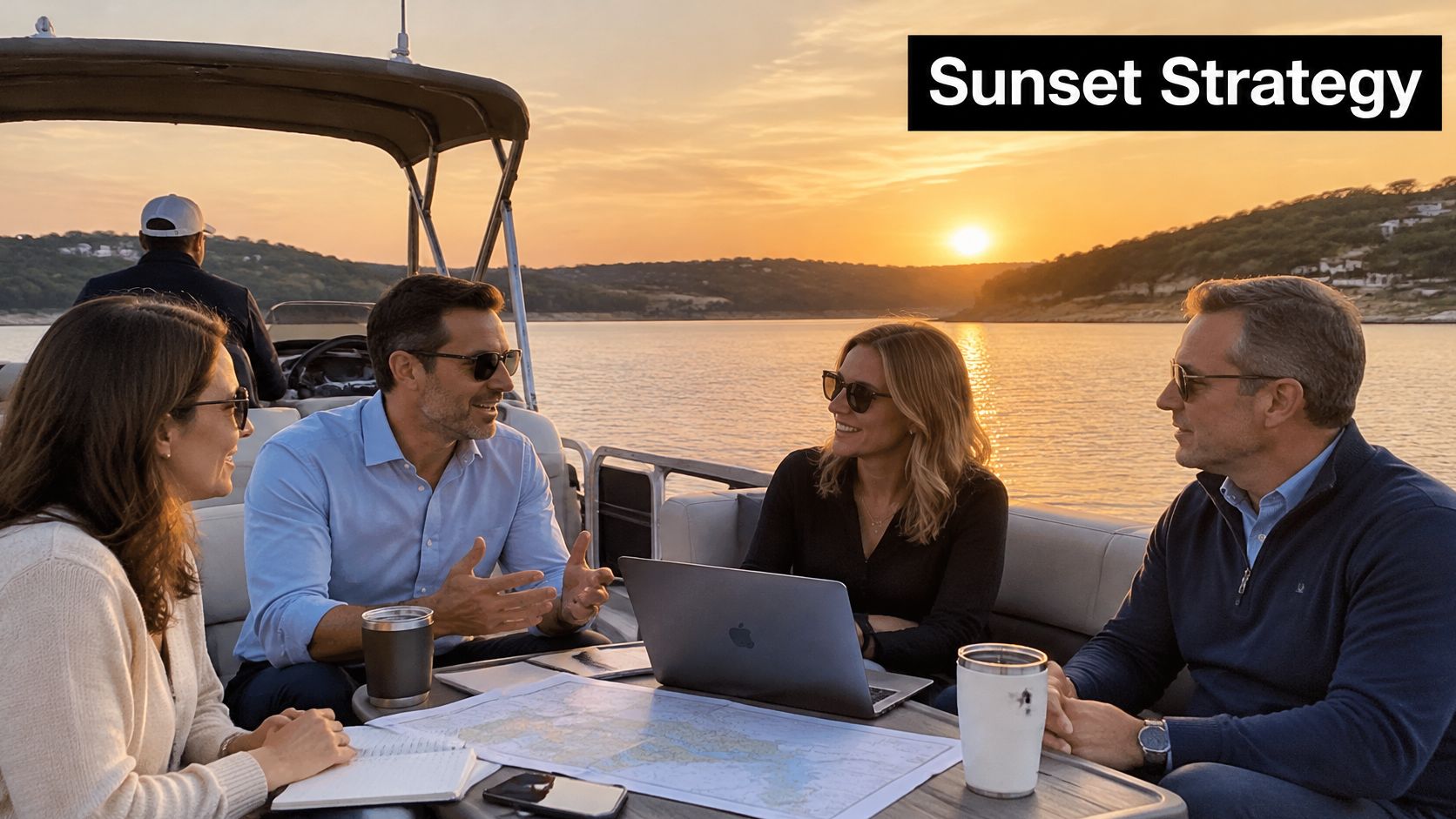
A leadership team boards in the late afternoon with three decisions to make before the quarter closes. They work through the agenda as the light changes, then put away their laptops and end the evening together on Lake Travis. The setting gives strategy work a clear finish, while the shared time supports relationships beyond the meeting.
A 2017 Robert Half Management Resources survey of more than 2,200 CFOs found that 80% of companies did not hold annual gatherings. Among respondents whose companies did hold them, 19% named aligning teams around business strategies as a benefit. The figures point to a practical opportunity: give leaders uninterrupted time to align on priorities, then leave room for informal conversation.
Set the agenda before anyone boards
- Send an agenda with time blocks. Set a firm end to business so attendees know when the discussion gives way to social time.
- Choose a vessel that fits the group. Confirm that everyone has a seat and space to move comfortably. A crowded boat makes it harder to focus.
- Plan around sunset. Set the departure and meeting schedule so the final toast falls near golden hour.
- Book the time that suits your agenda. Allow enough time for the group to finish its work before the evening closes.
For a quarterly planning session, the department heads could board at 5:30, work from 5:45 to 7:15 through three questions printed on a card, then raise a glass at 7:30. A remote team that meets twice a year could use the same format for an annual strategy check-in, with informal conversation afterward. On a captained yacht, the team can stay focused on the agenda rather than operating the boat.
Set a firm end time for business. If the agenda runs into the closing toast, the team loses the chance to enjoy the evening together.
2. Lake Travis Team Challenge Regatta
Two crews, a cooler that has to cross open water without tipping, and a scoreboard nobody wants to lose to. Competitive formats work because they hand a team a small, real problem to solve in front of everyone.
The evidence is stronger than most planners assume. A systematic review of controlled team-building interventions found positive, statistically significant effects on teamwork behaviors and team performance, with generally medium-sized benefits across industries. One meta-analysis inside that review covered 51 articles, 72 interventions, 194 effect sizes, and 8,439 participants. That's a long way from a personality quiz and a trust fall.
Build roles into the game
- Name a captain and a scorekeeper per crew. Clear roles stop the loudest person from running everything and give quiet planners a job that matters.
- Keep each challenge to 20 or 30 minutes. Energy drops fast after half an hour in the sun, and a tired team stops competing and starts sulking.
- Confirm swim ability privately, in advance. Provide life jackets, water, and shade without making anyone announce a limitation in front of their team.
- Close with a huddle on the boat. Two questions only: what worked, and what slowed us down.
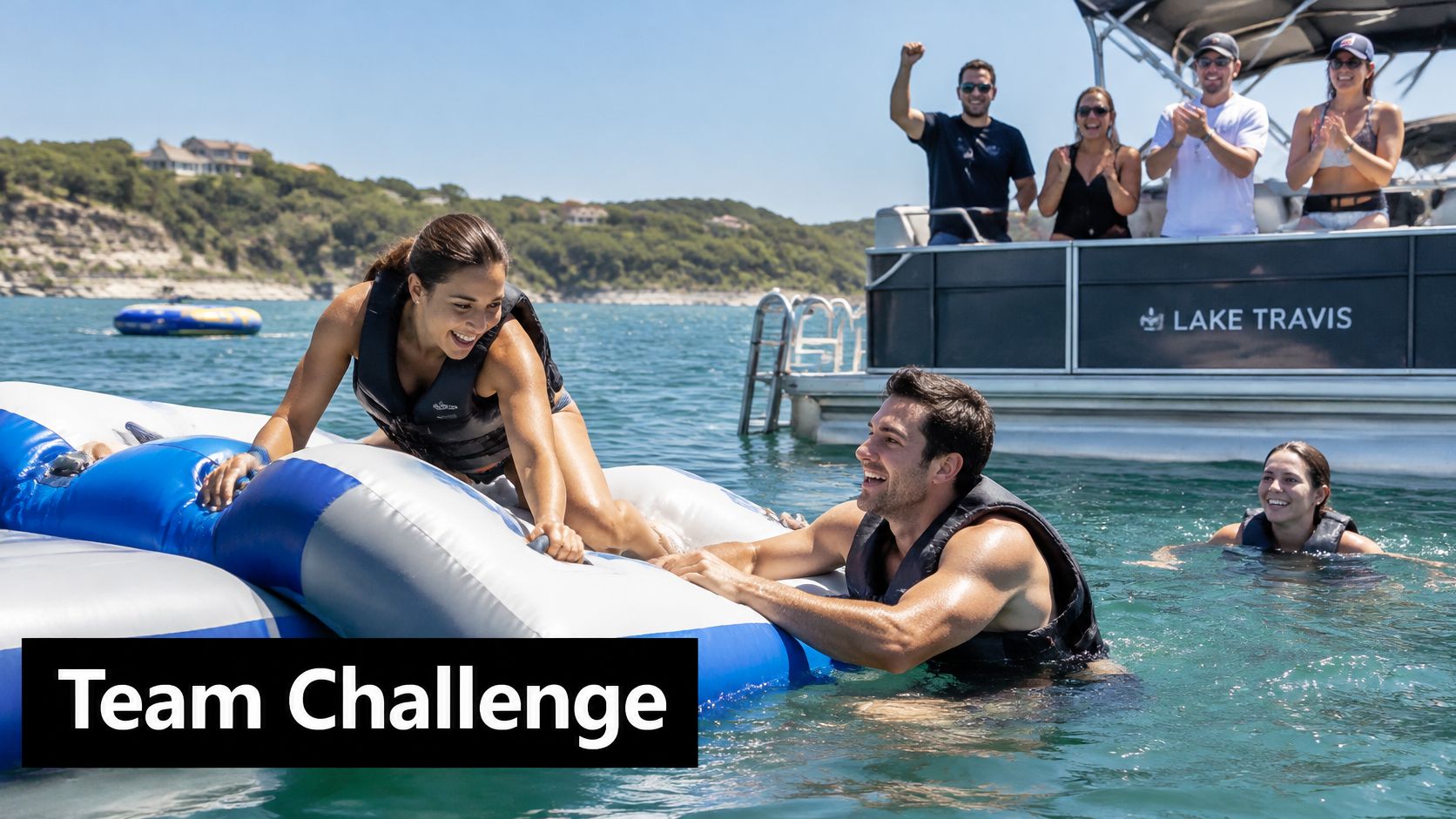
A sales team that splits into two crews for a relay requiring coordinated paddling and passing learns more about handoffs than a slide about handoffs ever will. An operations group running a scavenger hunt with clues at each lake stop gets the same effect with less physical demand. Rotate the mixed teams between rounds so people work with colleagues they don't sit near on a Tuesday.
A game nobody debriefs is just recess. The ten minutes after the scoreboard is where the retreat actually happens.
3. Rooftop Deck Networking Mixer
Most corporate networking happens in rooms built to keep people seated and facing forward. An open upper deck does the opposite, and that changes who talks to whom.
This isn't a side activity you squeeze in after the core agenda. Team-building formats made up 32.82% of the global corporate retreat market in 2025, and Emburse data cited in an Outback Team Building market analysis shows 44% of offsite agendas go to social programming and team building against 36% for work-related tasks. The social block is the main event. Design it like one.

Make introductions easy
The top level of a double-deck boat gives people room to move between clusters, which is exactly what a hotel ballroom prevents. If you're weighing layouts, understanding the difference between a roof deck and a rooftop matters more than it sounds: one is a working deck with railings, shade, and seating, the other is a photo opportunity.
- Use name tags with a prompt. "Ask me about" beats a job title every time.
- Hold one short toast at a set time. Twenty minutes of speeches kills a room. Ninety seconds of thanks opens it.
- Confirm the guest count against capacity before you book. External partners plus staff adds up faster than planners expect.
- Schedule around golden hour. Best light, best photos, and a natural reason for people to circulate.
A regional firm can host clients and partners on a weekday evening with name tags and one icebreaker and get more cross-department introductions in two hours than in a quarter of internal meetings. A startup can put investors and staff on the same deck before a funding round and let the setting do the relationship work.
4. Pontoon Working Lunch Retreat
Not every retreat needs a party boat. Some of the best work of the quarter happens at eight miles an hour, with a sandwich and no interruptions.
The case for smaller, calmer formats keeps getting stronger. Cisco's 2025 hybrid-work study, cited in Booking.com's 2025 corporate event trends report, found that 41% of workers preferred office-based work, 28% preferred hybrid work depending on the task, and 26% preferred working from home, while the share reporting hybrid arrangements fell from 62% in 2022 to 45% in 2025. The same report notes 63% of organizers expected increased demand for smaller micro-events. A half-day pontoon lunch is exactly that: small, focused, and easy to say yes to.
Practical rule: if the session needs a projector, book a conference room. A pontoon lunch is for conversation, decisions, and documents you can hold in one hand.
Keep the work surface workable
- Pack materials for wind. Waterproof folders or tablets in a zipped bag. Loose paper becomes lake litter in about four seconds.
- Bring food that doesn't need heating. Packaged sandwiches, fruit, and cold drinks keep the day moving and the deck clean. Have it delivered to the dock and stowed in the cooler before boarding.
- Set a hard start and end time. A half-day that runs long costs people their evening, and they remember that longer than they remember the agenda.
- Ask the captain about wind and waves before you finalize. A calm morning can turn a working lunch into a hold-on-to-your-laptop afternoon.
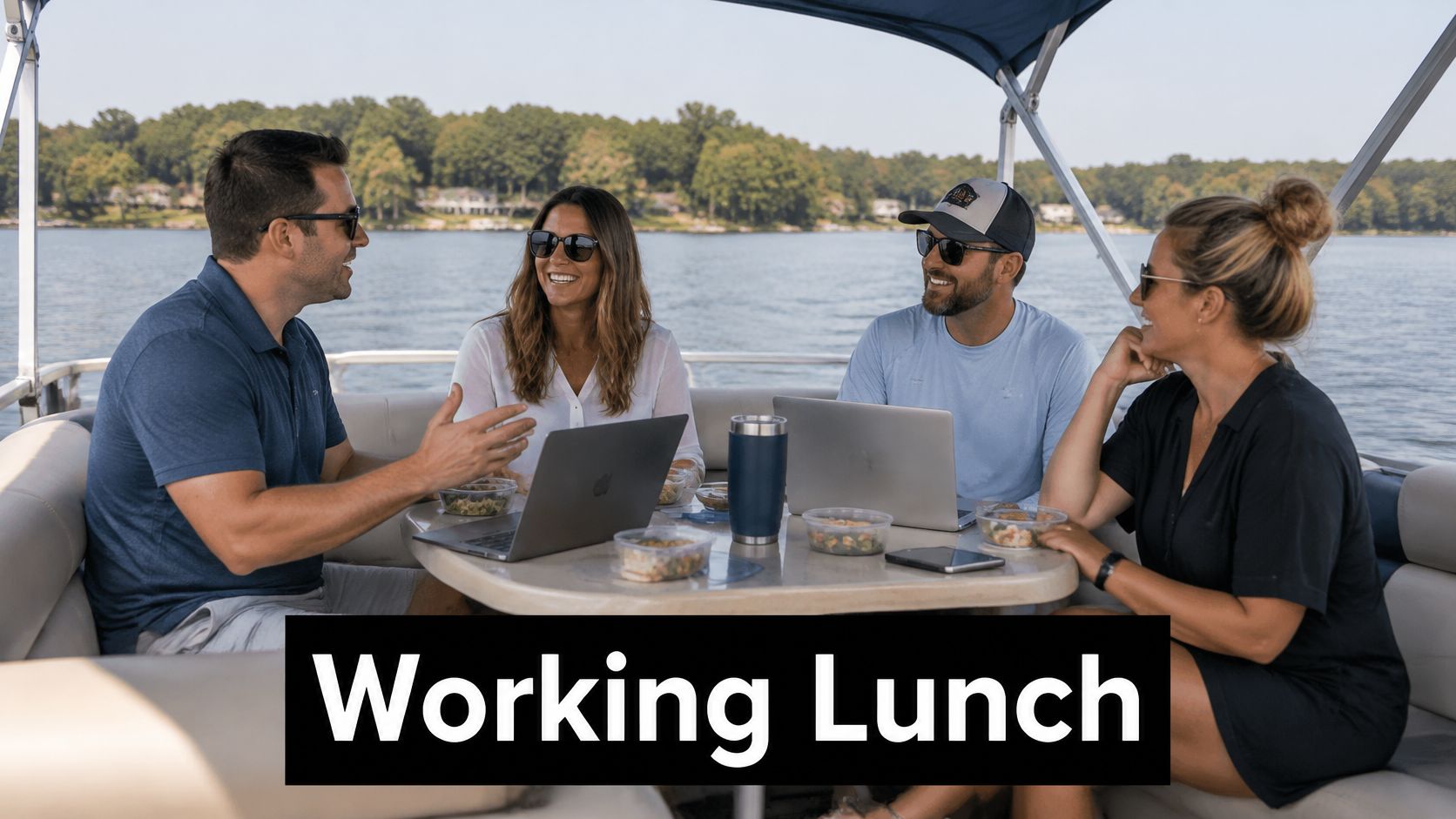
Say a product team needs to review a roadmap with six people. Board at 10, work until noon on a slow cruise, anchor for lunch, dock by 2. A small leadership group can run an annual budget review the same way. It's the lowest-cost format on this list, and for a team that freezes in a conference room, it's often the most productive.
5. Waterslide Recreation Day for Employees
Morale doesn't move because of a slide deck. It moves when the person who signs your expenses goes down a waterslide in a company t-shirt and comes up laughing.
The stakes are bigger than a fun Friday. Gallup's global workplace report found that only 23% of employees worldwide were engaged at work in 2022, and estimated that actively disengaged and not-engaged employees cost the global economy $8.8 trillion in lost productivity. Its meta-analysis of 112,312 business units found teams in the top engagement quartile had 23% higher profitability than teams in the bottom quartile.
A recreation day doesn't create engagement on its own. It creates the shared memory that recognition and connection build on, and it gives people something to talk about besides deadlines.
Our double-deck party boat setups put a waterslide, a shaded deck, and a swimming stop in the same footprint, which means swimmers and sunbathers stay at the same party instead of splitting into two.
Plan for the people who won't swim
- Offer a quiet, shaded area. Not everyone wants to be in the water, and not everyone drinks. Give them a good seat and no commentary.
- Stock sunscreen, shade, and water. Heat exhaustion ends a party faster than rain does.
- Publish the schedule in advance. People plan around a start time, a lunch time, and a recognition moment.
- Put recognition in the middle of the day. Short awards or thank-yous while everyone is together and the energy is still high.
A summer appreciation day with waterslide races and a group lunch works for a 40-person company. A nonprofit marking an annual milestone can run the same format with games instead of races, and a team that just shipped a brutal project can use it to close the loop properly.
6. Client Appreciation Yacht Cruise
A renewal conversation goes differently on a shaded deck with a drink in hand than it does across a conference table with a contract in the middle.
Hosting clients on the water signals effort, and effort is what people remember when the renewal comes around. The logistics deserve the same care as the guest list, starting with who can get on board. A 2025 study of 1,000 event delegates found that 93% of disabled participants encountered barriers, including inaccessible layouts at 28% and overstimulating environments at 27%, according to reporting on event professionals' accessibility priorities.
Ask before you assign a boarding time
- Send personalized invitations. Date, departure point, dress code, and what to expect on board. A forwarded calendar invite is not an invitation.
- Ask about dietary and accessibility needs in the RSVP. Step-free boarding, restroom access, shade, and a low-sensory corner are things you verify rather than assume.
- Keep the program brief. A two-minute welcome and a closing thank-you outperform a presentation every time.
- Book weekend and sunset departures early. Those are the dates that disappear first.
Our client appreciation event formats suit a consulting firm hosting top accounts to mark a multi-year partnership, and a brokerage bringing agents and key partners together at the start of spring. Both benefit from the same thing: a host who is present with guests instead of managing a boat.
Guests forgive a cloudy afternoon. They don't forgive a boarding ramp nobody checked.
7. Company Milestone Celebration Cruise
A record quarter deserves better than cake in the break room.
Milestones are the easiest retreat to justify and the easiest to get wrong, because the temptation is to fill the evening with speeches. Event professionals don't judge these nights by attendance alone. A 2024 benchmarking survey reported by BizBash found that 93% measure attendee satisfaction, 76% use post-event surveys, and more than 71% track attendance, with 63% ranking attendee satisfaction among their top three priorities.
The bigger the company, the more the boring logistics matter. Forrester's Q1 2025 survey of more than 250 B2B event decision-makers found that 28% of the largest organizations had deployed six or more event technology platforms, yet only one in five had fully integrated its primary platform with the rest of its marketing stack. One shared manifest beats five spreadsheets and a group chat.
Run one recognition moment, then get out of the way
- Build a two-minute milestone reel. Photos, numbers, a few faces from year one. Play it through the boat's sound system, then stop.
- Coordinate catering to the schedule. Food lands while guests are settled, not while they're queuing to board.
- Take the group photo at a scenic stop. The whole company on one deck with the lake behind them.
- Send a two-question survey the following week. What was the best part, and what would you change.
A growing company marking its tenth anniversary can run a sunset cruise with ten minutes of recognition and three hours of social time. A product launch party works the same way, with the toast early and the deck free afterward.
Protect the one moment: ten minutes of recognition, delivered well, beats forty minutes of speeches nobody remembers.
8. Quiet Lake Reflection Retreat
The hardest thing to book in a busy quarter is quiet.
Some teams don't need a party. They need a morning without noise, a clear view, and time to think about what they're doing. Wellness has become a venue criterion rather than a perk. In a 2024 survey of 500 UK meeting and event planners by OnePoll for Hand Picked Hotels, 77% said wellness facilities for delegates were a priority when selecting an offsite venue, as Hospitality and Catering News reported.
Protect the silence
- Turn the sound system down. A 2000-watt stereo is a tremendous asset on a party boat and a terrible one on a reflection cruise. Background level or nothing.
- Schedule reflection blocks with start and end times. Open-ended silence makes people anxious. Bounded silence makes them productive.
- Bring journals and prompt cards. "What are we pretending not to know about this quarter" gets further than "share your thoughts."
- Leave in the morning. Afternoon heat on the lake is real, and a calm morning turns into a sluggish afternoon.
A leadership team can take a four-hour morning cruise before its busiest season: an hour of individual reflection, an hour in pairs, an hour as a whole group, and the rest left open for whatever surfaces. A wellness-focused company can run the same structure with guided journaling and a short breathing session on the bow while the boat sits at anchor in a quiet cove.
That's the retreat people come back from rested instead of needing a day to recover from it.
How the 8 Lake Travis Corporate Retreat Formats Compare
| Item | Vessel Type | Ideal Group Focus | Format |
|---|---|---|---|
| Sunset Strategy Session Cruise | Captained yacht or pontoon | Leadership planning and strategy | Structured session followed by sunset social time |
| Lake Travis Team Challenge Regatta | Captain-supported boat with water toys | Teamwork and collaboration | Rotating water-based games and challenges |
| Rooftop Deck Networking Mixer | Double-deck party boat | Networking and relationship building | Open-air evening mixer with a quieter lower deck |
| Pontoon Working Lunch Retreat | Premium pontoon | Small-team planning and brainstorming | Half-day working lunch and discussion |
| Waterslide Recreation Day for Employees | Double-deck party boat with waterslide | Employee morale and appreciation | Full-day recreation with swimming and water activities |
| Client Appreciation Yacht Cruise | Captained luxury yacht | Client relationships and loyalty | Private afternoon or sunset hospitality cruise |
| Company Milestone Celebration Cruise | Pontoon or double-deck party boat | Company culture and recognition | Celebration with speeches, food, music, and social time |
| Quiet Lake Reflection Retreat | Luxury yacht or pontoon | Reflection, wellness, and strategic thinking | Calm half-day retreat with guided and individual reflection |
Choose Your Lake Day and Plan Your Retreat
A retreat earns its place on the calendar when its format serves a clear business goal. For strategy, give the group a focused agenda and time to think. For team energy, build in shared challenges and a short debrief. For client loyalty, make conversation and hospitality the priority. For morale, pair time on the water with a genuine thank-you.
Remote and hybrid teams can make a strong case for in-person time together. A lake day gives colleagues room to talk beyond the usual meeting agenda, with the setting itself marking a change of pace.
Calendar planning matters, too. Skift's reporting on event registration timing notes that 84% of attendees decide to attend an event at least four weeks before registering, while three-year Maritz research found 45% of conference attendees delayed registration until fewer than four weeks out. Those figures describe different moments in the process. For a retreat, settle on a date and headcount early enough to match your group with an available vessel.
A quick way to pick
- Decisions on the table? Choose a sunset strategy cruise, set three questions, and finish with a clear stop time.
- New or disconnected team? Run a team challenge regatta, then use the debrief to connect the activity to collaboration at work.
- Clients and partners? Pick a rooftop mixer or hosted yacht cruise, with conversation and hospitality at the center.
- A demanding stretch behind you? Plan a waterslide day and make space to recognize the team.
- Leadership group needs quiet? Choose a calm cruise with time for individual reflection and a bounded discussion.
Once the format is clear, set the agenda and headcount, then call Lake Travis Yacht Rentals to arrange a boat or multiple boats for a larger corporate event. Custom itineraries are available by phone. The company has a fleet of 19 yachts and party boats, the largest on Lake Travis. It books year-round, depending on weather, so contact the business once your preferred date is set.
Lake Travis Yacht Rentals offers captained yacht and party boat charters on Lake Travis in Austin, Texas. For a leadership group, choose a focused cruise; for a larger company celebration, ask about arranging multiple boats. Each yacht comes with a captain, restroom, 18-foot lily pad, and a 2,000-watt-or-higher stereo with subwoofer. Visit Lake Travis Yacht Rentals to check dates and plan your retreat.