You've got a Saturday circled, a group chat that keeps changing its headcount, and one friend who's already announcing they'll drive the boat. There's also a deposit link sitting unclicked, because a small voice keeps asking what happens if it rains, if someone brings a jet ski, or if the marina shuts things down at the last minute.
Spend ten minutes on those questions now and the rest of the planning collapses into what it should be: a grocery list, a playlist, and a countdown.
Boat rental rules aren't a wall of penalties designed to keep you off the water. They're the reason your boat leaves the dock on time, with the right gear, a sober captain, and a life jacket for every single person who steps aboard. Learn them once and you'll book faster than the group still reading fine print on Friday afternoon.
What Boat Rental Rules Cover
One minute at a Lake Travis dock tells you how the whole system works. Boat rental rules are the legal and house requirements that decide who may drive, how many people and how much gear can board, how passengers behave, and what you confirm before you pay a deposit.
Three layers stack up on a Texas lake. The U.S. Coast Guard sets the federal floor for flotation, fire protection and navigation equipment. Texas Parks and Wildlife adds state rules on top, and it can require more than the federal standard, never less. The operator's own charter agreement sits on top of both. It can be stricter than the law, never looser.
Here's the distinction that saves you an argument at the dock: the federal and Texas layers are law. Nobody at the marina can waive them for your group, however good the reason. House policy is where flexibility lives. Deposit timing, weather calls, bow seating and the captain's service fee are written terms, and a well-run operator puts every one of them in front of you before money changes hands.
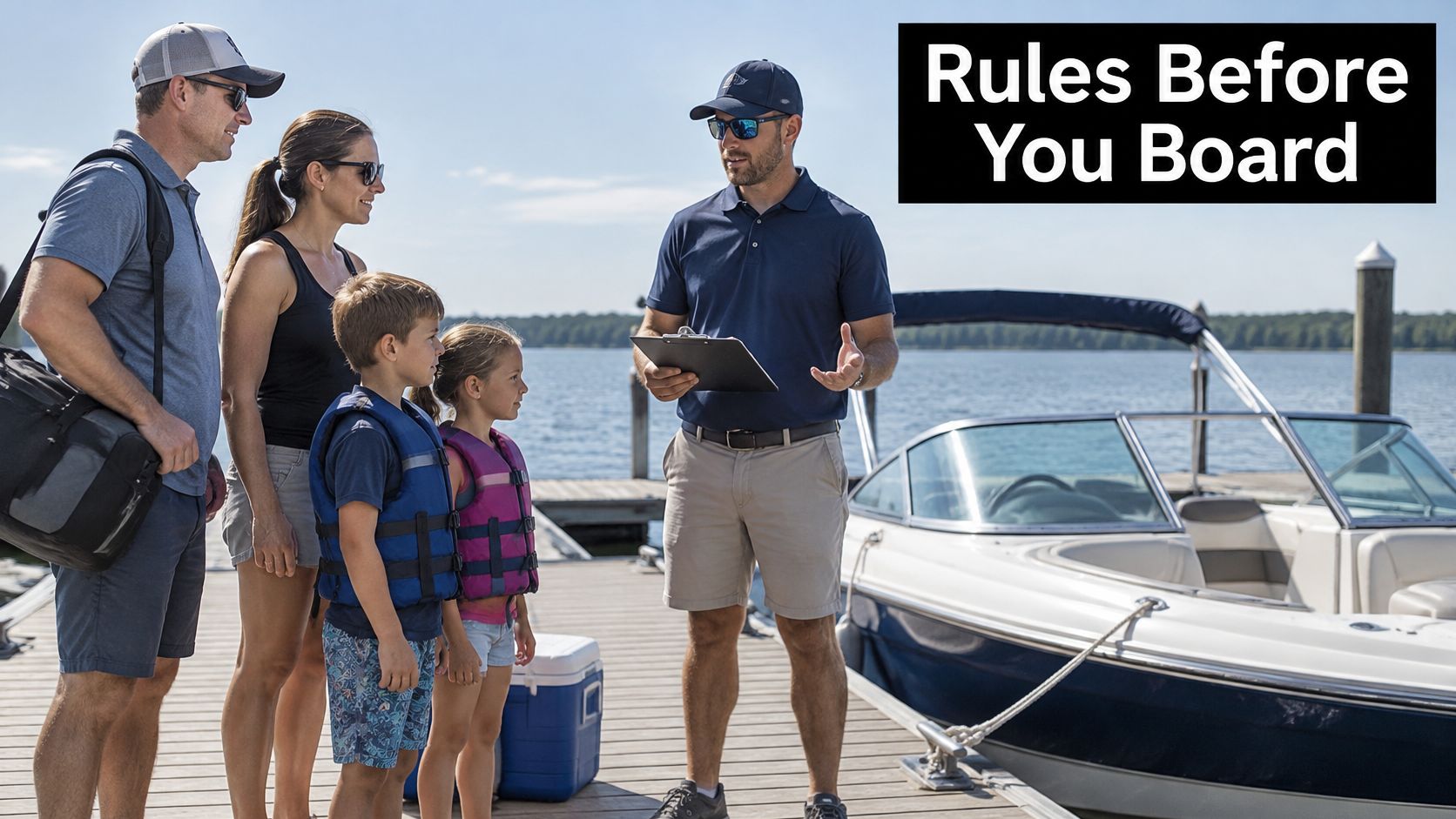
Four buckets cover everything you'll be asked about: operator eligibility, safety equipment, passenger behavior, and booking terms. Everything below follows that order: a one-screen reference table first, then the person at the wheel, gear by vessel length, life jacket sizing and wear, conduct on board, the special cases a captained charter creates, a booking checklist you can run in order, and the official pages worth opening yourself.
Every Boat Rental Rule at a Glance
Your group gets one shot at the best part of the day. The paperwork, briefings and limits decide whether that shot happens. Treat the rules as your pass onto the water, then sort them fast: federal and Texas law set the floor, while the operator's house policy controls the terms of the charter. Law does not bend at the dock. House policy can be strict, but it is written down before you pay.
| Category | The rule in one line | What it means for your group |
|---|---|---|
| Who may operate (law + house policy) | Lake Travis Yacht Rentals charters are captained, and all boats come with a captain because customers cannot captain their own boat | Ask who takes the wheel before you pay |
| Passenger capacity (law) | The vessel's rated maximum is a legal limit, not a suggestion | Your guest list is capped by the boat, not by the dock |
| Life jackets carried (law) | One U.S. Coast Guard-approved wearable per person aboard, plus a throwable Type IV device on boats 16 feet and over, as required by federal boating equipment rules | Every guest counts toward the jacket count |
| Life jackets worn (law) | In Texas, anyone younger than 13 must wear an approved jacket while the boat is underway under Texas boating safety requirements | Parents plan sizes before boarding |
| Fire safety (law) | An approved marine extinguisher is required on applicable motorboats, and navigation lights are required away from the dock after dark | Checked by the crew before departure, not by guests |
| Alcohol (law + house policy) | Legal-age passengers may drink on many charters, but the operator stays sober and boating while intoxicated is strictly enforced | The captain is always the sober one |
| Riding positions (house policy) | Guests may ride on the bow of a yacht but must be seated while the boat is under way | Best photo spot on the lake, one rule attached |
| Captain's authority (house policy) | Customers must follow all safety instructions and captain guidance during a rental, and failure to comply with safety rules or rental agreements may end the charter without refund | Listen once, then enjoy the whole day |
| Banned items (house policy) | Jetskis are banned, and if anyone in the party shows up with a jetski rental, the charter ends immediately | Leave the jetski on the trailer |
| Waivers (house policy) | The person booking signs a Damage Waiver online at booking, and all passengers sign a Release of Liability Waiver on the boat before departing | Two signatures stand between you and the water |
| Payment (house policy) | A $400 deposit secures the booking and applies to the total charter amount, the final balance is charged on the Monday before the charter, and a regular credit card must be on file so damage to the boat or equipment can be charged | Budget the full amount up front |
| Cancellations (house policy) | Deposits and the charter amount due are non-refundable within 3 weeks of the charter, and no cancellations are allowed within 21 days of the charter | Commit when your group commits |
| Weather (law + house policy) | A light sprinkle does not stop the charter, but all bookings are subject to weather conditions, applicable laws and marina regulations | Flexibility is part of the plan |
| Overnight stays (house policy) | Overnight stays are not available at the dock or at anchor, and boats are rented only at the scheduled times listed on the booking system | Plan your ride home |
Keep the labels in view before you argue a point. Capacity and jacket counts come from law, so no phone call, sob story or upgrade fee changes them. The house policy rows cover waiver timing, deposit schedule, the refund cut-off, bow seating, the jetski ban, prepaid card restrictions and the captain's service fee. Those terms are controlled by the operator. Read them before they become a dockside surprise.
Federal rules set the floor. Texas builds on them, which is why a serious charter agreement reads stricter than the state code. Stricter works in your favor here. Looser means someone is cutting corners with your Saturday.
On a Lake Travis Yacht Rentals charter, the captain is part of the rental. That person runs the boat, gives the instructions and keeps the group inside the safety rules. Customers cannot captain their own boat, and captains are required for safety and insurance requirements. The boats are captained by the business's own staff, with no exceptions. Those staff are licensed, background checked and drug tested regularly, even though the business contracts its boat captains.
A captained boat also removes most of the gear scramble. Every rental includes a captain, Lily Pad, Noodles, dry storage, a 150 quart cooler, a loud stereo with LED speakers, a subwoofer, Bluetooth connectivity and life jackets. Boats listed on the prices page are rented for 3 to 8 hours, so choose the window that fits your group and own the schedule once it is booked.
Pay attention to the money rows. Prepaid cards are not allowed. A regular credit card must be on file. The mandatory captain service fee is based on the full price of the boat plus tax and can be paid through Venmo, PayPal or cash, with no checks. Failure to keep the boat clean results in a minimum $200 cleaning fee charged to the card on file. Consent to text messages is not a condition of purchase, so do not treat that choice as part of the booking price.
The free boat rental giveaway is simple: customers join the email list to enter. Every other booking is subject to availability, confirmation, weather conditions, applicable laws and marina regulations. Those conditions are not loopholes. They are the guardrails that keep the day on schedule and the boat ready for the next group.
Who Can Drive a Rental Boat
Two routes put you on the water, and they split responsibility in completely different ways. Knowing which route you're on settles half the questions your group will throw at you.
The Self-Drive Route
On a self-drive rental, the guest is the operator. That makes eligibility a real screening step, not a formality. Expect the company to check a minimum operator age that moves with horsepower and with the company's own policy, a valid driver's license or state ID, and a boater-education card or temporary certificate where Texas requires one for your vessel and age. Ask for the exact minimum in writing for the boat you're reserving, because the number isn't identical across every class of vessel.
Behind the counter, the livery carries its own obligations. Before a motorboat is rented or let for hire, the owner or operator must obtain the vessel's certificate of number and identify the applicant as a vessel livery, according to the Texas vessel-livery statute. The business keeps a record for six months that includes the renter's name and address, the vessel's certificate number, departure date and time, and expected return time. It must also carry liability insurance from an insurer authorized in Texas, brief every operator on Texas water-safety law, the vessel's handling and local boating rules, and keep the operator's signed acknowledgment for at least six months.
That's why a compliant check-in feels thorough. Identity, eligibility, registration, insurance, a vessel-specific briefing, a signed acknowledgment, and a retained record. All of it exists so your trip is lawful before the engine turns over.
Three questions worth asking any operator: who is the operator of record for this trip? What happens if a guest briefly takes the helm? Is the safety briefing verbal, or do I sign for it?
A company that stumbles on those three is telling you something. A company that answers in one breath, in writing, is ready for your group.
The Captained Route
The second route removes the guesswork entirely. A licensed captain is legally in charge from the dock to the dock, and no guest touches the wheel. Every boat in our fleet goes out with one of our captains at the helm, no exceptions, because our insurance and our safety standards require it. Guests never carry the operator's obligations.
If you're still sorting out whether you personally need a license, the answer for a crewed trip is straightforward, and do I need a boating license walks through the fine print. For self-drive, the same page tells you what to bring. Either way, the questions about the split of duties on a crewed boat get their own treatment further down.
Safety Equipment Every Rental Boat Must Carry
equipment requirements follow the vessel, not the party. The same hull needs the same gear whether four guests climb aboard or fourteen, which is why capacity, vessel length and operating conditions all drive compliance decisions. Federal rules set the floor. Texas and local authorities can add to it. A captained charter adds the operator's own house rules on top, and those are the ones nobody negotiates at the dock.
The federal baseline is person-count driven. At least one U.S. Coast Guard-approved, wearable personal flotation device must be onboard for every person, appropriate to the wearer and the activity and kept in serviceable condition. Boats over 16 feet also carry a Coast Guard-approved throwable, generally a Type IV, per the federal flotation regulations in 33 CFR Part 175. That framework also reaches sound-producing devices, navigation lights, visual distress signals where they apply, fire extinguishers, ventilation and backfire flame arrestor systems, and required pollution or sanitation placards. Those are minimum federal standards, so compliance starts there and stops nowhere near guesswork.
Texas adds clear requirements for motorboats. The Texas Parks and Wildlife Department states that operating, or allowing the operation of, a vessel without required safety equipment is prohibited. For motorboats from 16 feet to under 26 feet, the state requires one approved wearable for every person aboard plus at least one approved throwable Type IV that is readily accessible. Depending on the vessel and propulsion system, a Type B-1 marine fire extinguisher is required, and navigation lights are required when a boat is away from the dock after dark.
| Vessel length | Wearable PFDs | Throwable device | Fire extinguisher | Also required |
|---|---|---|---|---|
| Under 16 ft | One approved wearable per person | Not required federally | Not required by length alone | Sound-producing device; navigation lights after dark |
| 16 ft to under 26 ft | One approved wearable per person | At least one Type IV, readily accessible | Type B-1 marine extinguisher, depending on vessel and propulsion | Sound device; navigation lights after dark; ventilation and backfire flame arrestor on inboards |
| 26 ft and over | One approved wearable per person | At least one Type IV, readily accessible | Type B-1 extinguisher where the vessel's propulsion and fuel system call for one | Navigation lights; visual distress signals where applicable; sanitation placard |
On a Lake Travis Yacht Rentals charter, the equipment list is part of the package, not a scavenger hunt. Every rental includes a captain and life jackets, with Lily Pad and noodles for the water time people came for. The boats also include dry storage, a 150 quart cooler, a loud stereo with LED speakers, a subwoofer and Bluetooth connectivity. Yachts are captained and come with an 18ft lily pad, a 2000+ watt stereo with subwoofer, and restrooms. Guests who want the full packing list should read what safety equipment is needed on a boat before boarding day.
What the Crew Checks Before You Board
The failure points are familiar. Jackets packed into a bin nobody can reach from a seat. A family booking that arrives with no infant sizes on board. Pool noodles and inflatable floats treated as flotation, which they never are. A throwable cushion buried under a cooler by the second hour.
Good crews recheck equipment after swimming and waterslide runs, when gear migrates, gets soaked and ends up in the wrong corner of the deck. That matters on a party boat because people move fast, bags shift and the clean cabin becomes a gear pile. Use the time before departure to reset the deck, keep walkways clear and put the jackets back where the next person can reach them.
What to Glance at During Boarding
Sixty seconds of looking around tells you plenty. Count the jackets against your headcount. Put a hand on the throwable device to confirm it's loose and reachable. Ask where the extinguisher lives. Ask where the first aid kit is. None of that is distrust. It's the same walk-through a captain does every trip, and it makes you a better passenger.
Then keep the rules simple. Follow the captain's guidance, stay seated while the boat is under way, and treat the safety briefing as part of the charter. Jetskis are banned on these charters. If anyone in the party shows up with a jetski rental, the charter ends immediately, and failure to follow safety rules or the rental agreement may end the charter without refund. Those rules feel strict because the day is built around a captain, a checked vessel and a group that knows where the gear is before the boat leaves the dock.
Life Jacket Rules That Apply to Every Passenger
Two different rules get blurred constantly, and the blur costs lives. Carriage is the legal floor: a jacket aboard for every person. Wearing is the behavior that saves someone. A boat can satisfy carriage while every passenger remains exposed during a swim stop, a waterslide run, a choppy afternoon or an unexpected fall overboard.
The numbers make the case better than any lecture. In 2024, the U.S. Coast Guard recorded 3,887 recreational-boating incidents, 556 deaths and 2,170 injuries, and shared by the Coast Guard's boating fatality release, drowning accounted for roughly three-quarters of deaths, with 87% of drowning victims with known life-jacket status not wearing one. Those victims weren't short a jacket. The jacket was in a locker.
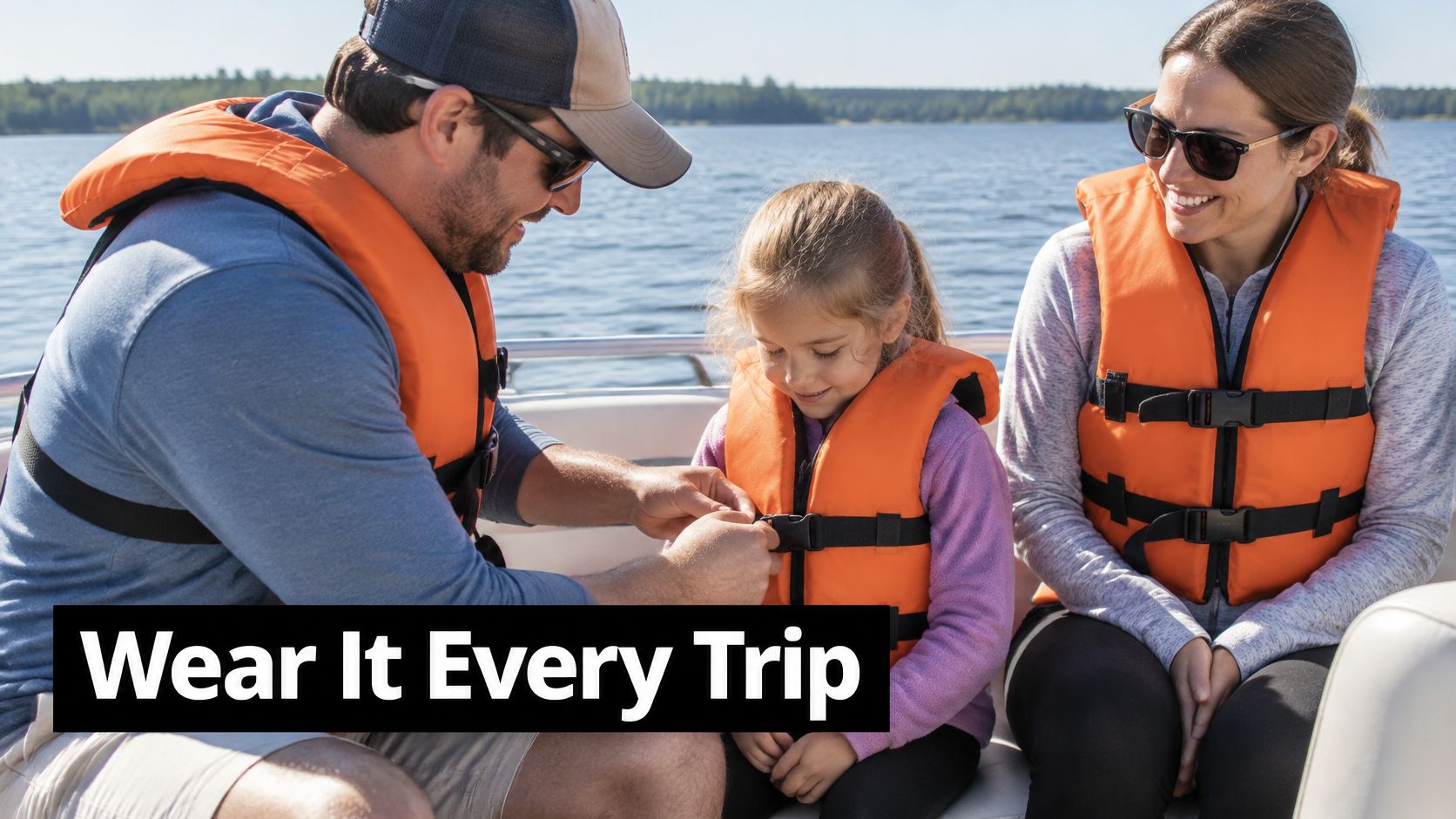
Texas adds a hard rule that settles a lot of family debates: anyone younger than 13 must wear a U.S. Coast Guard-approved life jacket whenever the boat is underway. Parents should plan sizes before boarding day, not at the dock with a squirming five-year-old and a stranger's tape measure.
| Size band | Typical weight | Fit check at the dock |
|---|---|---|
| Infant | under 30 lb | Straps fully fastened; jacket holds the head above water |
| Child | 30 to 50 lb | Lift both arms overhead; jacket must not rise above the chin |
| Youth | 50 to 90 lb | Lift both arms overhead; jacket must not rise above the chin |
| Adult | over 90 lb | Lift both arms overhead; jacket must not rise above the chin |
The Dock Test
Fasten every strap and buckle, then have the wearer lift both arms straight overhead. A properly fitted jacket stays put. If it rides up toward the chin or slides over the ears, it's too big, and too big is worse than useless in the water.
A jacket that fits belongs on a body. A jacket that doesn't fit belongs back in the bin, swapped for the next size up or down.
When to Wear One Beyond the Legal Minimum
Set your own policy higher than the law and nobody has a worse day. Wear them on upper decks where rails are lower. Wear them for waterslide runs and swim stops. Wear them on night cruises and whenever the lake chops up in the afternoon. Anyone who isn't a confident swimmer wears one the entire time, no debate.
One line covers every swim stop: guests swim only after the captain confirms the engine is off and conditions are safe. And say it plainly to the group, because someone always tests it: inflatables and pool toys are toys. They are never flotation.
Passenger Rules and Onboard Behavior
This is the part of the rulebook your group controls, and the part that decides whether the day feels effortless or tense.
Capacity is a hard number. The rated maximum on the vessel's capacity plate is a legal limit, not a target. If your guest list runs over it, someone stays on shore, and it's better to learn that during planning than at the dock with a rental car full of people.
U.S. Coast Guard figures show why sober operation sits at the center of every rental plan. In 2023, the Coast Guard recorded 3,844 recreational-boating incidents and 564 fatalities nationwide, and alcohol was the leading known contributing factor in fatal accidents, accounting for 79 deaths, or 17% of all fatalities, per the 2023 recreational boating statistics.
Alcohol, Plainly
Legal-age passengers may drink on many charters. The captain does not, ever. Boating while intoxicated is strictly enforced in Texas, and Texas Parks and Wildlife notes that BWI penalties are similar to driving-while-intoxicated penalties and may include suspension of the operator's driver's license. That's a real consequence attached to the person at the wheel, which is exactly why the wheel and the cooler never share a person.
The Rules That Keep the Boat Happy
- Follow safety instructions and captain guidance. They're binding for the whole trip. Ignoring them can end the charter on the spot, without a refund.
- Leave the jet ski at home. Jetskis are banned on our charters, and if anyone in the party shows up with a jetski rental, the charter ends immediately. No exceptions, no negotiation at the ramp.
- Sit while the boat is under way. Bow seating is the best photo spot on the lake, and it comes with one condition: seated, not standing, whenever the boat is moving.
- Plan a ride home. Boats are rented only for scheduled times, with no overnight stays at the dock or at anchor.
- Send the boat back tidy. A minimum $200 cleaning fee applies when the boat comes back in bad shape, and nobody wants that line item on a birthday bill.
The everyday conduct matters just as much. Have one person speak to the captain at a time instead of five people asking questions mid-maneuver. Keep children within sight. Send two sets of hands for heavy coolers. Small habits keep a group of sixteen moving in the same direction, and that's what makes a party boat feel relaxed rather than chaotic.
Special Cases on a Captained Charter
Most rule pages assume the renter is the operator. A captain-led charter breaks that assumption, and the division of responsibility is where groups get confused.
Three Roles on One Boat
The captain is responsible for navigation and lawful operation. The charter company is responsible for vessel condition, required equipment and the safety briefing. Passengers are responsible for following instructions, using equipment properly and not endangering anyone else. Texas requires liveries to provide safety equipment, explain vessel operation and applicable boating laws, obtain the operator's acknowledgment and carry liability insurance, and the Texas Parks and Wildlife Department reports that operator inattention, improper lookout, inexperience, machinery failure and navigation-rule violations rank among the leading contributing factors in recreational boating incidents. Layered controls are the point. A good captain reduces risk. A good passenger doesn't hand that risk back.
The Scenarios Groups Actually Ask About
Night cruises. Navigation lights are required away from the dock after dark, and speeds come down. The lake looks different at 9 p.m., and the captain plans for it.
Big party boats. Passenger count, throwable devices and fire protection all factor into whether a trip may legally begin. Overbooking isn't a pricing problem, it's a launch problem.
Weather. A light sprinkle doesn't cancel anything. The boat still goes out. Severe conditions, applicable laws and marina regulations can and do change the plan, and every booking is subject to availability, weather, laws and marina rules.
Families with children under 13. Jackets are worn whenever the boat is underway, so sizes get confirmed before boarding, not after.
Groups who want to drive themselves. Our captains are required for safety and for insurance, so guests can't take the helm as operator. If that's the experience you want, book a self-drive rental elsewhere.
Corporate and bachelor parties. Passengers of legal age may drink. Operating under the influence never happens, and a captain can end a trip that turns unsafe.
Something gets damaged. That paperwork earns its keep in those moments. Federal rules require an occurrence to be reported when someone dies, when an injury needs treatment beyond first aid, when vessel or property damage reaches $2,000, or when a vessel is completely lost, per the Coast Guard's 2023 accident statistics. The damage waiver you sign at booking and the release every passenger signs on board are what keep a bent rail from becoming your group's problem.
The question that resolves nearly every case: who is the operator of record for this trip, and where does the charter agreement say so in writing?
Booking Rules to Confirm Before You Pay
Money and paperwork run in a fixed order. Follow it and you'll never lose a date or a deposit.
- Check capacity against the full guest list, including children. Infants count as people on a Coast Guard capacity plate and in a jacket count.
- Confirm the booking window. Charters run in fixed blocks, typically three to eight hours, so pick the block that fits your plan rather than hoping to extend on the day.
- Pay the deposit that holds the date. Ours is $400 and it's applied to the total charter amount, so it's a commitment device, not a fee.
- Mark the day the balance charges. With us, the final balance is charged on the Monday before the charter. Nobody should discover that on a Thursday.
- Sign the damage waiver online at booking, and expect every passenger to sign a release of liability on board before departure. The person who books signs the damage waiver. Everyone signs the release.
- Keep a regular credit card on file. Prepaid cards aren't accepted, because the card on file has to cover any damage to the boat or equipment.
- Ask how the captain service fee is calculated and paid. Ours is based on the full price of the boat plus tax and can be paid by Venmo, PayPal or cash. Checks are not accepted.
- Write the cancellation cut-off into the group chat. Deposits and the charter amount due are non-refundable within three weeks of the charter, and no cancellations are allowed within 21 days.
- Ask what triggers a cleaning fee. Leaving the boat a mess carries a minimum $200 charge to the card on file.
The full mechanics of holding a date live on the deposit requirements page, which is worth reading before you promise sixteen people a Saturday.
The Two Mistakes That Cost Groups the Most
Treating headcount as capacity. A guest list built on vibes collides with a capacity plate built on physics, and the boat wins every time.
Missing the refund window. Groups talk for weeks, decide in a day, and then discover the cut-off passed while they were comparing coolers. Decide once, deposit once, done.
Related Rules and Official Sources Worth Reading
A short shelf of official pages answers the questions this guide raises, and each one exists for a specific reason.
- Vessel-by-vessel gear. The Texas Parks and Wildlife required safety equipment page tells you what your boat class must carry, from flotation to extinguishers to lights.
- Wear rules and enforcement. TPWD boating safety tips cover the under-13 jacket rule and boating-while-intoxicated enforcement in plain language.
- Livery duties. The Texas vessel-livery statute is the source for record-keeping, insurance and signed-acknowledgment requirements.
- Federal baseline. 33 CFR Part 175 sets the flotation floor that every state builds on.
- Risk numbers. The Coast Guard's annual recreational boating statistics publication is the document behind every wear-your-jacket argument you'll ever have.
- The local layer. Lake Travis marina regulations and any lake-specific rules the operator puts in the charter agreement.
Use them in that order. Check the official page for your vessel class first, then check the operator's agreement second, because an operator can be stricter than the law but never looser. Rules get updated, so confirm the version in force for the year you're booking.
If you're sizing jackets, the weight bands further up cover infants through adults. If you're weighing a self-drive rental, the operator-eligibility questions sit in the driving section. If you're planning a crewed trip, the responsibility split and the waiver timing both come back to one document: the charter agreement you sign.
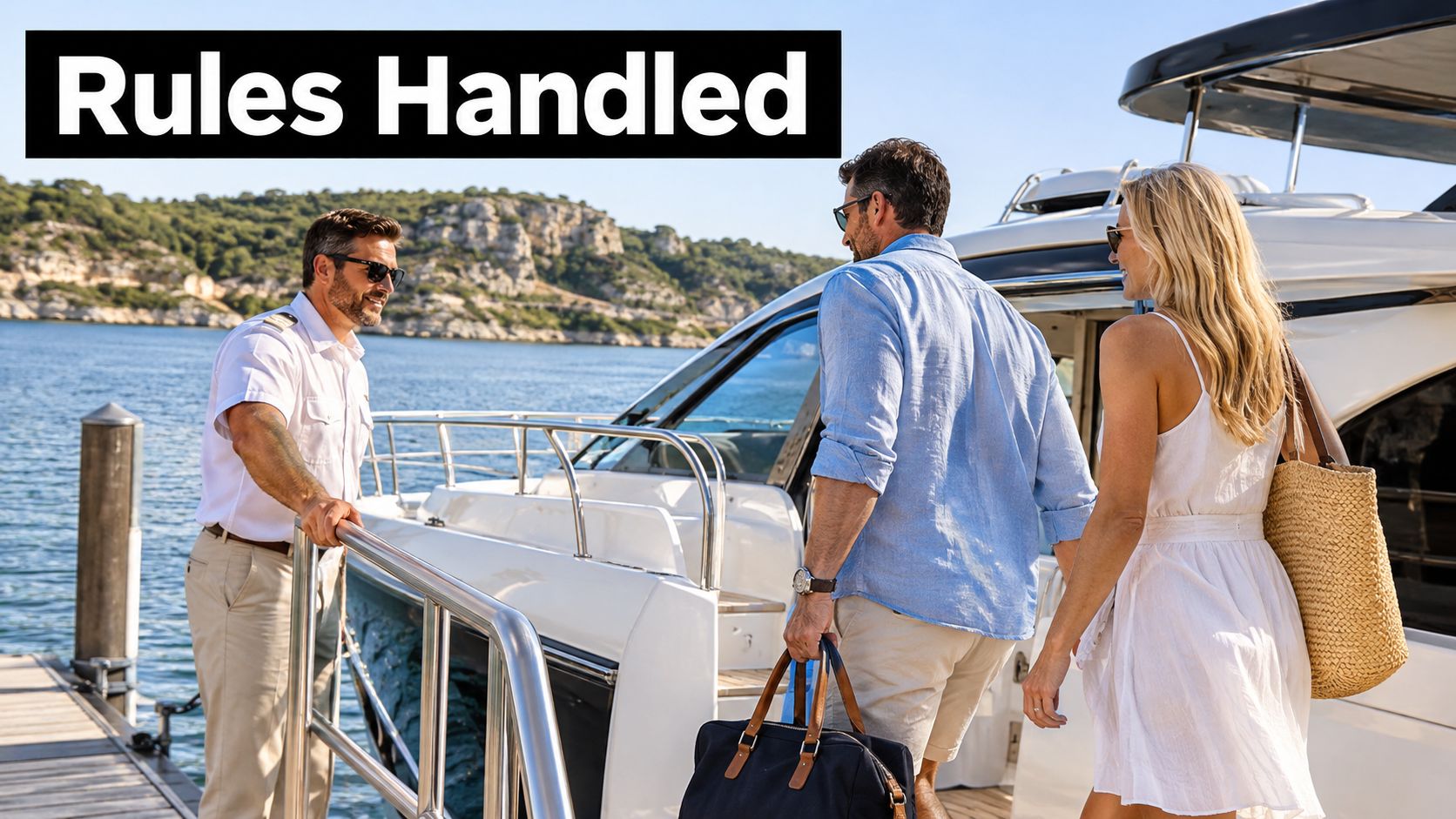
Book Your Lake Travis Charter With the Rules Handled
The rules are shorter than you expected, the tables cover them, and what's left is choosing a date. Every boat on the prices page is rented in three- to eight-hour blocks, every charter leaves the dock fully captained, and the gear you'd otherwise haul or hunt for is already aboard: life jackets, a 150 quart cooler, a lily pad, noodles and dry storage. Current inclusions are always confirmed on the booking page.
Three moves get you booked:
- Pick the boat that holds your full headcount, children included, and pick the time block that matches your plan.
- Pay the $400 deposit to lock the date. It applies to your total charter amount, and the final balance is charged on the Monday before your trip. Put a regular credit card on file, since prepaid cards are not accepted.
- Sign the Damage Waiver online at the time of booking. Every passenger in your group signs the Release of Liability Waiver on the boat before departure, so tell your crew to arrive a few minutes early and be ready to sign before the lines come off.
One more piece of paperwork: the mandatory captain service fee, calculated on the full price of the boat plus tax. Pay it by Venmo, PayPal or cash. No checks, ever.
Timing is the only real pressure, and it isn't artificial. Weekend slots and summer Saturdays fill first, so booking early gives your group more choice of boats and hours. Join the email list while you're at it. It's how you'll hear about new dates first, and it enters you in the free boat rental giveaway.
Then stop planning and start inviting people. You bring the guest list. The captain brings the rules, the gear and the route. The lake handles the rest.
Every boat in the fleet leaves the dock with a licensed, background-checked captain at the helm, which means the rules in this guide land on the crew instead of on you. That split is the whole point of a captained charter: the federal and Texas requirements you read about above are the crew's job to meet, and the house policies are simple enough to follow without thinking about them. You pick the boat that holds your whole group, lock the date with a deposit, and spend the weeks before your trip on the fun parts. Reserve your date with Lake Travis Yacht Rentals and let the captain handle everything that happens after boarding.